
Verb Types Worksheets
11th Grade Grammar and Mechanics Verb Types worksheets help students understand how verbs shape meaning, strengthen writing, and bring sentences to life. Every worksheet is free, ready-to-print in PDF format, and designed for immediate classroom use, whether you're teaching in school, homeschooling, tutoring, or providing extra practice at home. Students build curriculum-aligned skills in verb usage, sentence construction, editing, and academic writing while learning how thoughtful verb choices make writing clearer and more effective.
About This Collection of Worksheets
By 11th Grade, students have been working with verbs for years, but they’re now reaching the point where grammar becomes less about identifying parts of speech and more about making purposeful writing decisions. Should a sentence be written in the active or passive voice? Is a simple verb enough, or would a more descriptive verb phrase communicate the idea better? Would changing a modal verb make an argument sound more confident-or more cautious? These are the kinds of questions strong writers ask, and they’re exactly what these worksheets encourage students to explore.
What I like most about this collection is that it treats grammar as a writing tool instead of a list of rules. Students analyze real passages, revise authentic writing, experiment with different verb forms, and compare multiple ways to express the same idea. As they work through the activities, they’ll begin to notice how even small changes to a verb can shift emphasis, clarify meaning, or completely change the tone of a sentence.
Whether you’re preparing students for college writing, helping them revise essays, or simply building stronger grammar skills, these worksheets fit naturally into almost any English lesson. They’re great for writing workshops, independent practice, small-group instruction, homework, or review before assessments. More importantly, they help students become intentional writers who choose verb forms because they improve communication-not just because a grammar rule says they should.
Paul’s Teacher Tip
One thing I remind students all the time is that verbs do much more than tell what someone is doing. They’re responsible for showing time, certainty, emphasis, and even attitude. When students finish one of these worksheets, I like asking them to revisit a paragraph they’ve already written and challenge themselves to improve five verbs. Sometimes they’ll replace a weak verb with a stronger one. Other times they’ll switch from passive to active voice or choose a different modal verb to strengthen an argument. It’s a quick exercise, but students are always surprised by how much stronger their writing becomes without changing a single idea.
Worksheet Collection Skill Spotlights
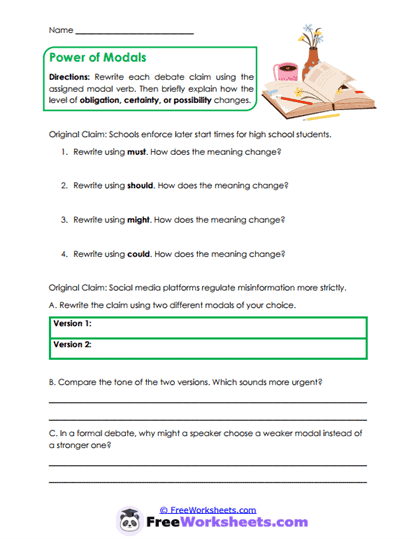
Modal Mastery
What Kids Do:
Students experiment with modal verbs like must, might, could, and should by rewriting persuasive claims and comparing how each version sounds. As they work through the activity, they’ll discover that changing just one helping verb can completely change how confident, persuasive, or cautious a statement feels.
Target Skill:
This worksheet helps students understand that grammar influences tone just as much as word choice. They’ll strengthen their understanding of modal verbs while improving persuasive writing, vocabulary, and their ability to choose language that matches their purpose and audience.
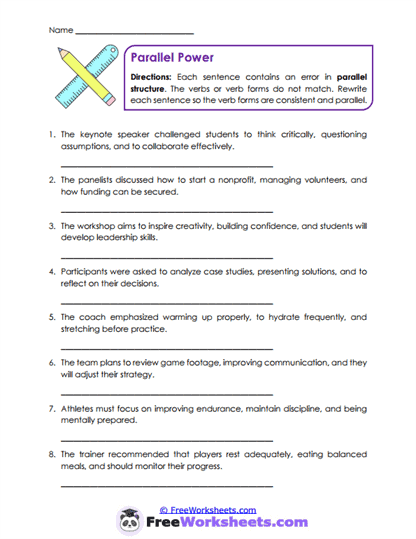
Parallel Verbs
What Kids Do:
Students edit sentences that sound a little awkward because the verb forms don’t match. As they rewrite each example, they’ll create smoother, more balanced sentences that flow naturally and sound much more polished when read aloud.
Target Skill:
Students develop an ear for strong writing while learning how parallel structure improves clarity and readability. They’ll strengthen grammar, sentence fluency, editing, and revision skills that transfer directly into essays, speeches, and presentations.
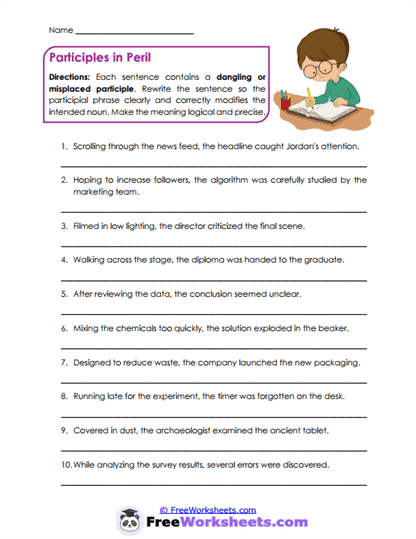
Participle Repair
What Kids Do:
Students tackle sentences with dangling and misplaced participles, figuring out exactly who-or what-a modifier is supposed to describe. Some examples are unintentionally funny, making the editing process both memorable and enjoyable as students rewrite each sentence to eliminate confusion.
Target Skill:
This activity helps students write more precise, readable sentences by improving modifier placement. They’ll strengthen proofreading, editing, and sentence construction while developing the habit of checking whether every descriptive phrase clearly connects to the correct noun.
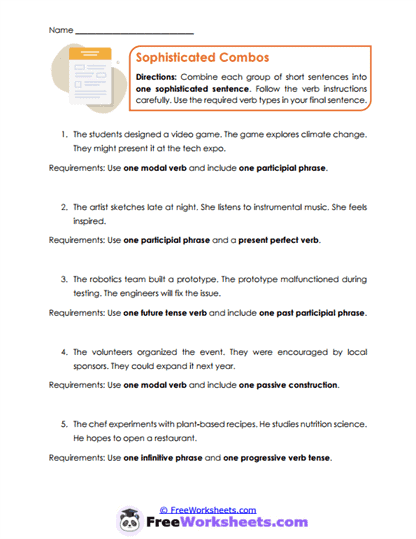
Sentence Combinations
What Kids Do:
Students take several simple sentences and combine them into one polished sentence using specific verb forms and advanced grammar features. There isn’t just one right answer, so they’ll have the opportunity to experiment with different sentence structures while still meeting the grammar challenge.
Target Skill:
Instead of relying on short, repetitive sentences, students learn how sophisticated verb constructions create smoother, more engaging writing. They’ll strengthen grammar, sentence variety, and academic writing while gaining confidence with advanced verb forms.
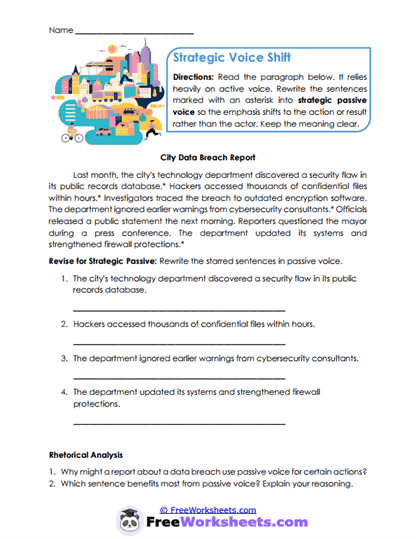
Strategic Voice
What Kids Do:
Students compare active and passive voice in a realistic news article and rewrite selected sentences to shift the reader’s focus. As they read both versions, they’ll see how journalists and technical writers intentionally choose one voice over the other depending on what they want readers to notice first.
Target Skill:
Students discover that active and passive voice each have a purpose when used thoughtfully. They’ll strengthen grammar, rhetorical analysis, editing, and informational writing while learning how verb voice influences emphasis and clarity.
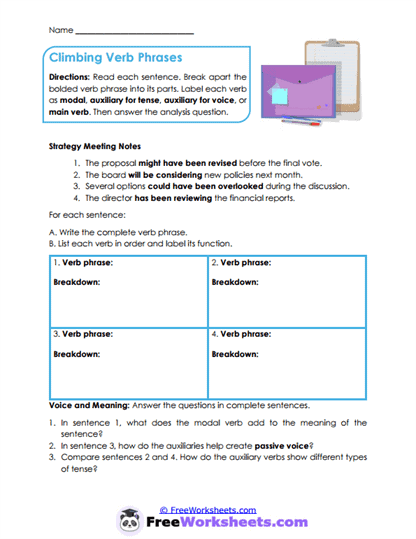
Verb Breakdown
What Kids Do:
Students pull apart complex verb phrases to see how each helping verb contributes to the overall meaning. They’ll identify modals, auxiliary verbs, and main verbs while exploring how small changes affect tense, certainty, and emphasis.
Target Skill:
This worksheet gives students a much deeper understanding of how verb phrases work together instead of treating every verb as a single word. They’ll improve grammar analysis, reading comprehension, and sentence construction while building confidence with advanced verb structures.
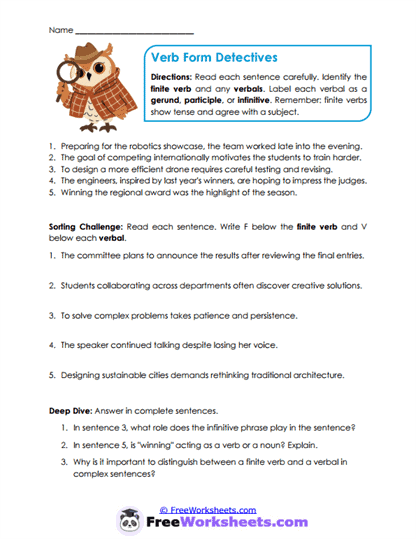
Verb Detectives
What Kids Do:
Students put on their detective hats as they search each sentence for the “real” verb. Along the way, they’ll separate finite verbs from gerunds, participles, and infinitives, discovering that words ending in -ing or beginning with to don’t always do the same job. By the end of the activity, they’ll be looking at sentences in a whole new way.
Target Skill:
This worksheet helps students recognize how different verb forms function within a sentence instead of relying on appearance alone. They’ll strengthen grammar analysis, editing, reading comprehension, and sentence construction while building a solid foundation for more advanced writing and revision.
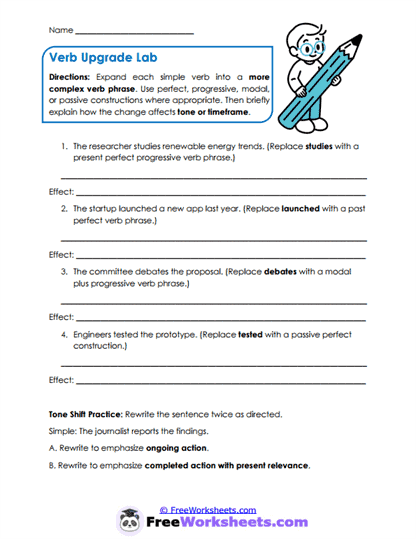
Verb Expansion
What Kids Do:
Students start with simple, straightforward verbs and “upgrade” them into more descriptive verb phrases. They’ll experiment with perfect, progressive, passive, and modal constructions to see how each one changes the timing, emphasis, or tone of a sentence without changing its basic idea.
Target Skill:
Students learn that stronger writing often comes from choosing more precise verb phrases rather than adding extra adjectives or longer sentences. They’ll build confidence with advanced verb forms while improving sentence variety, grammar, revision, and overall writing style.
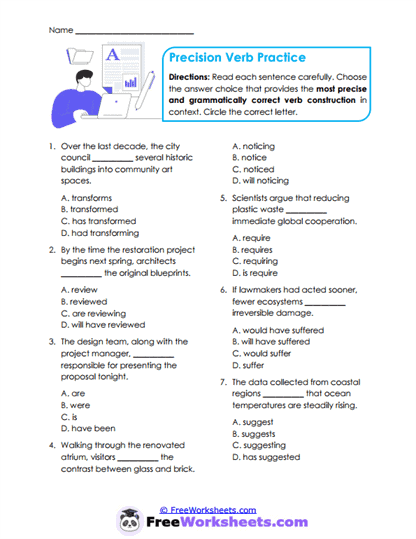
Verb Precision
What Kids Do:
Students carefully read academic sentences and choose the verb form that best fits the meaning of each one. Instead of guessing, they’ll use context clues to think about time, sequence, agreement, and purpose before deciding which choice sounds both natural and grammatically correct.
Target Skill:
This activity helps students make thoughtful grammar decisions instead of relying on memorized rules. They’ll strengthen verb usage, proofreading, editing, and analytical thinking while becoming more confident writers who understand why one verb form works better than another in a given situation.
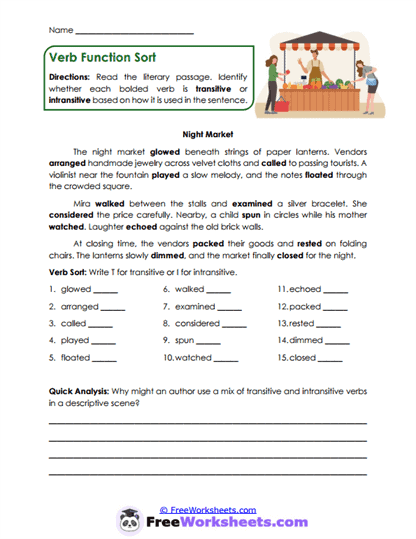
Verb Sorting
What Kids Do:
Students read a colorful literary passage and examine each highlighted verb to decide whether it’s transitive or intransitive. As they work through the story, they’ll notice that some verbs pass their action to a direct object while others stand perfectly well on their own. They may even discover that the same verb can behave differently depending on how it’s used in a sentence.
Target Skill:
This worksheet helps students understand verb function in the context of real writing instead of isolated grammar exercises. They’ll strengthen sentence analysis, reading comprehension, and descriptive writing while learning how thoughtful verb choices help authors create vivid, engaging scenes.
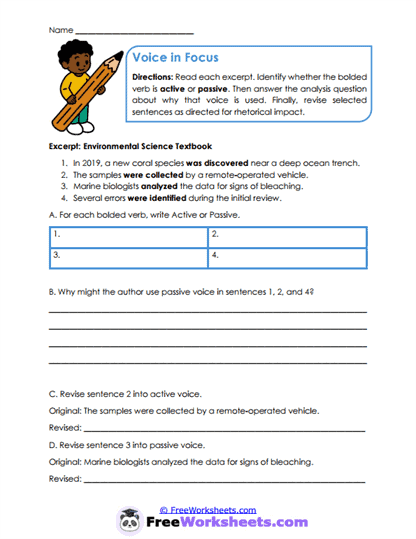
Voice Focus
What Kids Do:
Students compare active and passive voice in a scientific passage, looking closely at why the author made each choice. Then they’ll rewrite sentences in the opposite voice to see how the focus shifts from the person performing the action to the action itself-or vice versa. It’s a great way to see grammar in action instead of simply reading about it.
Target Skill:
Rather than treating passive voice as something to avoid, students learn that both voices have a place in effective writing. They’ll strengthen revision skills, grammar knowledge, rhetorical awareness, and editing while becoming more intentional about how they present information to readers.
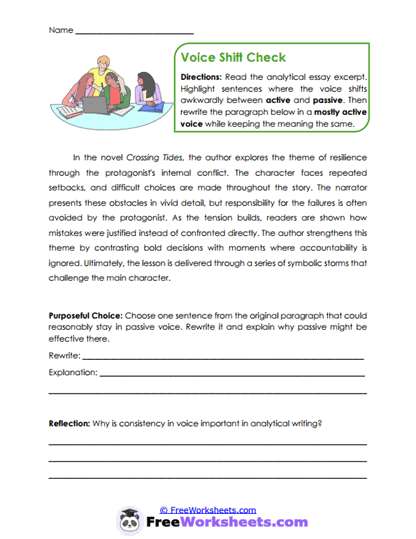
Voice Revision
What Kids Do:
Students revise a literary analysis that relies too heavily on passive voice, rewriting most of the paragraph in active voice while deciding whether a few passive constructions actually deserve to stay. As they compare the two versions, they’ll hear how small verb changes can make writing feel stronger, clearer, and more engaging.
Target Skill:
This activity encourages students to think like experienced editors instead of simply following grammar rules. They’ll strengthen active and passive voice, revision strategies, analytical writing, and sentence fluency while learning that the best writing decisions always depend on purpose, audience, and emphasis.