
Phrases And Clauses Worksheets
11th Grade Grammar & Mechanics Phrases And Clauses worksheets help students master advanced sentence construction, sophisticated syntax, and effective academic writing. Every activity is free, ready-to-print in PDF format, and designed for immediate classroom use by teachers, parents, tutors, and homeschool educators. Students build Common Core-aligned skills in sentence analysis, grammar application, and writing revision while developing greater confidence with complex sentence structures.
About This Collection of Worksheets
Phrases and clauses can feel overwhelming for many high school students because they are not just memorizing labels anymore; they are learning how sentence parts actually work together to create meaning. This collection gives 11th Grade learners repeated practice with independent clauses, dependent clauses, adjective clauses, noun clauses, modifiers, sentence expansion, sentence compression, and revision. The goal is to help students see grammar as a writing tool, not just a set of rules.
These worksheets are especially helpful for students who can write basic sentences but need support making their writing smoother, clearer, and more sophisticated. Each activity asks learners to do something meaningful with grammar, such as combine ideas, choose the right clause, fix confusing modifiers, reduce wordiness, or explain why punctuation is needed. That kind of practice helps students slow down, look carefully at sentence structure, and make stronger writing choices.
Teachers can use this collection during grammar instruction, writing workshops, essay revision, test preparation, or targeted intervention. Parents and homeschool educators can also use the worksheets to help older students strengthen advanced grammar without needing a complicated lesson plan. Because the activities connect grammar to real writing, students get practice that carries over into essays, research papers, literary analysis, and college-ready communication.
Paul’s Teacher Tip
When teaching phrases and clauses, do not rush straight into labels. Many students need to first hear the sentence aloud and talk through which part can stand by itself and which part depends on another idea. Once they understand that relationship, the grammar terms become much easier to remember. I would also have students revise one sentence from their own writing after each worksheet, because that is where the skill really starts to stick. The best grammar lessons are the ones students can immediately use to make their own writing clearer.
Worksheet Collection Skill Spotlights
Clause Analysis
What Kids Do:
Students take complex sentences apart and identify which clauses can stand alone and which ones depend on other information. They look closely at subordinating conjunctions, relative pronouns, punctuation, and sentence relationships so they can explain how each part works inside the sentence.
Target Skill:
This worksheet strengthens clause recognition, sentence analysis, punctuation awareness, and grammatical reasoning. Students build Common Core-aligned language skills by explaining how independent and dependent clauses work together to create clear, complete, and well-structured sentences.
Clause Building
What Kids Do:
Students write their own sentences using adjective, adverb, and noun clauses instead of only identifying them in someone else’s writing. The prompts give students room to be creative while still requiring them to build complete, thoughtful sentences with accurate clause structure.
Target Skill:
This activity develops advanced sentence construction, dependent clause usage, sentence variety, and writing fluency. Students practice using different clause types with control so their academic writing becomes more flexible, detailed, and mature.
Clause Choice
What Kids Do:
Students read incomplete sentences and choose the dependent clause that best completes each idea. They must think about grammar, meaning, punctuation, and sentence flow before deciding which clause fits most naturally and makes the sentence clear.
Target Skill:
This worksheet builds clause function, logical sentence relationships, grammar decision-making, and reading comprehension. Students learn to recognize how dependent clauses connect ideas, which helps them write stronger complex sentences and edit their work more carefully.
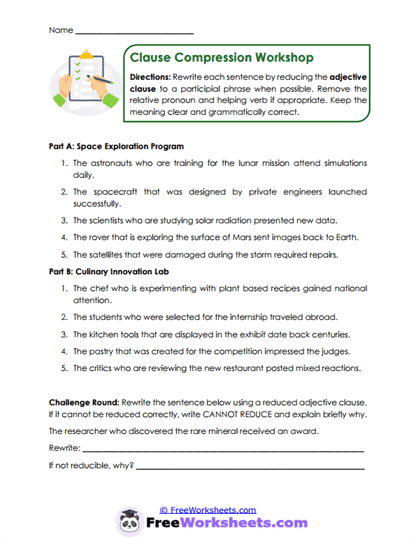
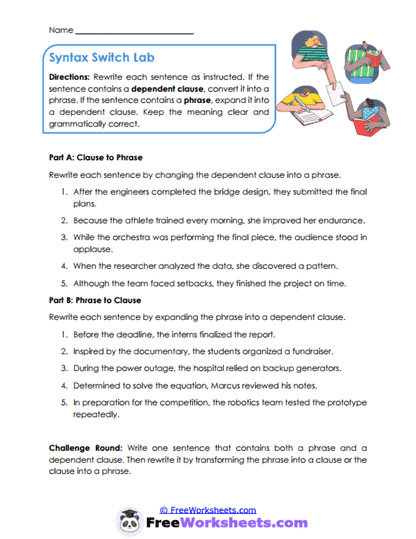
Clause Compression
What Kids Do:
Students reduce adjective clauses into shorter participial phrases when the sentence allows it. They also decide when a clause should not be reduced, which helps them understand that concise writing still needs to be grammatically correct and easy to understand.
Target Skill:
This worksheet targets concise writing, adjective clause reduction, participial phrase formation, and sentence fluency. Students practice improving sentence efficiency while preserving meaning, a key skill for stronger essays, research writing, and academic revision.
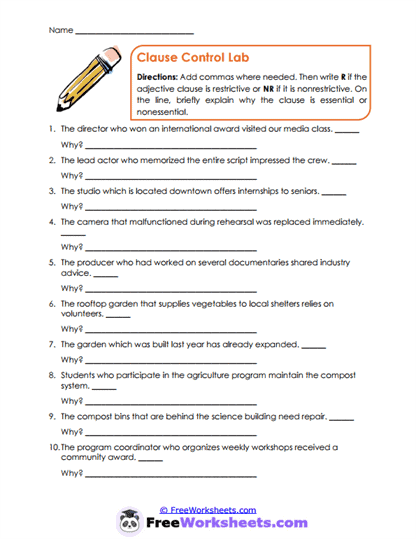
Clause Control
What Kids Do:
Students identify restrictive and nonrestrictive adjective clauses and decide where commas belong. They explain whether the clause gives essential information or simply adds extra detail, helping them understand punctuation through meaning instead of guessing.
Target Skill:
This activity strengthens comma usage, adjective clause analysis, restrictive and nonrestrictive clause recognition, and editing accuracy. Students build the grammar reasoning needed to punctuate complex sentences correctly in essays, reports, and formal writing.
Clause Editing
What Kids Do:
Students act like editors by finding and correcting clause-related errors in realistic sentences. They fix punctuation problems, fragments, run-ons, awkward clause placement, and unclear sentence structures while explaining why their corrections improve the writing.
Target Skill:
This worksheet develops proofreading, clause error correction, sentence structure control, and revision skills. Students practice applying grammar knowledge in context, which supports stronger writing mechanics and better performance on editing-based assessments.
Clause Expansion
What Kids Do:
Students begin with simple sentences and expand them by adding meaningful dependent clauses. Instead of just making sentences longer, they learn to add useful details that improve meaning, create smoother flow, and build more developed academic writing.
Target Skill:
This activity focuses on sentence expansion, dependent clause placement, sentence development, and complex sentence writing. Students practice turning basic ideas into richer, more complete sentences while maintaining grammar accuracy and readability.
Clause Revision
What Kids Do:
Students revise awkward sentences that contain weak or confusing clause structures. They reorganize sentence parts, improve flow, remove unnecessary repetition, and make each sentence clearer while keeping the original meaning intact.
Target Skill:
This worksheet strengthens sentence revision, clause placement, clarity, and editing judgment. Students learn that strong writing is not only about being correct; it is also about making sentences smoother, clearer, and easier for the reader to follow.
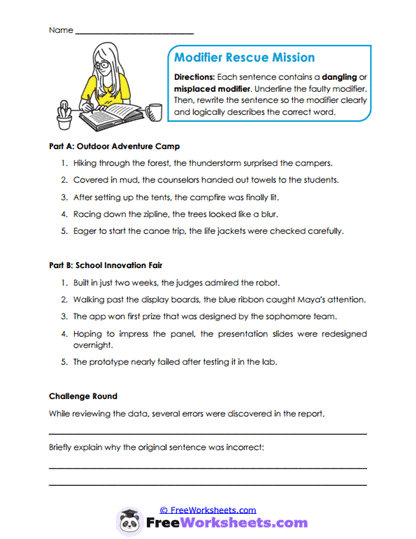
Modifier Rescue
What Kids Do:
Students identify dangling and misplaced modifiers that make sentences confusing or unintentionally funny. Then they rewrite each sentence so the descriptive phrase clearly points to the correct noun or subject.
Target Skill:
This activity builds modifier placement, sentence clarity, editing accuracy, and grammatical precision. Students learn how small placement errors can change meaning, which helps them write cleaner essays, reports, and polished academic responses.
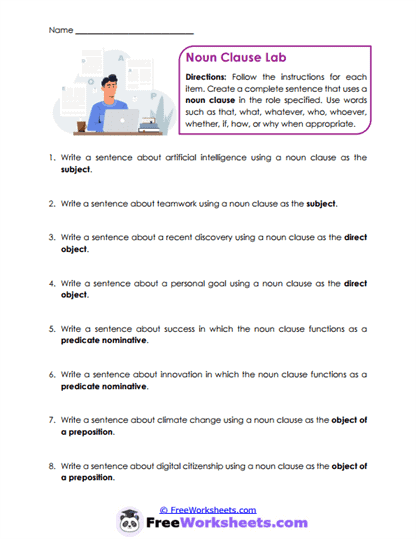
Noun Clauses
What Kids Do:
Students write original sentences using noun clauses as subjects, direct objects, predicate nominatives, and objects of prepositions. The prompts ask them to create complete thoughts while using words such as what, whoever, whether, if, that, and why.
Target Skill:
This worksheet develops noun clause usage, sentence function recognition, advanced syntax, and original sentence writing. Students learn how clauses can act like nouns, which helps them understand complex grammar patterns in both reading and writing.
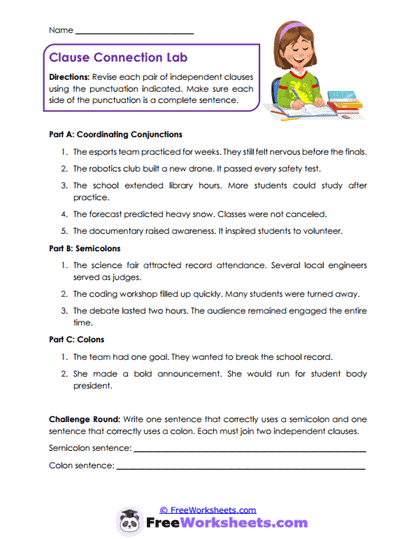
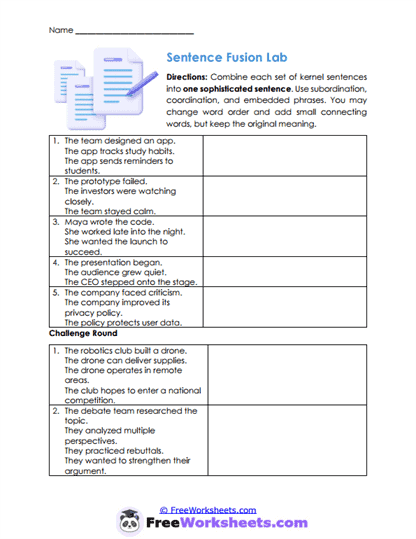
Sentence Fusion
What Kids Do:
Students combine short, related sentences into one smoother and more sophisticated sentence. They use conjunctions, embedded phrases, and clauses to connect ideas while keeping the original meaning clear and organized.
Target Skill:
This activity strengthens sentence combining, syntax, sentence variety, and advanced writing fluency. Students practice moving from choppy writing toward more polished academic sentences that sound natural, mature, and easier to read.
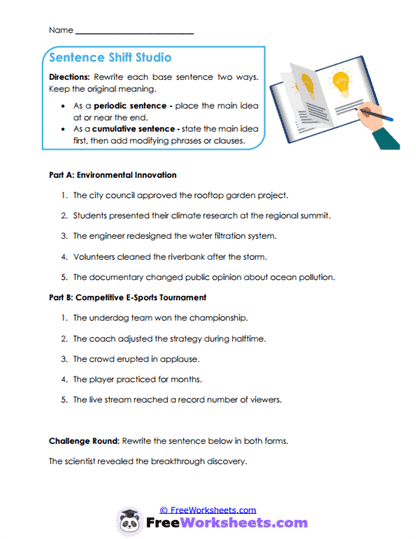
Sentence Shift
What Kids Do:
Students rewrite sentences in both periodic and cumulative forms to see how sentence structure changes emphasis and style. They practice moving information around while keeping the meaning the same, which helps them notice how writers control rhythm and focus.
Target Skill:
This worksheet targets sentence variety, syntax control, periodic structure, cumulative structure, and writing style. Students learn to make intentional sentence choices that improve fluency, emphasis, and sophistication in academic writing.