
Linear Inequalities Worksheets
These worksheets help students solve, graph, interpret, and apply inequalities using algebraic reasoning and visual models. These free, ready-to-print worksheets come in PDF format for immediate classroom use, homework assignments, intervention support, or independent review. Students strengthen skills involving inequality symbols, number-line graphs, compound inequalities, algebraic modeling, and real-world problem solving through structured practice activities.
About This Collection of Worksheets
This collection of linear inequalities worksheets gives students meaningful practice solving and graphing inequalities while applying algebraic reasoning to practical situations. Students work through one-step, two-step, and multi-step inequalities, inequalities with variables on both sides, compound inequalities, and graphing inequalities on number lines and coordinate planes. The activities help learners connect symbolic algebra to visual representations and real-world decision-making.
The worksheets include number-line graphs, coordinate-plane graphing tasks, word problems, interval reasoning activities, compound inequality practice, and contextual modeling situations. Students practice identifying solution sets, graphing inequalities correctly, reversing inequality symbols when dividing by negatives, writing inequalities from verbal descriptions, and interpreting constraints within realistic scenarios. The progression of activities supports both procedural fluency and deeper understanding of how inequalities describe ranges of possible values.
Teachers can use these printable PDF worksheets for guided instruction, independent practice, intervention, review lessons, enrichment, homework, or assessment preparation. The layouts provide organized workspaces for calculations, graphing, written explanations, and algebraic modeling. The mix of symbolic and real-world problem types also helps students strengthen reasoning skills while connecting inequalities to everyday planning and decision-making situations.
Paul’s Teacher Tip
Students are often more successful with inequalities when they think about them as “many possible answers” instead of searching for one exact solution. Encourage learners to test sample values after solving so they can confirm whether their answer makes sense. One of the most common mistakes happens when students forget to reverse the inequality symbol after multiplying or dividing by a negative number, so repeated verbal reminders and worked examples are helpful. Graphing activities also become easier when students read the inequality aloud before choosing the shading direction or deciding between an open or closed circle. Real-world problems involving budgets, schedules, and limits can help students understand why inequalities matter outside the classroom. Asking students to explain what their solution means in words often strengthens both understanding and accuracy.
Worksheet Collection Skill Spotlights
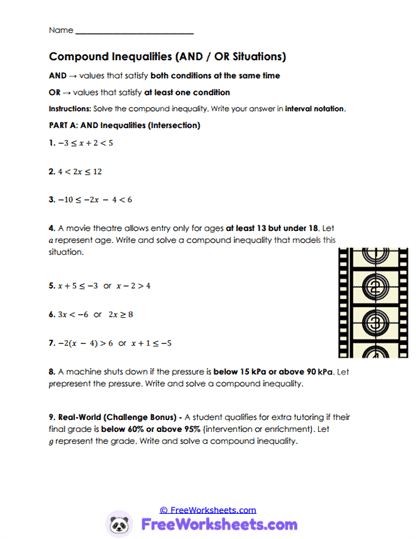
Compound Logic
- What Kids Do:
Students solve AND and OR compound inequalities, compare interval solution sets, and interpret real-world situations involving ranges, restrictions, and overlapping conditions. - Target Skill:
Students strengthen logical reasoning and interval analysis skills by distinguishing between intersection and union solutions while solving compound inequalities accurately.
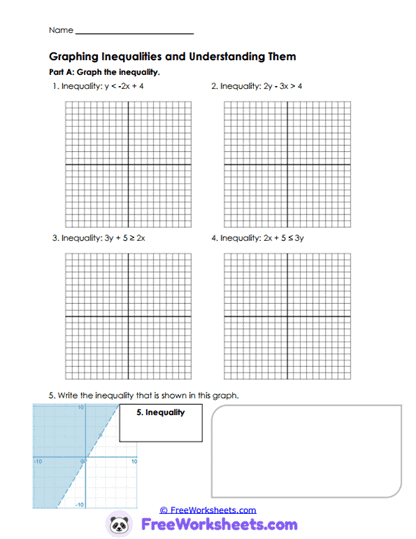
Graph Regions
- What Kids Do:
Students graph inequalities on coordinate planes using boundary lines, shaded regions, and test points while interpreting algebraic inequalities visually. - Target Skill:
Students improve graphing and algebra interpretation skills by connecting inequality notation to shaded solution regions and understanding solid versus dashed boundary lines.
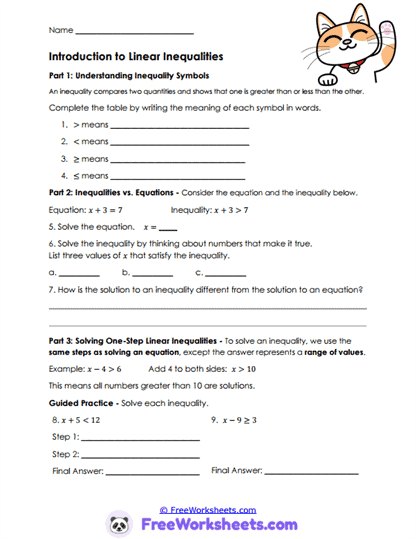
Inequality Basics
- What Kids Do:
Students solve one-step inequalities, identify inequality symbols, compare equations and inequalities, and explain how inequality solutions represent ranges of values. - Target Skill:
Students build foundational inequality reasoning by interpreting symbols correctly, solving simple inequalities accurately, and understanding solution sets conceptually.
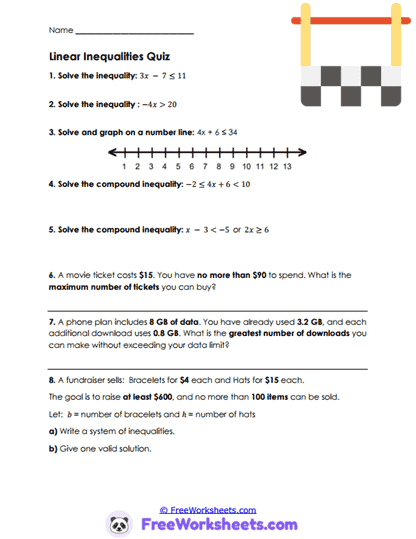
Inequality Review
- What Kids Do:
Students complete mixed review problems involving graphing, compound inequalities, algebraic solving, and real-world inequality applications across multiple formats. - Target Skill:
Students reinforce overall inequality fluency by combining solving, graphing, interpreting, and modeling skills within one comprehensive review activity.
Inequality Stories
- What Kids Do:
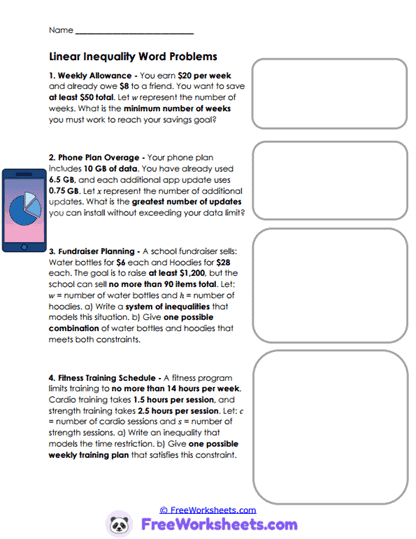
Students solve real-world inequality word problems involving budgets, data plans, schedules, and fundraising goals while defining variables and interpreting solutions. - Target Skill:
Students strengthen applied algebra reasoning by modeling practical constraints with inequalities and explaining solution sets within realistic situations.
Multi-Step Solving
- What Kids Do:
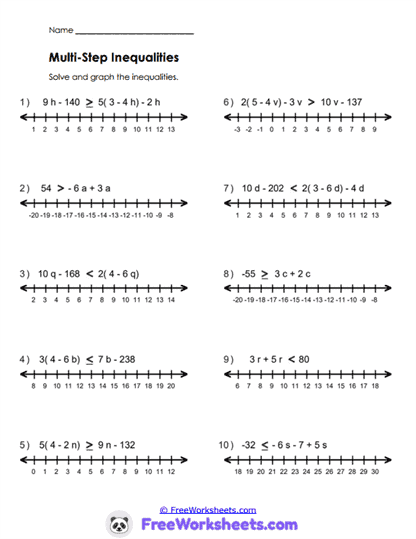
Students solve advanced inequalities involving distribution, combining like terms, and multi-step algebraic simplification before graphing the solution set. - Target Skill:
Students improve algebra fluency and organization skills by solving complex inequalities carefully and connecting symbolic solutions to visual graphs.
Number Graphs
- What Kids Do:
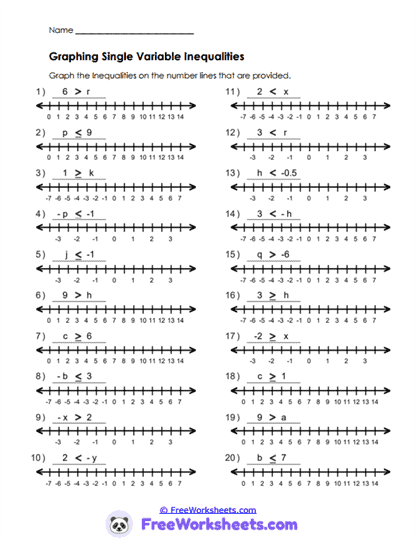
Students graph single-variable inequalities on number lines using open and closed circles while shading the correct solution direction visually. - Target Skill:
Students strengthen visual inequality interpretation skills by connecting inequality symbols to graph structure and understanding inclusive versus strict solutions.
Real Constraints
- What Kids Do:
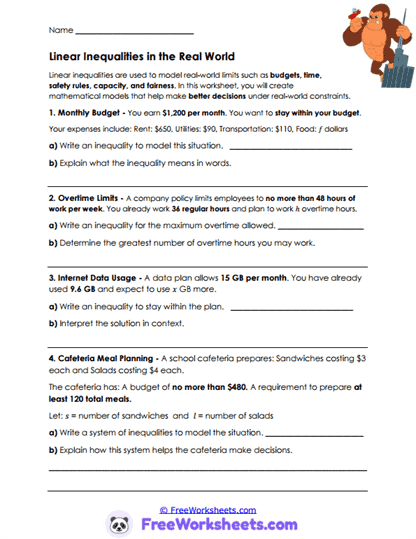
Students write and interpret inequalities involving budgets, overtime limits, meal planning, and internet data usage while explaining practical restrictions. - Target Skill:
Students develop mathematical modeling skills by representing real-world constraints with inequalities and interpreting acceptable solution ranges clearly.
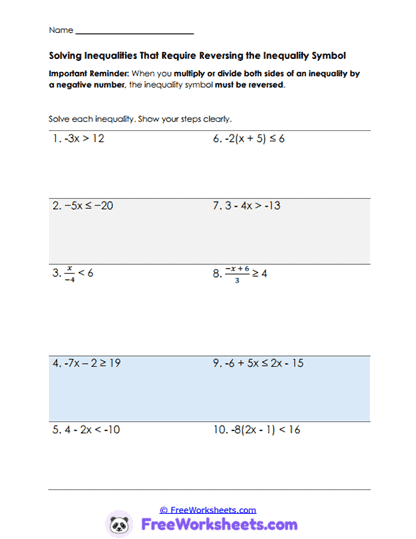
Symbol Reversal
- What Kids Do:
Students solve inequalities involving negative coefficients and divisors while reversing the inequality symbol correctly during algebraic solving. - Target Skill:
Students strengthen algebra accuracy by applying the negative-number reversal rule correctly and organizing multi-step inequality solutions carefully.
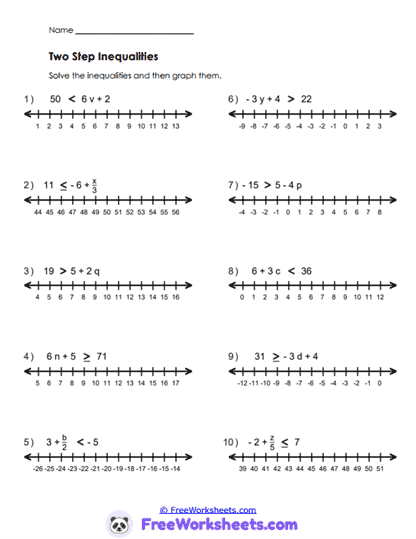
Two-Step Solving
- What Kids Do:
Students solve two-step inequalities using inverse operations and graph the solutions on number lines using appropriate shading and endpoint symbols. - Target Skill:
Students improve solving-and-graphing fluency by connecting algebraic steps to visual solution sets and interpreting inequality notation accurately.
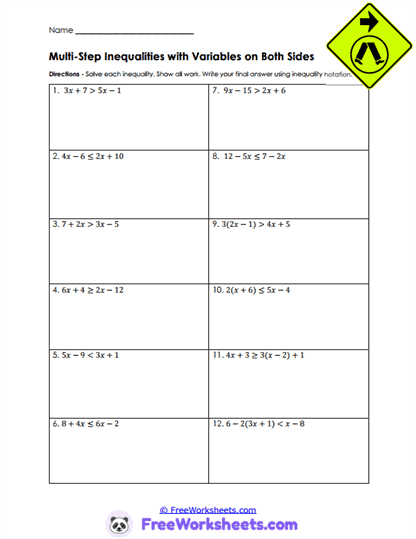
Variable Balance
- What Kids Do:
Students solve inequalities with variables on both sides by combining like terms, moving expressions carefully, and isolating variables step by step. - Target Skill:
Students strengthen advanced algebra reasoning by organizing multi-step inequality solving carefully and maintaining correct inequality relationships.
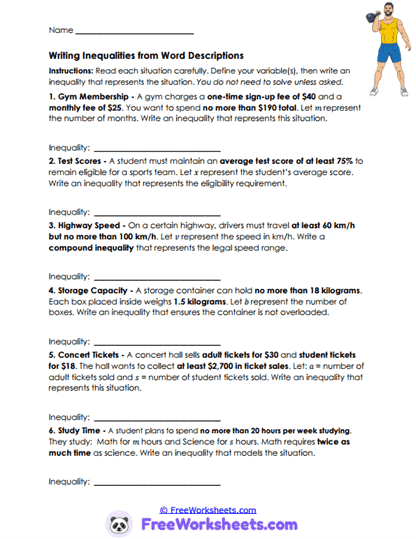
Word Inequalities
- What Kids Do:
Students translate verbal descriptions involving limits, minimums, and maximums into algebraic inequalities using variables and mathematical symbols. - Target Skill:
Students improve algebraic modeling and vocabulary interpretation skills by connecting inequality phrases to mathematical notation and practical situations.