
Systems Of Linear Equations Worksheets
Systems of linear equations in 11th grade math help Algebra 2 students find values that satisfy two relationships at the same time. These free, ready-to-print PDF worksheets are prepared for immediate classroom use, homework, review, intervention, tutoring, or independent systems practice. Students strengthen graphing, substitution, elimination, solution classification, and real-world modeling while meeting key 11th grade curriculum goals.
About This Collection of Worksheets
Systems of linear equations help 11th grade students understand how two conditions can work together to determine one shared solution, no solution, or infinitely many solutions. Students learn that the ordered pair solving a system must make both equations true, and they explore several ways to locate that solution, including graphing, substitution, and elimination. As the problems become more involved, students also learn to compare methods and decide which approach is most efficient for the structure of a particular system.
The worksheets in this collection provide a wide mix of practice rather than repeating one solving routine. Students verify proposed solutions, graph line intersections, solve through substitution and elimination, create useful coefficients, choose efficient methods, classify solution types, analyze mistakes, match systems with ordered pairs, complete missing algebra steps, write systems from real-world situations, and interpret ticket-sale models. These activities reinforce procedural accuracy while helping students understand what a system solution actually represents.
Teachers can use these pages throughout an 11th grade Algebra 2 systems unit for guided lessons, independent classwork, homework, intervention, partner practice, review stations, or assessment preparation. Parents, tutors, and homeschool educators can also select individual worksheets to target a specific need, such as substitution, elimination, method choice, or modeling. The progression from checking existing solutions to creating and solving real-world systems gives students multiple ways to build both confidence and flexible algebraic reasoning.

Paul’s Teacher Tip
Before students solve a system, ask them to look at the equations and explain which method appears easiest and why. An isolated variable usually points toward substitution, matching or opposite coefficients often favor elimination, and graph-friendly equations may make graphing the cleanest choice. When using elimination, have students mark the variable they intend to cancel before combining anything so the purpose of each step stays clear. After finding an ordered pair, encourage students to substitute it into both original equations as a final check. For word problems, require students to define x and y in words before writing the equations so the meaning of each variable stays consistent from setup through interpretation.
Worksheet Collection Skill Spotlights
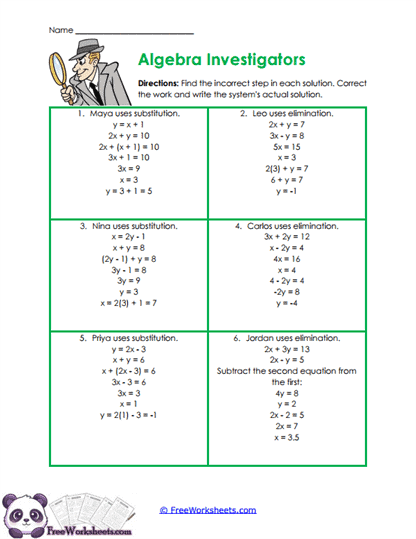
Algebra Errors
What Kids Do:
Students review six worked systems that contain mistakes made during substitution, elimination, simplification, or back-substitution. They compare each algebraic line with the one before it, locate the first incorrect step, explain the specific problem, and then repair the work to produce the correct ordered-pair solution.
Target Skill:
This activity strengthens error analysis and procedural understanding across the two major algebraic system-solving methods. Students reinforce sign control, substitution accuracy, equation combining, back-substitution, and the 11th grade habit of checking the reasoning behind each step instead of only judging the final answer.
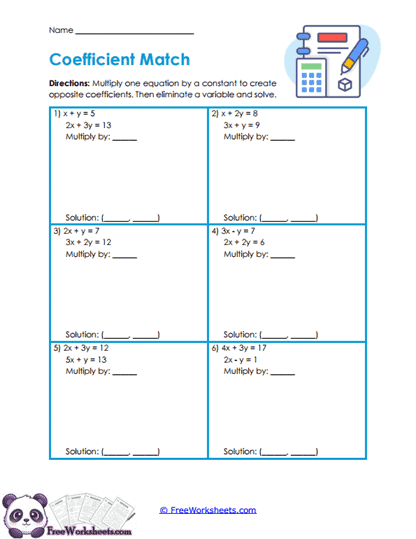
Coefficient Setup
What Kids Do:
Students work through six systems where elimination is not immediately available. They determine which equation should be multiplied, choose a useful factor, apply that multiplier to every term, create matching or opposite coefficients, and then continue with elimination to solve for both variables.
Target Skill:
Students develop the ability to prepare a system strategically before eliminating a variable. The worksheet reinforces equivalent equations, the multiplication property of equality, coefficient comparison, and efficient setup while helping students understand that elimination can be created even when the original coefficients do not line up.
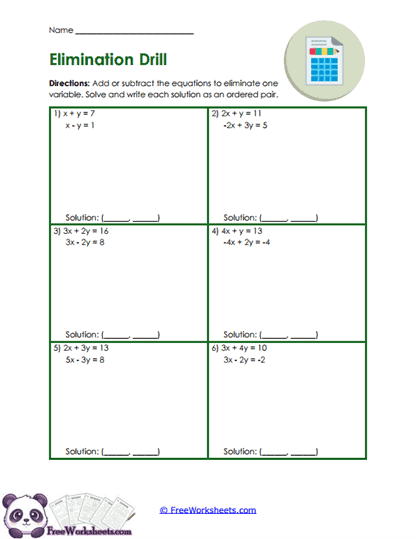
Elimination Practice
What Kids Do:
Students solve six linear systems by examining the coefficients and deciding whether adding or subtracting the equations will cancel one variable. After combining the equations, they solve for the remaining variable, substitute that value into an original equation, and write the completed solution as an ordered pair.
Target Skill:
This worksheet builds fluency with elimination as a structured method for solving systems exactly. Students strengthen coefficient reasoning, sign accuracy, one-variable equation solving, back-substitution, and the connection between two separate equations and one shared solution.
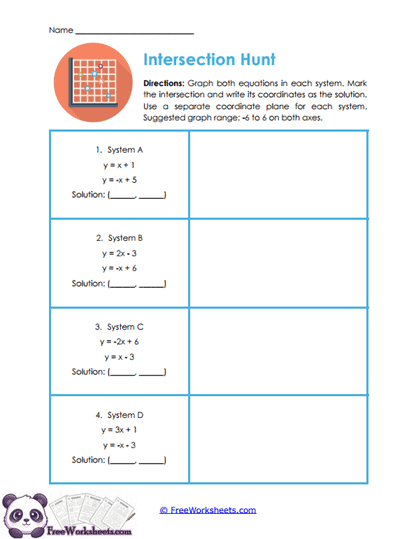
Graph Intersections
What Kids Do:
Students graph both equations from four systems on the same coordinate plane. They identify each line’s slope and starting point, plot the lines accurately, locate the exact point where they intersect, and record that shared coordinate as the solution to the system.
Target Skill:
Students connect graphical intersections with algebraic system solutions. The activity reinforces linear graphing, slope interpretation, ordered-pair notation, and the key idea that the solution represents the one point that satisfies both equations simultaneously.
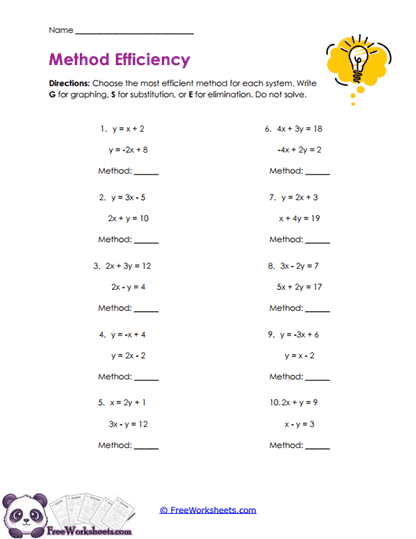
Method Choice
What Kids Do:
Students examine ten systems without fully solving them and choose graphing, substitution, or elimination as the most efficient method. They look for clues such as an isolated variable, coefficients that already cancel, or equations written in a form that makes graphing especially convenient.
Target Skill:
This activity develops strategic decision-making rather than dependence on one familiar method. Students learn to analyze system structure, compare possible solution paths, and choose an efficient approach, which is an important step toward more independent 11th grade Algebra 2 problem solving.
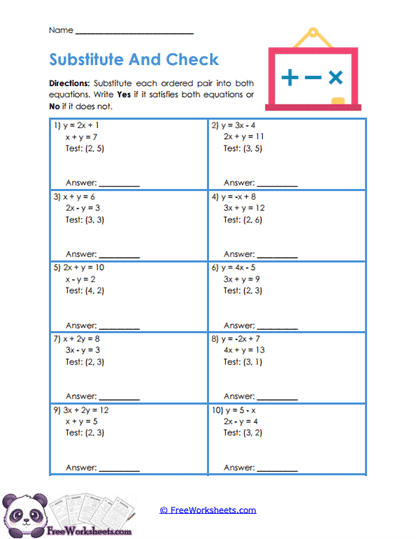
Solution Check
What Kids Do:
Students are given ten systems and a proposed ordered pair for each one. They substitute the x- and y-coordinates into both equations, simplify each statement, and decide whether the point satisfies the entire system rather than stopping after checking only one equation.
Target Skill:
Students build a precise understanding of what a system solution means. The worksheet reinforces substitution, ordered-pair structure, equation verification, and the idea that a valid solution must satisfy two conditions at the same time.
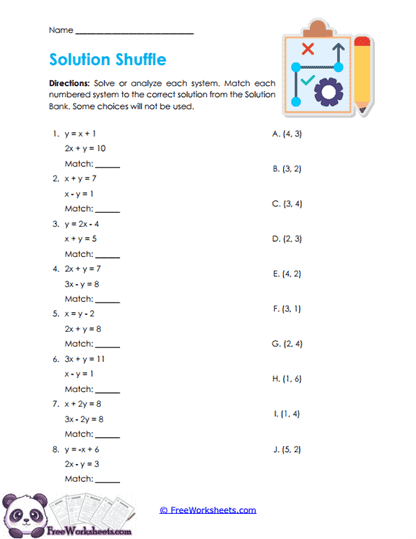
Solution Match
What Kids Do:
Students solve eight mixed systems and match each one to the correct ordered pair from an answer bank containing extra choices. They select whichever method is most efficient, determine both variable values, write the solution in proper coordinate order, and use the answer bank only after completing the algebra.
Target Skill:
This mixed review strengthens method selection, exact system solving, and solution verification. Students practice moving flexibly among substitution and elimination while reinforcing the meaning of an ordered pair as the common solution to both linear equations.
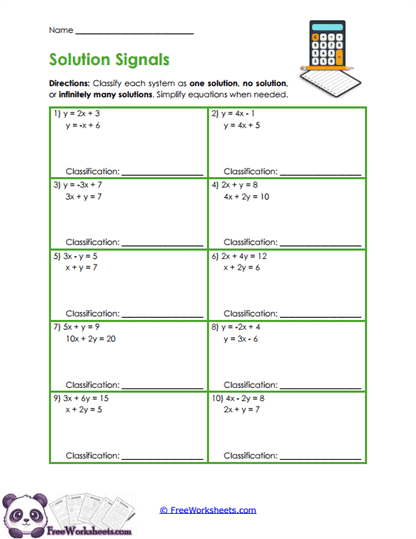
Solution Types
What Kids Do:
Students inspect ten systems and classify each as having one solution, no solution, or infinitely many solutions. They simplify or compare the equations, recognize intersecting lines, parallel lines, or equivalent equations, and interpret true or false statements that may appear when variables cancel.
Target Skill:
Students develop a deeper understanding that not every system ends with one ordered pair. The worksheet connects algebraic outcomes with graph behavior and reinforces how false identities signal no solution while true identities indicate infinitely many solutions.
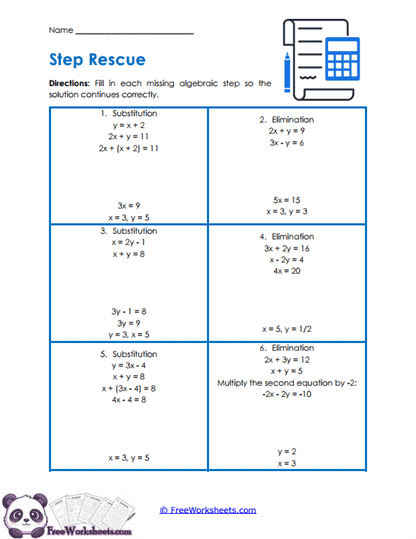
Step Rescue
What Kids Do:
Students complete six partially worked substitution and elimination solutions by determining which algebraic step belongs in each blank. They compare the lines before and after the missing work and decide whether the needed move is distribution, simplification, equation multiplication, elimination, or back-substitution.
Target Skill:
This activity strengthens procedural reasoning by asking students to understand the connection between steps rather than simply repeat a memorized routine. Students reinforce substitution, elimination, equivalent transformations, and the logical sequence required to solve a linear system accurately.
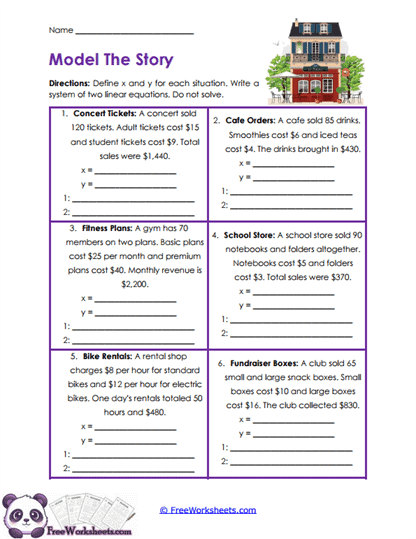
Story Systems
What Kids Do:
Students read six real-world situations involving tickets, drinks, memberships, school supplies, rentals, and fundraiser boxes. They define what x and y represent and write two linear equations that model the given totals, usually separating a quantity relationship from a cost or value relationship.
Target Skill:
Students translate verbal information into algebraic systems while keeping variable meanings consistent. The worksheet strengthens modeling, equation construction, interpretation of totals, and the ability to identify two independent relationships within one 11th grade application problem.
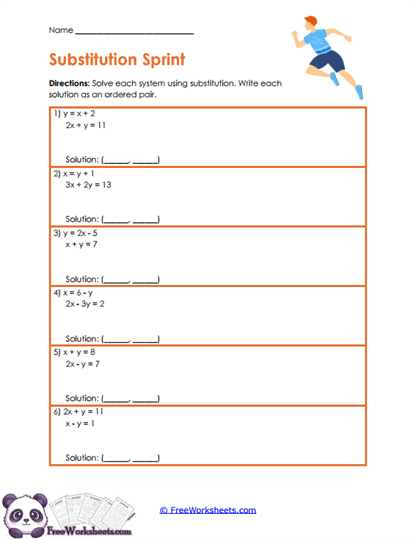
Substitution Solve
What Kids Do:
Students solve six systems by replacing one variable with an equivalent expression from the other equation. They simplify the resulting one-variable equation, solve it, substitute that value back into an original equation, and combine the two values into an ordered-pair solution.
Target Skill:
This worksheet reinforces substitution as both a solving method and a broader algebraic idea that equal expressions can replace one another. Students strengthen equation solving, parentheses use, sign control, back-substitution, and complete solution writing.
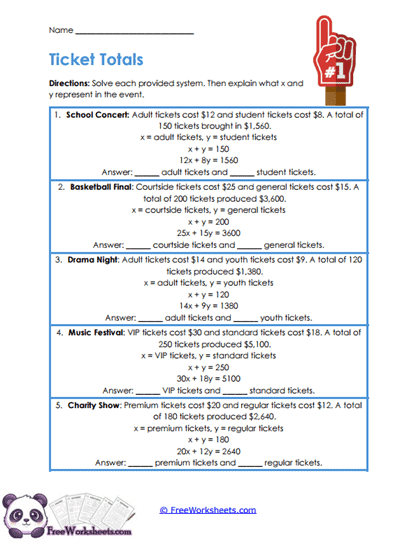
Ticket Models
What Kids Do:
Students solve five event-ticket systems in which the total number of tickets and total revenue are already modeled by two equations. They use substitution or elimination to find both ticket quantities and then interpret the resulting ordered pair in terms of the two ticket categories named in each situation.
Target Skill:
Students apply system-solving methods to a practical count-and-revenue model. The activity reinforces elimination or substitution, variable interpretation, ordered pairs, and the important distinction between finding numerical values and explaining what those values mean in a real-world context.