
Exponential And Logarithmic Equations Worksheets
Exponential and logarithmic equations in 11th grade math help students understand inverse relationships, solve for unknown exponents, and model quantities that grow or decay over time. This free collection of ready-to-print PDF worksheets fits immediate classroom instruction, homework, review, tutoring, intervention, or independent Algebra 2 practice. Students convert forms, apply logarithm properties, choose efficient solving methods, check domains, and interpret exponential models while developing the reasoning expected throughout the 11th grade curriculum.
About This Collection of Worksheets
Exponential and logarithmic equations give 11th grade students a way to solve relationships in which the unknown may appear in an exponent. Students learn that logarithmic and exponential forms describe the same underlying relationship, then use that connection to rewrite equations, solve with common bases, apply logarithms when bases do not match conveniently, and interpret answers within the domain of a logarithmic function. These ideas bring together exponent rules, inverse functions, algebraic manipulation, and mathematical modeling.
The worksheets in this collection build those skills through several different formats. Students match exponential and logarithmic forms, convert between notations, solve with common bases, apply logarithms to exponential equations, choose efficient methods, classify logarithm properties, expand and condense expressions, solve logarithmic equations with domain checks, audit proposed solutions, correct common errors, and use exponential models to determine time in growth and decay situations. This mix helps students connect symbolic procedures with the reasoning behind them instead of treating logarithms as isolated rules.
Teachers can use these pages throughout an 11th grade Algebra 2 unit for direct instruction, guided practice, independent work, homework, intervention, review, partner activities, or assessment preparation. Parents, tutors, and homeschool educators can also use individual worksheets to target one difficulty at a time, such as form conversion, log properties, equation solving, or domain restrictions. The progression from foundational inverse relationships into real-world modeling gives students repeated opportunities to recognize, solve, verify, and interpret exponential and logarithmic relationships.

Paul’s Teacher Tip
Before students reach for logarithms, have them first ask whether both sides can be rewritten using a common base, because that method is often quicker and cleaner. When logarithms are necessary, encourage students to isolate the exponential expression before taking a log and then use the power property to bring the exponent down. For logarithmic equations, make the domain check part of the solving routine, not an optional final step, by having students write the restriction beside the original problem. When teaching log properties, keep multiplication, division, and exponents visually connected to addition, subtraction, and coefficients so students can see the structural pattern. For real-world models, require students to identify the starting value, growth or decay factor, target value, and unknown time before writing any equation.
Worksheet Collection Skill Spotlights
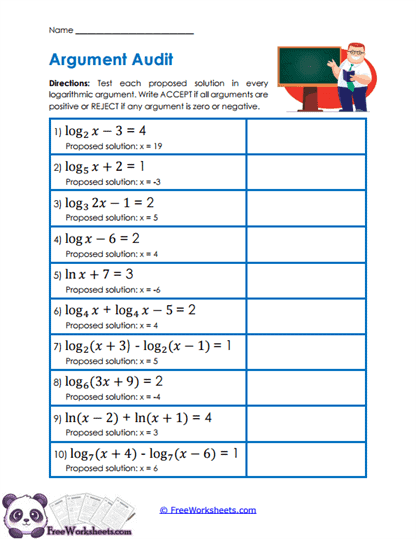
Argument Audit
What Kids Do:
Students examine ten logarithmic equations that already include proposed solutions and decide whether each value should be accepted or rejected. They substitute the value into every logarithm argument, calculate whether each resulting expression stays positive, and reject any candidate that makes even one argument zero or negative.
Target Skill:
This activity reinforces the domain restriction that real logarithms require positive arguments. Students strengthen substitution, solution verification, and extraneous-solution reasoning while learning that an algebraic candidate is not automatically a valid final answer in 11th grade logarithmic equations.
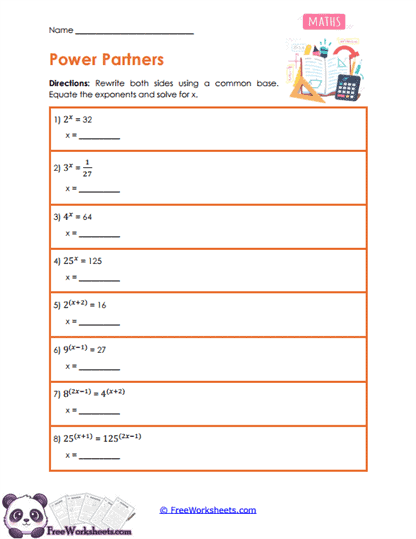
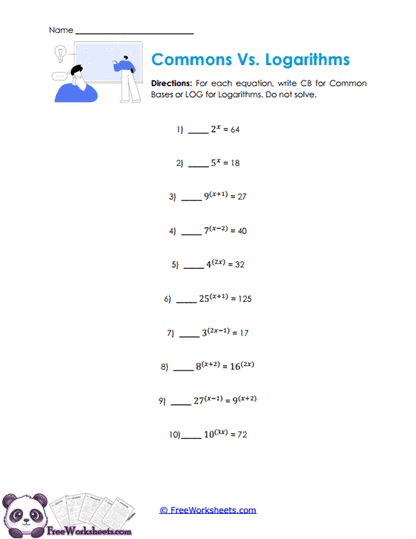
Common Bases
What Kids Do:
Students solve eight exponential equations by rewriting numbers and expressions as powers of the same base. Once both sides use matching bases, they set the exponents equal, solve the resulting linear equation, and handle related powers such as 4, 9, 16, 25, 27, and 125.
Target Skill:
Students build fluency with an efficient exponential-solving method that avoids unnecessary logarithms. The worksheet reinforces exponent properties, equivalent expressions, common-power recognition, and the 11th grade strategy of comparing exponents only after the bases truly match.
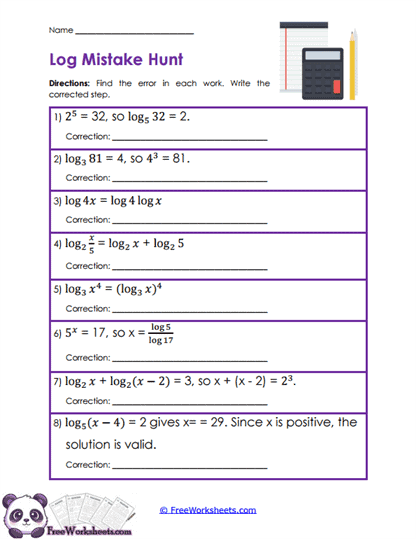
Error Logs
What Kids Do:
Students inspect eight worked examples containing mistakes in exponential-log conversions, logarithm properties, exponential equation solving, or domain reasoning. They locate the first incorrect step, name the rule that was misused, rewrite the faulty expression or equation, and continue to the correct result.
Target Skill:
Error analysis strengthens conceptual understanding across the entire topic. Students review bases, exponents, product and quotient properties, inverse relationships, equation-solving methods, and domain restrictions while developing the self-checking habits needed for more advanced 11th grade Algebra 2 work.
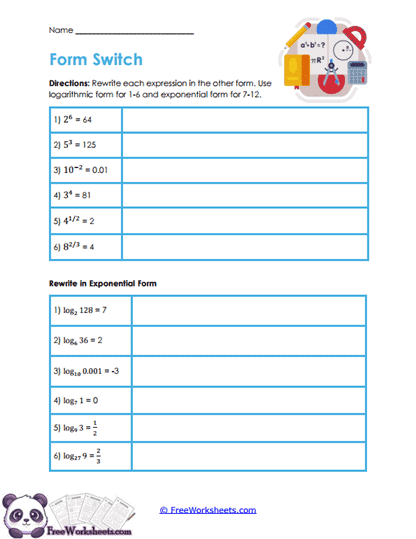
Form Conversion
What Kids Do:
Students rewrite equations in both directions between exponential and logarithmic notation. They identify the base, exponent, and result in each expression, then reposition those same quantities correctly while working with positive, negative, fractional, and other less familiar exponents.
Target Skill:
This worksheet develops fluency with the inverse relationship between logarithms and exponentials. Students learn to preserve the base while correctly placing the exponent and result, creating a foundation for evaluating logarithms and solving more complex 11th grade exponential and logarithmic equations.
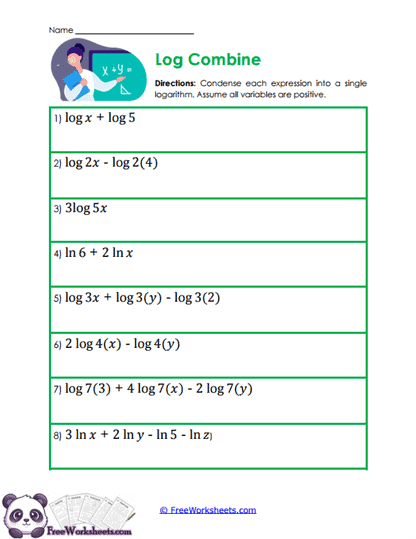
Log Condensing
What Kids Do:
Students combine eight multi-term logarithmic expressions into single logarithms. They move coefficients into arguments as exponents, turn sums of logs into products, turn differences into quotients, and organize several terms carefully until only one equivalent logarithmic expression remains.
Target Skill:
Students practice using logarithm properties in reverse and recognizing expansion and condensation as opposite processes. The activity reinforces product, quotient, and power relationships while preparing students to simplify logarithmic equations before converting them into exponential form.
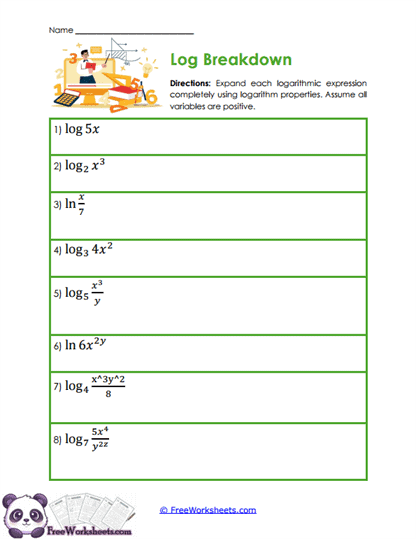
Log Expansion
What Kids Do:
Students expand eight logarithmic expressions containing products, quotients, powers, constants, and multiple variables. They identify which property applies at each stage and rewrite the original expression as a sum or difference of simpler logarithms with exponents moved to coefficients.
Target Skill:
This activity strengthens structural understanding of logarithmic properties and their connection to exponent rules. Students learn to break complicated expressions into equivalent parts while carefully avoiding invalid moves such as splitting logarithms across addition inside an argument.
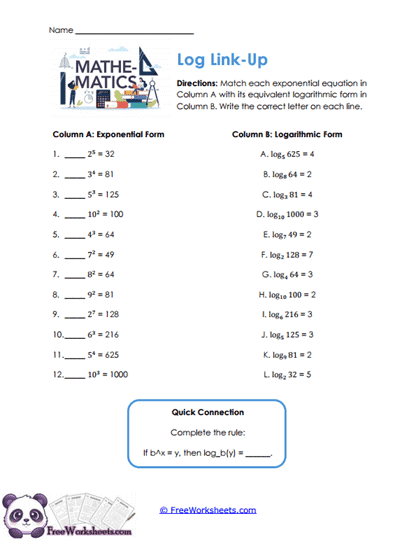
Log Pairing
What Kids Do:
Students match twelve exponential statements with logarithmic equations that describe the same relationship. They track the base, exponent, and result across both forms and then complete a general conversion rule showing how an equation such as b^x = y corresponds to logarithmic notation.
Target Skill:
Students develop an intuitive understanding that logarithms answer exponent questions rather than representing an unrelated operation. The matching format reinforces inverse-function reasoning and helps 11th grade students recognize equivalent exponential and logarithmic representations quickly.
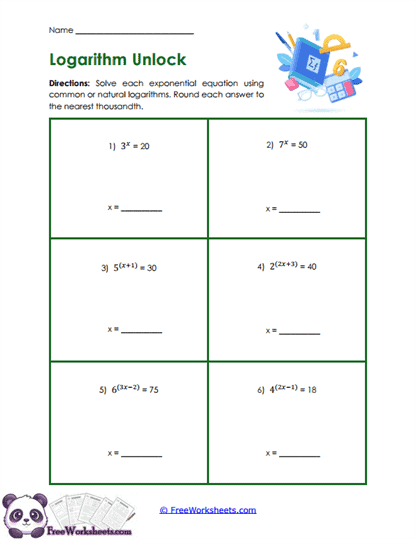
Logarithm Solve
What Kids Do:
Students solve six exponential equations whose values do not convert conveniently to a shared base. They take logarithms on both sides, use the power property to move variable exponents in front, solve the resulting linear equation, and round decimal answers to the nearest thousandth.
Target Skill:
Students learn a general method for solving exponential equations when common bases are unavailable. The worksheet reinforces logarithm properties, multi-step algebra, calculator use, and the important Algebra 2 idea that logs can transform an unknown exponent into a solvable coefficient.
Method Choice
What Kids Do:
Students inspect ten exponential equations and decide whether common bases or logarithms would provide the more efficient solving method. They look for familiar powers, hidden related bases, and equations whose numerical values cannot reasonably be rewritten with one convenient shared base.
Target Skill:
This activity develops strategic problem solving rather than mechanical procedure. Students learn to evaluate equation structure before calculating, distinguish when a shortcut is available, and choose between two valid methods based on efficiency and mathematical simplicity.
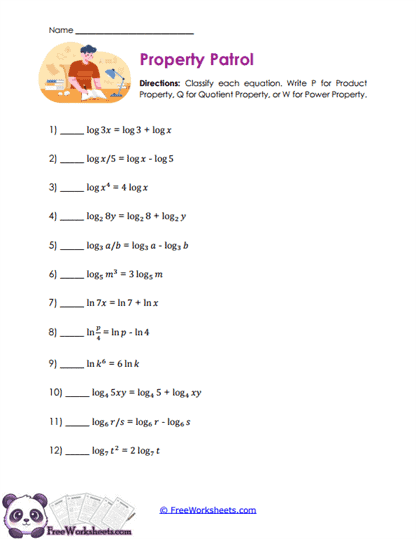
Property Sort
What Kids Do:
Students classify twelve logarithmic identities as examples of the product, quotient, or power property. They examine multiplication, division, and exponents inside logarithm arguments and label each pattern while working with common logarithms, natural logarithms, and other bases.
Target Skill:
Students strengthen recognition of the three major logarithm properties before applying them in longer expressions. The worksheet reinforces the connection between operations inside logarithms and the corresponding addition, subtraction, or coefficients that appear after rewriting.
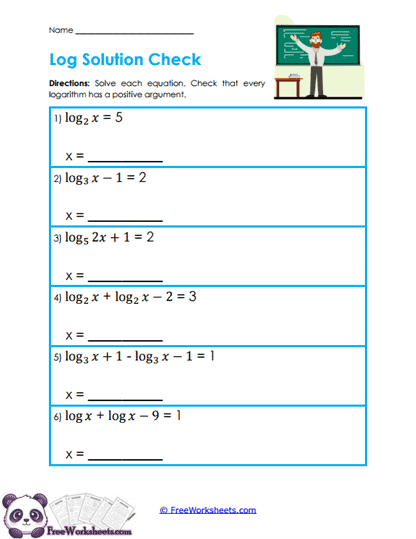
Solution Check
What Kids Do:
Students solve six logarithmic equations using exponential conversion, isolation, and logarithm properties when needed. After finding candidate values, they substitute each result into every logarithmic argument and confirm that all arguments remain greater than zero before accepting the solution.
Target Skill:
This worksheet combines procedural equation solving with domain reasoning. Students learn that a correct sequence of algebraic steps can still produce an invalid logarithmic answer, strengthening 11th grade habits of verification, restriction analysis, and extraneous-solution detection.
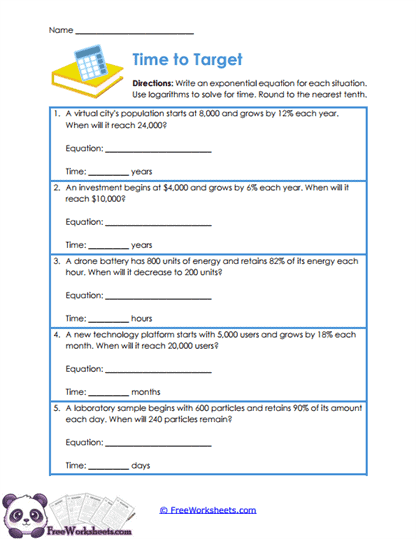
Target Time
What Kids Do:
Students model five real-world growth and decay situations involving populations, investments, batteries, online users, and laboratory samples. They identify initial amounts and exponential factors, set each model equal to a target value, and use logarithms to solve for the unknown time.
Target Skill:
Students apply exponential and logarithmic equations to realistic modeling problems where time appears in the exponent. The activity reinforces growth and decay factors, percentage interpretation, equation construction, logarithmic solving, and the practical role of logarithms in 11th grade finance, science, and population models.