
Polynomial Operations Worksheets
Polynomial operations in 11th grade math give Algebra 2 students the tools to organize, combine, expand, divide, and interpret increasingly complex expressions. Ready for immediate classroom use, these free PDF worksheets can be printed for lessons, homework, intervention, tutoring, review, or independent practice. By working with like terms, distribution, exponent rules, standard form, and polynomial division, students develop the symbolic fluency and structural reasoning emphasized throughout the 11th grade curriculum.
About This Collection of Worksheets
Polynomial operations require 11th grade students to understand both the structure of an expression and the rules used to transform it. Before performing calculations, students need to recognize terms, coefficients, exponents, degree, and like terms so they can determine which pieces may be combined and how each operation changes the expression. From there, addition, subtraction, multiplication, and division become connected processes rather than separate sets of procedures.
This collection develops those ideas through a broad range of Algebra 2 activities. Students identify polynomial features, sort like terms, add and subtract expressions, distribute monomials, expand products, recognize special product patterns, solve backward for missing polynomials, divide by monomials, complete polynomial long division, analyze common mistakes, and connect multiplication with rectangular area models. The variety gives students repeated opportunities to simplify, organize, verify, and interpret polynomial expressions in different forms.
Teachers can use these worksheets throughout an 11th grade polynomial unit for direct instruction, guided practice, independent work, homework, intervention, review stations, or assessment preparation. Parents, tutors, and homeschool educators can also target individual trouble spots such as sign changes during subtraction, exponent rules during multiplication, or organization during long division. Because the collection moves from expression structure into increasingly involved operations, it works well for both skill development and cumulative review.

Paul’s Teacher Tip
Encourage students to identify the operation before touching any terms, because addition, subtraction, multiplication, and division follow very different rules for coefficients and exponents. For addition and subtraction, have them mark like terms first and remind them that exponents do not change when coefficients combine. During subtraction, require students to rewrite the second polynomial with every sign changed before combining anything. For multiplication, separate the work into two stages: create every product first, then combine like terms. When students reach long division, insist on descending powers and zero placeholders for missing terms so the columns stay aligned from beginning to end.
Worksheet Collection Skill Spotlights
Area Products
What Kids Do:
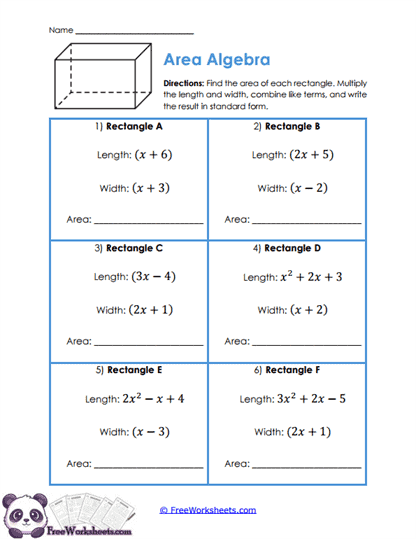
Students find the areas of six rectangles whose lengths and widths are written as polynomial expressions. They multiply the two side expressions using systematic distribution, create every required partial product, combine like terms, and write each finished area polynomial in standard form.
Target Skill:
This activity connects polynomial multiplication with the familiar geometric relationship area = length × width. Students reinforce distribution, like-term combination, standard form, and expression structure while seeing how 11th grade polynomial products can represent meaningful geometric quantities.
Error Analysis
What Kids Do:
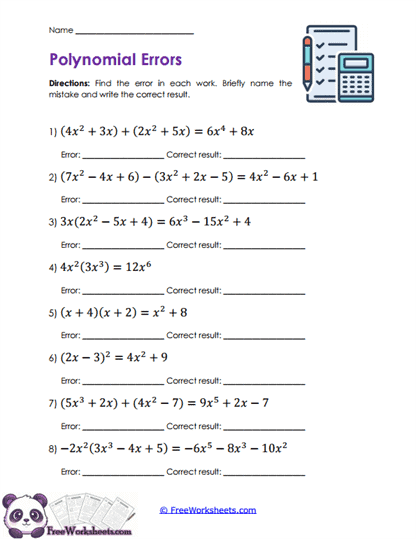
Students examine eight worked polynomial problems that contain mistakes involving addition, subtraction, distribution, multiplication, signs, exponent rules, or improper combining of terms. They locate the first incorrect step, describe the error specifically, and rewrite the calculation correctly.
Target Skill:
Students strengthen their understanding of polynomial rules by explaining why a solution fails rather than simply replacing the final answer. The activity reinforces like-term recognition, sign control, exponent properties, and self-checking across several major 11th grade polynomial operations.
Long Division
What Kids Do:
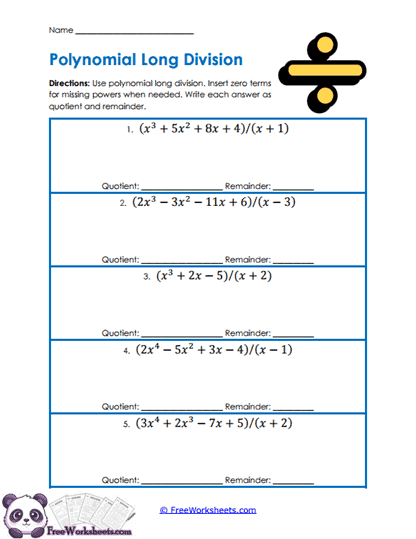
Students divide five higher-degree polynomials by binomials using polynomial long division. They organize terms by descending degree, insert placeholders when powers are missing, divide leading terms, multiply back, subtract the entire resulting polynomial, bring down the next term, and continue until reaching a quotient and possible remainder.
Target Skill:
This worksheet develops an organized polynomial-division process modeled after numerical long division. Students strengthen leading-term reasoning, subtraction of grouped expressions, degree alignment, quotient construction, and remainder interpretation while preparing for factor, zero, and rational-expression work.
Missing Polynomial
What Kids Do:
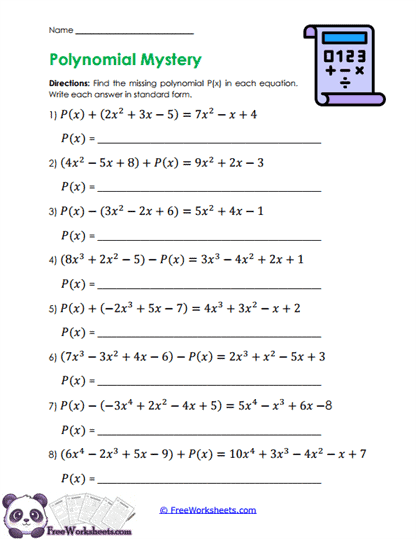
Students solve eight problems in which an entire polynomial P(x) is missing from an addition or subtraction relationship. They use inverse operations to work backward from the known result, carefully distribute negative signs when necessary, combine corresponding terms, and write the recovered polynomial in standard form.
Target Skill:
Students learn that inverse-operation reasoning can be applied to whole algebraic expressions, not just individual numbers or variables. The activity reinforces polynomial addition and subtraction, equation structure, sign management, and the 11th grade ability to reason backward from a known result.
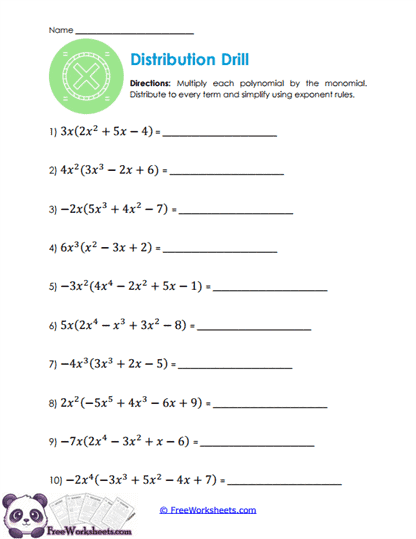
Monomial Distribution
What Kids Do:
Students multiply ten polynomials by single monomial factors. They distribute the outside term to every term inside each polynomial, multiply numerical coefficients, determine the correct sign for each product, and add exponents when powers with the same variable base are multiplied.
Target Skill:
This focused practice strengthens the distributive and exponent rules that support more advanced polynomial multiplication. Students learn to coordinate coefficient multiplication, sign rules, and exponent addition while ensuring that no term inside the polynomial is skipped.
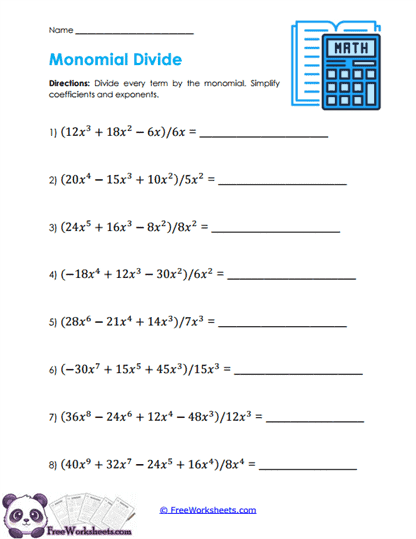
Monomial Division
What Kids Do:
Students divide eight polynomial expressions by monomials one term at a time. They separate the numerator into individual divisions, simplify numerical coefficients, subtract exponents for matching variable bases, determine positive or negative signs, and combine the simplified terms into a final polynomial.
Target Skill:
Students build fluency with term-by-term polynomial division and the quotient rule for exponents. The worksheet reinforces coefficient arithmetic, exponent subtraction, sign control, and expression simplification while preparing 11th grade students for full polynomial long division.
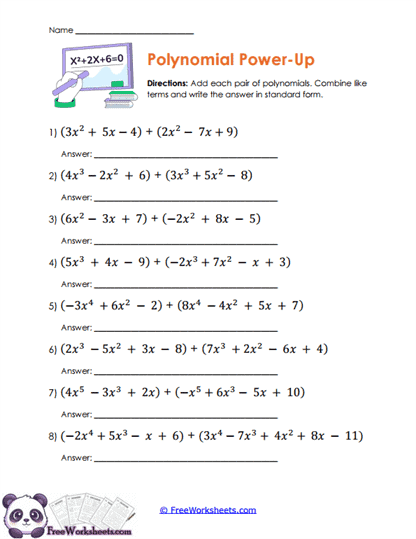
Polynomial Addition
What Kids Do:
Students add eight pairs of polynomials containing terms of different degrees and signs. They identify matching variable powers, add only the corresponding coefficients, carry unmatched terms into the result, and reorder the finished polynomial from the greatest exponent to the constant term.
Target Skill:
This worksheet develops accurate like-term combination while emphasizing that polynomial addition changes coefficients but not exponents. Students reinforce standard form, signed-number arithmetic, expression organization, and the closure of polynomial expressions under addition.
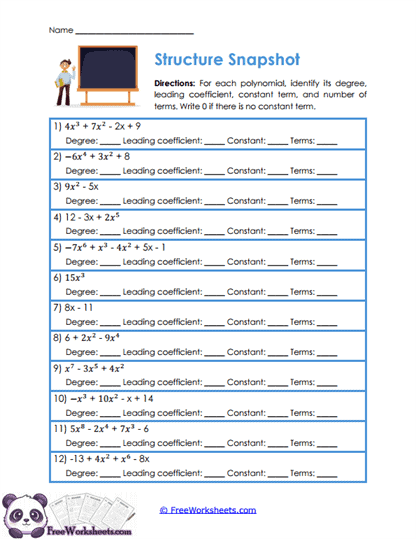
Polynomial Parts
What Kids Do:
Students analyze twelve polynomial expressions and identify the degree, leading coefficient, constant term, and total number of terms in each one. They scan the entire expression for the greatest exponent rather than assuming the first written term automatically determines its structure.
Target Skill:
Students build the vocabulary and structural awareness needed before carrying out polynomial operations. The activity reinforces degree, leading terms, coefficients, constants, and term counting while preparing students to recognize whether later results are organized correctly.
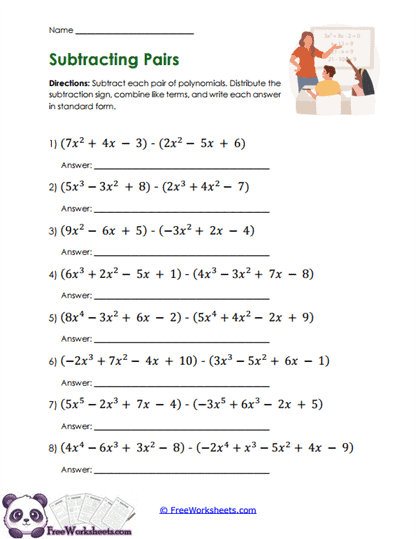
Polynomial Subtraction
What Kids Do:
Students subtract eight polynomial expressions by first distributing the subtraction across every term of the second polynomial. They rewrite changed signs, locate matching terms, combine coefficients carefully, preserve unmatched terms, and arrange each final expression in descending powers.
Target Skill:
This activity develops disciplined sign control during polynomial subtraction. Students reinforce the idea that subtracting a grouped expression changes every term inside it, while also strengthening like-term recognition, signed-number arithmetic, and standard-form organization.
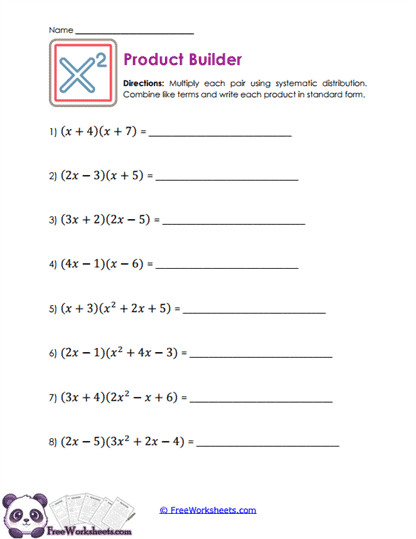
Product Expansion
What Kids Do:
Students multiply pairs of polynomial expressions, beginning with binomial products and progressing to binomial-by-trinomial multiplication. They distribute every term in one polynomial across every term in the other, record all partial products, combine matching powers, and write the result in standard form.
Target Skill:
Students develop systematic polynomial multiplication instead of relying on incomplete shortcuts. The worksheet strengthens multi-term distribution, sign accuracy, exponent rules, like-term combination, and organization while building the fluency needed for quadratics and higher-degree polynomial functions.
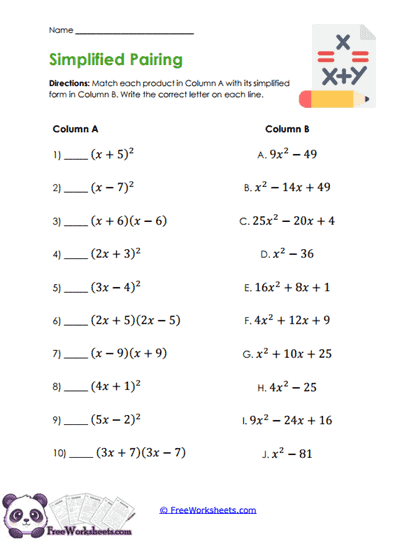
Product Matches
What Kids Do:
Students match ten polynomial products with their correctly expanded and simplified forms. The problems include squared binomials, conjugate pairs, positive and negative terms, and expressions whose middle terms may combine or cancel, requiring students to verify all coefficients and signs before making each match.
Target Skill:
This activity develops recognition of common polynomial product structures while reinforcing full multiplication reasoning. Students practice binomial squares, difference-of-squares patterns, distribution, and like-term combination while learning to check familiar patterns instead of relying on memory alone.
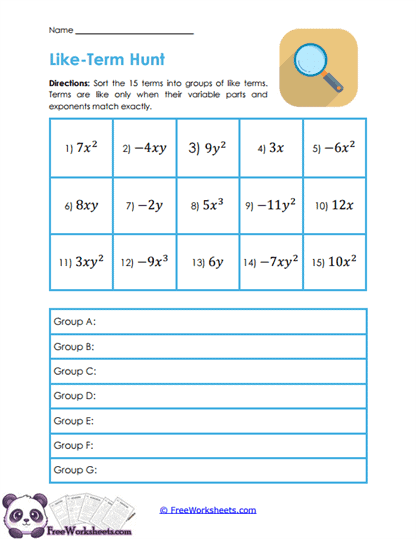
Term Groups
What Kids Do:
Students sort fifteen algebraic terms into groups of like terms by comparing the variable letters and exponents in each expression. They ignore differences in coefficients and focus on whether every variable component and corresponding power matches exactly before placing terms together.
Target Skill:
This worksheet establishes the recognition skill required for accurate polynomial addition and subtraction. Students learn that coefficients may differ while variable parts must match exactly, strengthening expression structure, exponent awareness, and 11th grade readiness for combining longer polynomial expressions.