
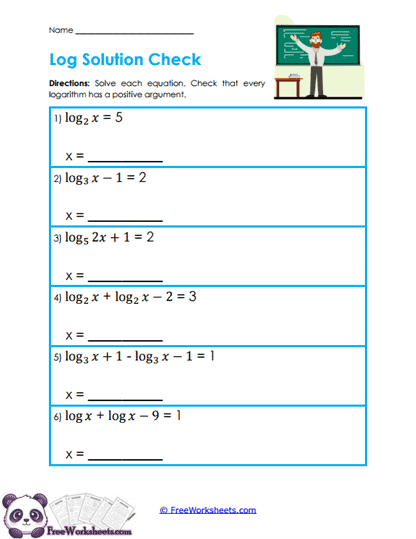
About This Worksheet
This worksheet helps eleventh-grade students practice solving logarithmic equations while checking that every answer stays inside the valid logarithm domain. Students work through six equations that involve single logarithms as well as equations with more than one log term. After solving, they must make sure every logarithm argument is positive before accepting the answer.
For example, an equation such as log2 x = 5 can be rewritten in exponential form to find x. Other problems require students to isolate a logarithm first or combine logarithmic terms before converting forms. Once a possible solution is found, students check that each logarithm contains a positive argument.
What Students Practice
Students practice rewriting logarithmic equations in exponential form, isolating log expressions, and using logarithm properties when needed. They then test the proposed value against the original equation’s domain restrictions. This gives them a full solve-and-check routine.
The worksheet also reinforces an important rule: the argument of a real logarithm must be greater than zero. Students learn that an algebraic answer is not automatically valid just because it came from correct equation-solving steps.
Why This Skill Matters
Logarithmic equations can produce answers that look correct algebraically but are not allowed in the original expression. This happens because logarithms of zero or negative numbers are not defined in the real-number system. Students need to check the domain before accepting a solution.
This skill becomes especially important as logarithmic equations grow more complicated. An answer may work in one part of the equation but make another logarithm invalid. Learning to check every argument helps students avoid extraneous solutions.
Common Challenges
Students may stop as soon as they solve for x and forget the domain check. Encourage them to substitute the answer into every logarithm argument and make sure each one is positive. This should become part of the normal solving routine.
Another common mistake is checking only whether x itself is positive. The important question is whether the full argument is positive. For example, if the logarithm contains x – 3, then x must be greater than 3, not merely greater than zero.
How To Use It
Teachers can use this worksheet after students have practiced basic logarithmic equations and logarithm properties. It works well for guided practice, independent classwork, homework, or review before more advanced equation solving. Asking students to write the domain restriction beside each problem can strengthen the habit.
Parents and homeschool teachers can remind students to do one last check after finding x: “Is everything inside every log greater than zero?” If yes, the solution can stay. If not, it must be rejected.
Grade Alignment
This worksheet is intended for Grade 11 Algebra 2 and supports solving logarithmic equations while respecting the domain of logarithmic functions. It reinforces inverse exponential-logarithmic relationships and algebraic reasoning with logarithm properties.
Students should already know how to rewrite logs in exponential form and use product, quotient, and power properties. After this practice, they are ready to evaluate proposed solutions and analyze extraneous answers.