
About This Worksheet
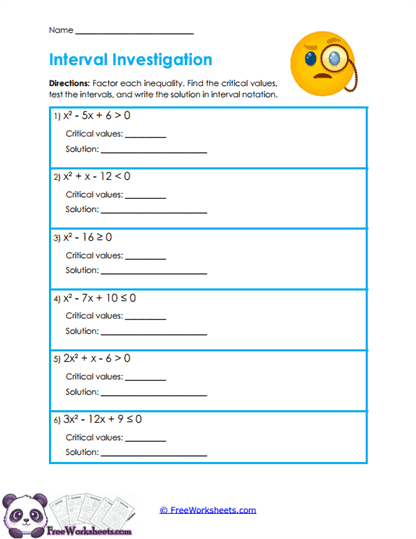
This worksheet helps eleventh-grade students practice solving quadratic inequalities by finding critical values and testing intervals. Students work through six inequalities. They first find the values where the related quadratic equals zero, then use those values to divide the number line into sections and decide where the expression is positive or negative.
The problems include inequalities asking for values greater than zero, less than zero, and cases that include equality. Students write the final answer in interval notation, which helps connect algebraic solving with number-line thinking.
What Students Practice
Students practice factoring quadratic expressions to find critical values, then checking the sign of the expression in each interval. They learn that the roots mark the places where the sign of the quadratic may change.
The worksheet also reinforces open and closed endpoints. A strict inequality does not include the critical values, while an inequality with equality may include them when the original expression equals zero there.
Why This Skill Matters
Quadratic inequalities are different from quadratic equations because the answer is usually a range of values, not just one or two points. Students need to understand where the parabola lies above or below the horizontal axis.
This skill connects algebra with graphing. Solving a quadratic inequality tells students where a quadratic function is positive or negative, which matches where its graph sits above or below the axis.
Common Challenges
Students may solve the related quadratic correctly but stop after finding the critical values. Remind them that those values only divide the number line. They still need to determine which intervals actually satisfy the inequality.
Another common mistake is using the wrong endpoint type in interval notation. Students should check whether the inequality includes equality before deciding whether a root belongs in the solution.
How To Use It
Teachers can use this worksheet after students understand quadratic equations and basic interval notation. It works well for guided practice, independent classwork, homework, or a bridge into graph-based inequality work.
Parents and homeschool teachers can remind students of the basic order: find the roots, split the number line, test one value from each section, and keep the intervals that make the inequality true.
Grade Alignment
This worksheet is intended for Grade 11 Algebra 2 and supports solving polynomial inequalities and interpreting their solution sets. It builds directly on quadratic factoring and connects to graph behavior.
Students should already know how to factor quadratics and write intervals. After this practice, they can move into checking proposed quadratic-inequality solution sets.