
About This Worksheet
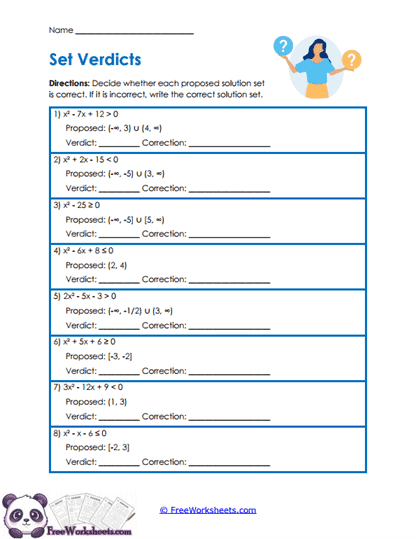
This worksheet helps eleventh-grade Algebra 2 students practice checking proposed solution sets for quadratic inequalities. Students are given eight inequalities along with an answer someone has already suggested. Their job is to decide whether that proposed set is correct or incorrect. If it is wrong, they must write the corrected solution.
The activity asks students to think about more than just the roots. They need to decide which intervals actually make the quadratic positive, negative, or equal to zero. This makes the worksheet a strong follow-up to interval testing because students are now judging complete solution sets rather than building them from scratch every time.
What Students Practice
Students practice factoring quadratic expressions, identifying critical values, and deciding where the expression has the correct sign. They also review how strict inequalities differ from inequalities that include equality.
The worksheet gives students practice with interval notation and endpoint decisions. Some proposed answers may have the correct boundary values but use the wrong intervals, while others may include or exclude endpoints incorrectly. Students must check the whole solution, not just part of it.
Why This Skill Matters
Quadratic inequalities often produce solutions that cover more than one interval. Students need to understand how the roots divide the number line and how the sign of the quadratic changes across those sections.
This skill also strengthens error checking. Instead of assuming a proposed answer is correct, students learn to verify the roots, the interval directions, and the endpoint rules. That kind of careful review is useful throughout Algebra 2.
Common Challenges
Students may focus only on whether the critical values are correct. Remind them that the intervals between and outside those values matter just as much. A solution can have the right roots but still use the wrong regions.
Another common mistake is forgetting whether the inequality includes equality. If equality is included, any root that makes the quadratic exactly zero can belong in the solution. If the inequality is strict, those roots are excluded.
How To Use It
Teachers can use this worksheet after students have practiced solving quadratic inequalities on their own. It works well for partner discussion, independent review, homework, or test preparation. Asking students to explain why a proposed set is wrong can deepen their understanding.
Parents and homeschool teachers can ask, “Are the boundary numbers right?” and then, “Which parts of the number line actually make the inequality true?” Those two checks can help students work through each problem more carefully.
Grade Alignment
This worksheet is designed for Grade 11 Algebra 2 and supports work with quadratic inequalities, interval notation, and sign analysis. It builds on solving quadratics and interpreting where a polynomial is positive or negative.
Students should already understand factoring and interval testing. After this practice, they can move into reading inequality behavior directly from quadratic graphs.