
Solving Multi-step Linear Inequalities Worksheets
Multi-step linear inequalities in 9th grade math challenge students to combine several algebra skills while keeping inequality rules accurate from start to finish. This free set of ready-to-print PDF worksheets supports immediate classroom use, homework, intervention, review, tutoring, and independent practice with increasingly complex expressions. Students work through distribution, like-term simplification, variable movement, sign reversals, and solution interpretation to build the reasoning expected across the 9th grade curriculum.
About This Collection of Worksheets
Solving multi-step linear inequalities asks 9th grade students to bring several familiar Algebra 1 skills together in one problem. They may need to distribute, combine like terms, move variable terms, simplify both sides, and then isolate the variable while remembering that multiplying or dividing by a negative number reverses the inequality symbol. These problems help students move beyond simple one-step procedures and develop a more organized approach to algebraic reasoning.
The worksheets in this collection target both procedural fluency and deeper understanding. Students decide when to keep or flip inequality symbols, solve with negative coefficients, complete mixed multi-step problems, distribute through parentheses, combine like terms, work with variables on both sides, graph finished solutions, analyze errors, fill in missing algebra steps, recognize all-real-number and no-solution cases, model real-world limits, and choose correct answers from multiple options. This variety gives students repeated opportunities to solve, explain, check, and interpret inequalities in different formats.
Teachers can use these pages throughout a 9th grade inequalities unit for direct instruction, guided practice, homework, intervention, partner work, review stations, or assessment preparation. Parents, tutors, and homeschool educators can also use individual activities to target a specific trouble spot such as distribution, negative coefficients, or graphing. The progression from focused skill work to mixed applications helps students build confidence before tackling broader Algebra 1 constraint and modeling problems.

Paul’s Teacher Tip
Have students simplify each side of the inequality before they start moving terms whenever parentheses or like terms are present. When variables appear on both sides, encourage them to choose the direction that avoids a negative coefficient when possible because that often reduces sign mistakes. At the final multiplication or division step, pause and ask whether the coefficient is negative before writing the solution symbol. For graphing, have students read the completed inequality aloud before choosing the endpoint and shading direction. When a variable cancels completely, remind students to evaluate the remaining numerical statement instead of trying to force an x-value into the answer.
Worksheet Collection Skill Spotlights
Answer Check
What Kids Do:
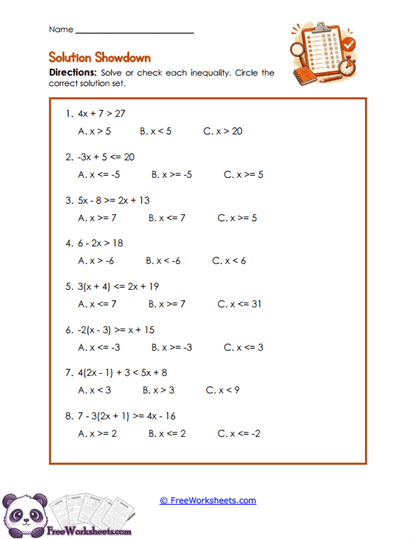
Students solve eight mixed multi-step linear inequalities and compare their results with three possible answer choices. They work through distribution, like-term simplification, variable movement, negative coefficients, and possible sign reversals before deciding which final inequality is mathematically correct.
Target Skill:
This activity strengthens cumulative inequality-solving fluency while helping students recognize common distractors involving wrong signs, incorrect boundaries, or incomplete simplification. Students practice following a full algebraic sequence and verifying that the selected answer matches the completed 9th grade solution process.
Boundary Graphs
What Kids Do:
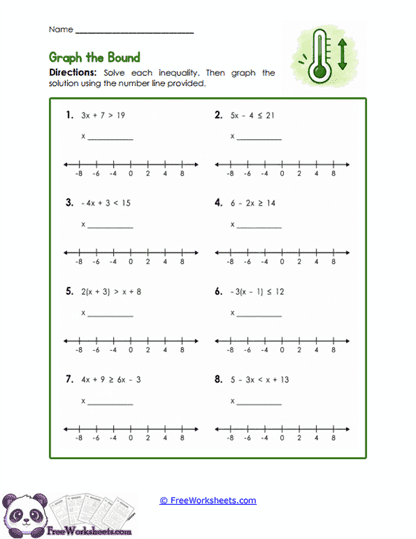
Students solve eight multi-step inequalities and then represent each final solution on a number line. After simplifying expressions and isolating x, they determine whether the endpoint should be open or closed and whether the ray should extend toward greater or lesser values.
Target Skill:
Students connect symbolic algebra with visual solution sets. The worksheet reinforces multi-step solving, boundary inclusion, inequality direction, and graph interpretation while helping 9th grade students see that a solved inequality describes an entire range of possible values.
Cancel Cases
What Kids Do:
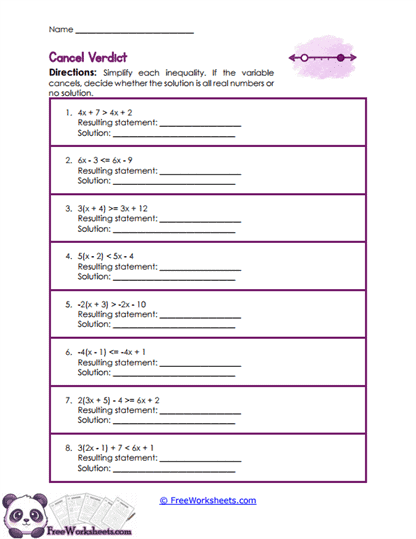
Students simplify eight inequalities in which the variable eventually cancels from both sides. They evaluate the numerical statement that remains and decide whether it is always true or always false, then classify the final solution as all real numbers or no solution.
Target Skill:
This worksheet develops understanding of special inequality outcomes that do not end with x compared to a number. Students strengthen expression simplification, logical interpretation, and solution-set reasoning while learning how true and false statements determine unusual 9th grade algebraic results.
Context Limits
What Kids Do:
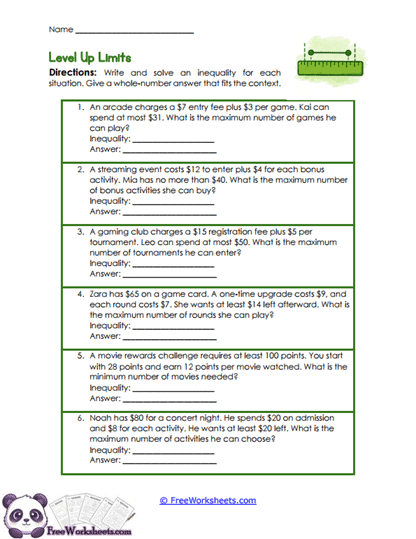
Students translate six real-world situations involving arcade costs, streaming fees, clubs, game cards, rewards, and concert attendance into multi-step inequalities. They identify fixed and changing quantities, solve the inequality, and interpret the final answer using a whole-number value that fits the context.
Target Skill:
Students apply Algebra 1 inequalities to practical constraints involving budgets, fees, limits, and minimum requirements. The activity strengthens modeling, symbol selection, multi-step solving, and contextual interpretation while helping students connect 9th grade algebra to everyday decision-making.
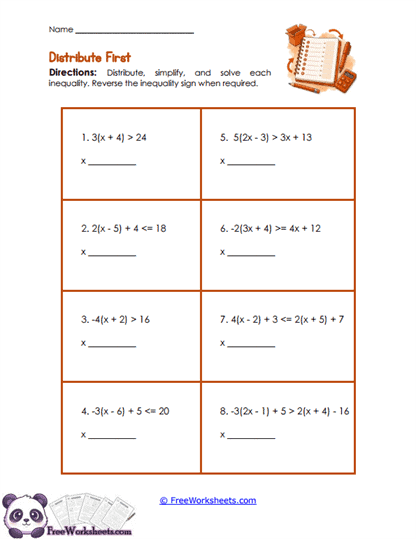
Distribute First
What Kids Do:
Students solve eight inequalities that begin with expressions inside parentheses. They apply the distributive property to every term, simplify both sides, move variable and constant terms as needed, and then isolate x while checking whether a final negative division requires a symbol reversal.
Target Skill:
This focused practice develops accurate use of distribution within inequality solving. Students strengthen expression simplification, sign control, equation balance, and step order while preparing for more complicated 9th grade problems involving multiple terms on both sides.
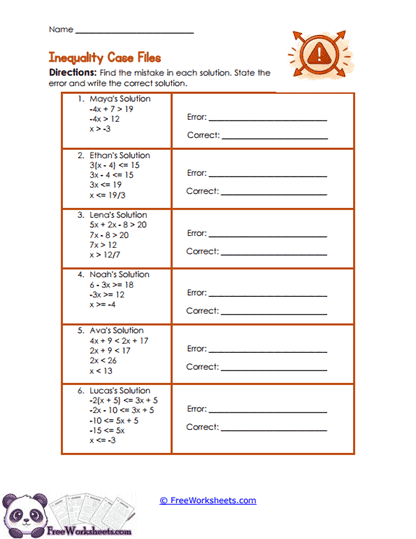
Error Hunt
What Kids Do:
Students inspect six worked inequality solutions containing mistakes in distribution, sign direction, like-term combination, variable movement, or negative division. They identify the first incorrect step, explain what went wrong, and then repair the solution using valid algebraic reasoning.
Target Skill:
Error analysis helps students understand why each solving step works rather than relying only on memorized routines. They strengthen self-checking, symbolic accuracy, mathematical explanation, and recognition of common mistakes that can change an entire inequality solution set.
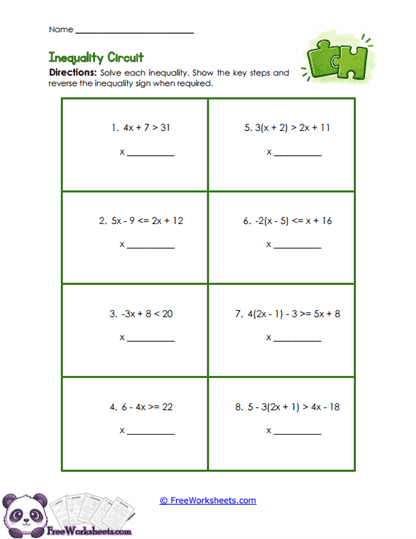
Inequality Circuit
What Kids Do:
Students work through eight mixed multi-step inequalities that combine distribution, like terms, variables on both sides, and negative coefficients. They decide which algebraic move should come next, simplify carefully, and reverse the inequality symbol only when multiplication or division by a negative value requires it.
Target Skill:
This activity brings several core Algebra 1 skills together in one set. Students practice organizing long solution paths, maintaining equivalent inequalities, managing signs, and choosing efficient steps, giving them strong 9th grade preparation for mixed assessments and more advanced constraint problems.
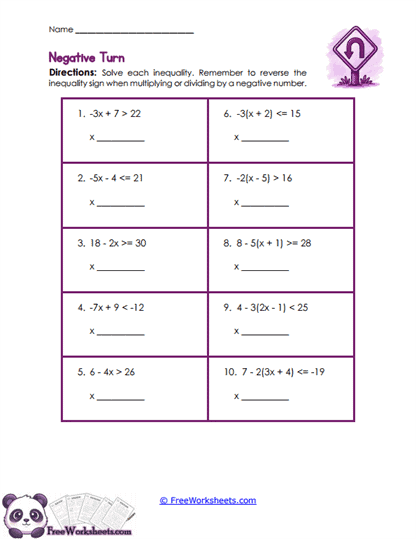
Negative Turns
What Kids Do:
Students solve ten inequalities built around negative coefficients, negative multipliers, and sign-reversal situations. They simplify expressions, distribute when needed, isolate the variable, and identify the exact step where dividing or multiplying by a negative number forces the inequality symbol to change direction.
Target Skill:
Students develop reliable control of one of the most error-prone inequality rules. The worksheet reinforces negative-number operations, symbol direction, multi-step solving, and the distinction between simply seeing a negative number and actually performing a sign-reversing operation.
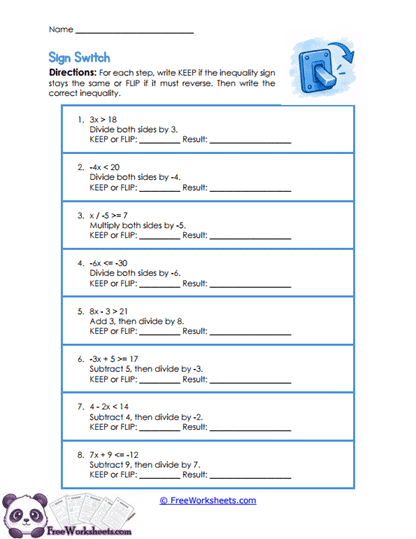
Sign Rules
What Kids Do:
Students examine eight inequality problems and label each key step as KEEP or FLIP before completing the solution. They decide whether the inequality symbol stays in the same direction or reverses based specifically on whether the solving step uses multiplication or division by a negative number.
Target Skill:
This activity isolates the sign-reversal rule so students can understand it conceptually before handling more complex problems. Students strengthen symbol awareness, inverse operations, and the 9th grade habit of connecting an inequality change to a specific algebraic operation.
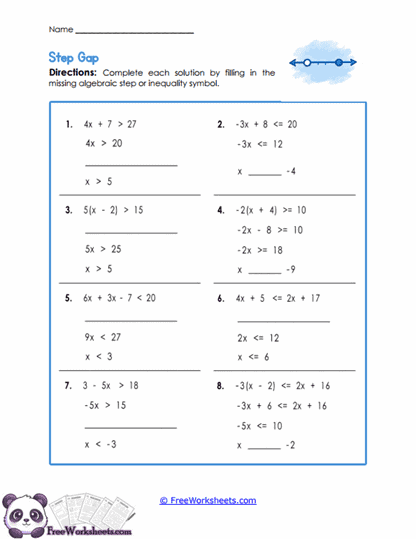
Step Gaps
What Kids Do:
Students study partially solved multi-step inequalities and fill in missing operations, values, or inequality symbols. They compare one line with the next, determine what transformation must have occurred, and pay special attention to whether a negative divisor should cause the missing symbol to reverse.
Target Skill:
Students strengthen understanding of the logic connecting each step in a solution. Rather than solving every problem from the beginning, they analyze equivalent transformations, inverse operations, and sign changes, building stronger 9th grade reasoning and self-checking skills.
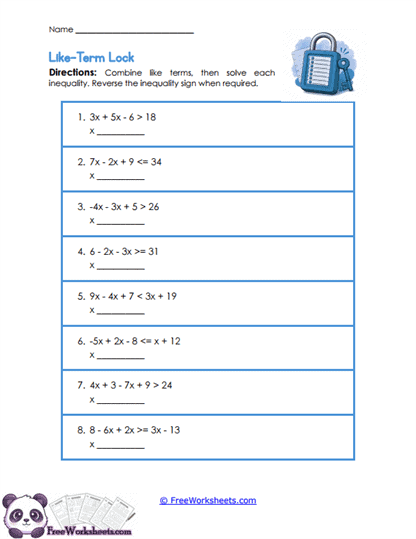
Term Combine
What Kids Do:
Students simplify eight inequalities by combining variable terms and constants before solving. Some problems include like terms on one side, while others require simplification on both sides before students collect the variable terms and finish isolating x.
Target Skill:
This worksheet reinforces the importance of simplifying algebraic structure before solving. Students practice identifying like terms, managing positive and negative coefficients, organizing expressions, and using clean simplification to make multi-step 9th grade inequalities easier to solve accurately.
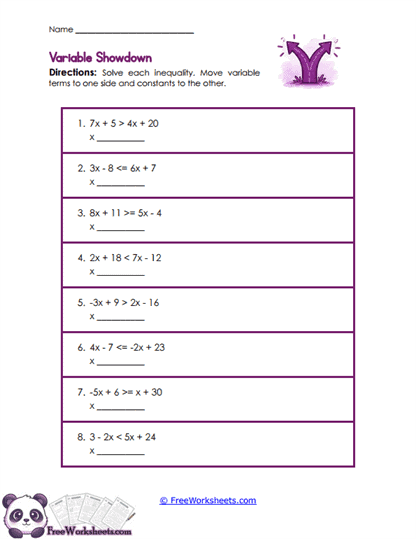
Variable Battle
What Kids Do:
Students solve eight inequalities containing variable terms on both sides of the symbol. They decide which x-terms to move, shift constants to the opposite side, simplify, and select a solving path that may help avoid unnecessary negative coefficients before the final division step.
Target Skill:
Students develop flexible algebraic strategy instead of following one fixed direction for every problem. The activity strengthens variable collection, equation balance, sign management, and 9th grade reasoning with inequalities that require coordinated changes on both sides.