
Solving Compound Inequalities Worksheets
Working with compound inequalities in 9th grade math teaches students how two conditions can combine to describe a precise range or set of values. These free, ready-to-print PDF worksheets offer immediate classroom practice through chained inequalities, split solutions, number-line graphs, real-world restrictions, and error analysis. By interpreting AND/OR relationships, solving multi-part inequalities, and representing solution sets visually, students develop the algebraic reasoning expected throughout the 9th grade curriculum.
About This Collection of Worksheets
Compound inequalities allow 9th grade students to describe situations where more than one condition must be considered at the same time. Students learn how AND statements create overlapping requirements, how OR statements allow separate possibilities, and how chained inequalities can describe values between two boundaries. These ideas help students make sense of ranges, restrictions, minimums, maximums, and other conditions that appear throughout Algebra 1.
The activities in this collection approach compound inequalities from several directions. Students classify AND and OR statements, solve three-part inequalities, work with negative coefficients, graph connected and split solution sets, match solved inequalities with answers, test individual values, translate verbal phrases into symbols, analyze incorrect work, classify solutions as all, none, or a specific range, and model real-world entry requirements. This mix helps students connect algebraic procedures with the logic and meaning behind each solution.
Teachers can use these worksheets at different points within a 9th grade inequalities unit, from introducing AND/OR logic to reviewing more complex symbolic and graphical representations. Individual pages work well for direct instruction, partner practice, independent work, homework, intervention, math stations, or short assessments. Parents, tutors, and homeschool educators can also use the collection to isolate one skill at a time before students combine solving, graphing, interpretation, and real-world modeling.

Paul’s Teacher Tip
Before students calculate anything, have them identify whether the compound statement uses AND or OR and explain what that means for the final solution. For chained inequalities, remind them that every operation must be applied to all three parts so the entire statement stays balanced. When dividing by a negative value, have students mark both inequality symbols before reversing them so one is not accidentally missed. Number-line sketches are especially useful when students are unsure whether two solution sets overlap, separate, include every number, or have no values in common. For additional challenge, give students a finished graph and ask them to write both a compound inequality and a real-world rule that could produce it.
Worksheet Collection Skill Spotlights
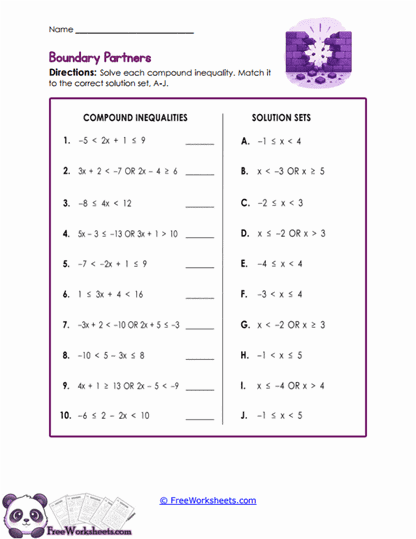
Boundary Pairs
What Kids Do:
Students solve ten compound inequalities and connect each result to a lettered solution set from an answer bank. They work with both chained AND inequalities and separate OR statements, carefully comparing boundary values, inequality directions, and whether endpoints are included before selecting each match.
Target Skill:
This activity strengthens students’ ability to recognize complete compound solution sets rather than focusing only on the numerical boundaries. Students practice solving, distinguishing AND from OR, checking inclusive versus strict endpoints, and identifying equivalent forms within 9th grade Algebra 1.
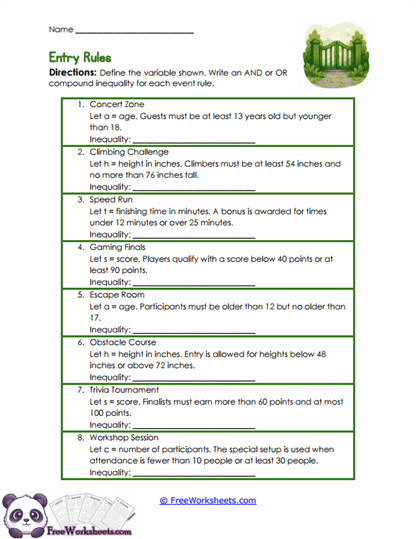
Entry Limits
What Kids Do:
Students translate eight real-world rules involving concert ages, climbing heights, race times, gaming scores, escape-room requirements, obstacle courses, tournaments, and attendance into compound inequalities. They determine whether both restrictions must apply together or whether either condition is enough.
Target Skill:
Students develop mathematical modeling skills by converting minimums, maximums, ranges, and separate qualifying conditions into symbolic statements. The activity reinforces phrases such as at least, at most, below, and more than while strengthening 9th grade AND/OR reasoning.
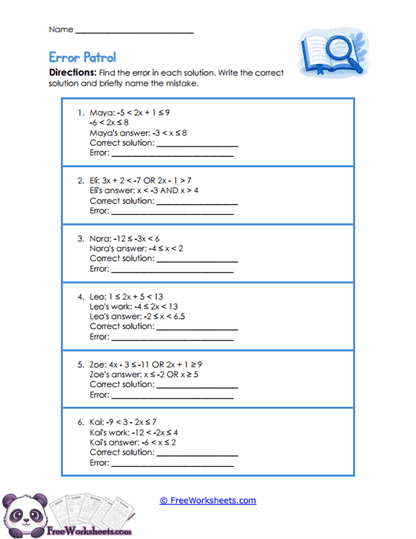
Error Review
What Kids Do:
Students examine six worked compound-inequality solutions containing mistakes involving sign direction, boundary values, incomplete solving, or incorrect use of AND and OR. They find the first faulty step, explain what went wrong, and rewrite the final solution correctly.
Target Skill:
Error analysis helps students understand compound inequality rules at a deeper level than routine solving alone. Students strengthen sign-reversal reasoning, connector choice, endpoint accuracy, and mathematical explanation while developing stronger habits for checking their own Algebra 1 work.
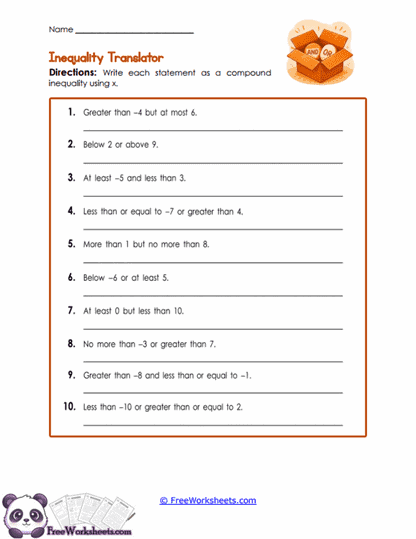
Inequality Words
What Kids Do:
Students read ten verbal descriptions such as “greater than -4 but at most 6” or “below 2 or above 9” and translate each one into symbolic notation. They choose the appropriate inequality signs and decide whether the two conditions should be connected with AND or OR.
Target Skill:
This worksheet strengthens the language-to-algebra connection that students need for word problems and modeling. Students learn how subtle wording changes affect boundary inclusion and solution structure, helping them represent 9th grade constraints accurately before solving or graphing them.
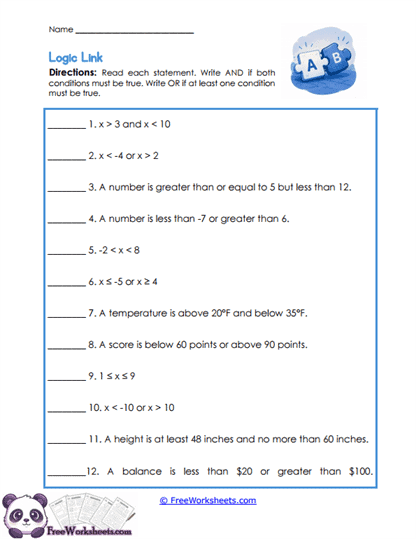
Logic Links
What Kids Do:
Students analyze twelve symbolic and real-world statements and determine whether each situation requires both conditions to be true or only one. They label each statement with AND or OR while considering examples involving ranges, temperatures, scores, heights, and balances.
Target Skill:
Students build the logical foundation needed for compound inequalities by distinguishing intersections from unions of solution sets. The activity helps them recognize that AND usually describes overlap while OR allows separate regions, making later solving and graphing work easier to interpret.
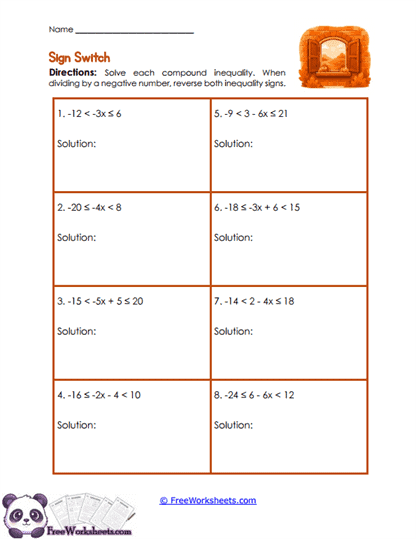
Sign Flip
What Kids Do:
Students solve eight three-part compound inequalities that include negative coefficients and divisors. They simplify all three sections, apply the same operation across the entire statement, and reverse both inequality symbols whenever multiplication or division by a negative number requires it.
Target Skill:
This focused practice strengthens one of the most error-prone parts of compound inequality solving. Students learn to preserve equivalence across three linked expressions while handling negative values and correctly reversing both symbols during 9th grade algebraic transformations.
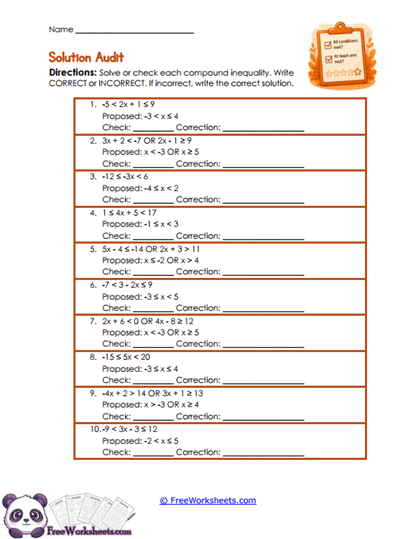
Solution Audit
What Kids Do:
Students review ten proposed answers to compound inequalities and decide whether each solution is correct or incorrect. They independently solve or verify the original statement, compare boundaries and symbols, check AND/OR structure, and write a corrected version whenever the proposed answer fails.
Target Skill:
Students strengthen mathematical verification by learning to judge a complete solution instead of accepting familiar-looking numbers. The activity reinforces sign direction, endpoint inclusion, connector logic, and solution-set structure while encouraging more careful self-checking in Algebra 1.
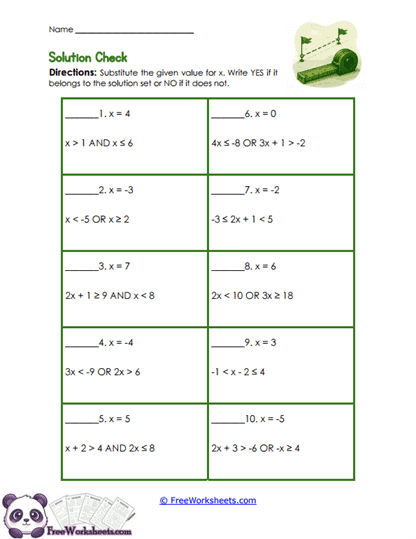
Solution Check
What Kids Do:
Students substitute given values into AND and OR compound inequalities and evaluate each condition separately. They then decide whether the value belongs to the full solution set, remembering that both conditions must work for AND while only one condition must work for OR.
Target Skill:
This activity makes the meaning of a solution set more concrete. Students practice substitution, inequality comparison, and logical reasoning while learning exactly what it means for a value to satisfy overlapping or alternative conditions in a 9th grade compound statement.
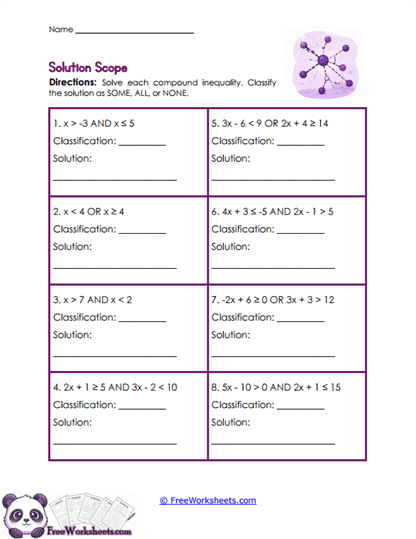
Solution Scope
What Kids Do:
Students solve compound inequalities and then classify each final result as a valid range, all real numbers, or no solution. They compare the conditions created by AND and OR statements to decide whether the solution sets overlap, separate, cover everything, or conflict completely.
Target Skill:
Students move beyond procedural solving and interpret the overall structure of compound solutions. This develops stronger reasoning about intersections, unions, impossible conditions, and universal solution sets while preparing them for more advanced constraints and systems of inequalities.
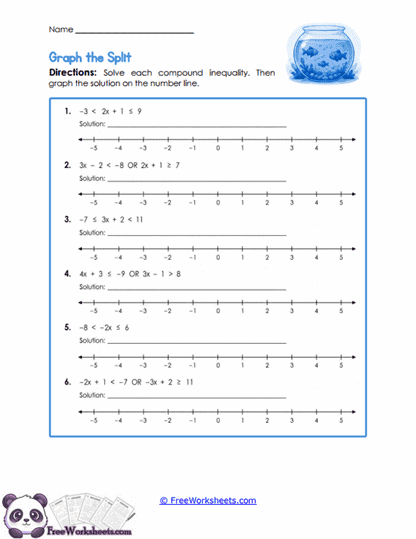
Split Graphs
What Kids Do:
Students solve six compound inequalities and represent each answer on a number line. The problems include connected AND intervals and split OR regions, requiring students to choose appropriate boundary points, open or closed circles, and shading between or away from the endpoints.
Target Skill:
Students connect symbolic compound inequalities with their visual meaning. The worksheet reinforces endpoint inclusion, number-line direction, AND versus OR structure, and the distinction between connected and separated solution sets, all important skills for 9th grade inequality graphing.
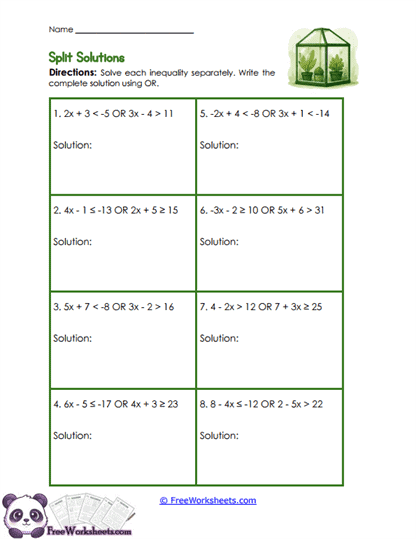
Split Solutions
What Kids Do:
Students solve compound inequalities joined by OR by treating each branch as a separate one-variable inequality. They isolate the variable in both parts, reverse symbols when negative multiplication or division requires it, and then combine the two finished solutions using OR notation.
Target Skill:
This activity develops fluency with split solution sets and teaches students to preserve the independent structure of OR statements. Students strengthen multi-step inequality solving, sign control, and the understanding that either branch may qualify a value for the final solution set.
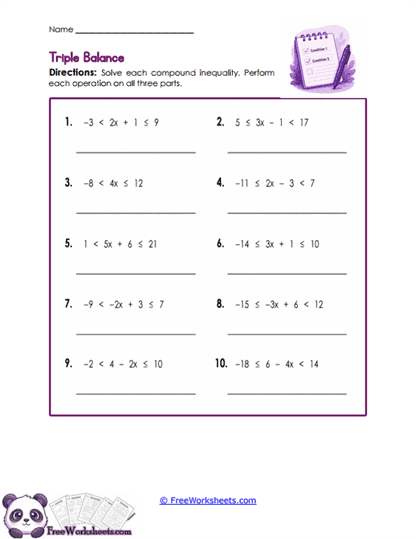
Triple Balance
What Kids Do:
Students solve three-part inequalities in which an algebraic expression sits between a lower and upper boundary. They perform the same inverse operation on the left, middle, and right portions, simplify step by step, and keep the variable inside one connected chained inequality.
Target Skill:
Students build accuracy with bounded compound inequalities by treating all three sections as one balanced statement. The activity reinforces inverse operations, connected AND reasoning, symbol direction, and the careful algebraic structure needed to solve 9th grade chained inequalities correctly.