
Linear Equations Worksheets
These worksheets help students strengthen equation-solving fluency, algebraic reasoning, and mathematical modeling skills. These free, ready-to-print worksheets come in PDF format for immediate classroom use during homework, intervention, review, or Algebra I instruction. Students develop curriculum aligned skills including solving multi-step equations, applying the distributive property, combining like terms, and interpreting linear relationships.
About This Collection of Worksheets
This collection of Linear Equations worksheets gives students meaningful practice solving equations, simplifying expressions, and modeling real-world situations with algebra. Learners work through one-step equations, multi-step equations, variables on both sides, distribution, combining like terms, and contextual problem-solving tasks while building confidence with algebraic structure and logical reasoning. The worksheets gradually increase in complexity so students strengthen both conceptual understanding and procedural fluency across multiple equation formats.
Teachers can use these printable worksheets during Algebra I lessons, guided practice, intervention groups, math stations, assessment preparation, or independent review. Puzzle-style decoding activities, equation classification tasks, and real-world budgeting problems help students stay engaged while reinforcing core algebra skills. Contextual activities involving subscriptions, memberships, purchases, and travel costs encourage learners to connect linear equations to practical decision-making situations outside the classroom.
These worksheets align closely with Common Core standards HSA-REI.B.3, HSA-SSE.A.1, and HSA-CED.A.1 while supporting foundational Algebra I equation-solving and modeling skills. Students practice solving one-step and multi-step equations, simplifying algebraic expressions, analyzing equation structure, and writing equations from real-world scenarios. The printable format makes this collection useful for classrooms, tutoring sessions, homeschool instruction, and additional algebra reinforcement at home.

Paul’s Teacher Tip
Many students can solve simple equations but struggle when multiple algebra skills appear together in the same problem. Encourage learners to slow down and simplify expressions completely before trying to isolate the variable. Organized work is especially important because skipped steps often lead to sign mistakes and incorrect simplification. Using balance-scale visuals can also help students understand why the same operation must happen on both sides of an equation. Real-world situations involving subscriptions, shopping, and service fees make equations feel more meaningful because students can see how algebra models practical decisions. Frequent mixed review with distribution, combining like terms, and multi-step solving helps learners recognize patterns and build long-term confidence with equation solving.
Worksheet Collection Skill Spotlights
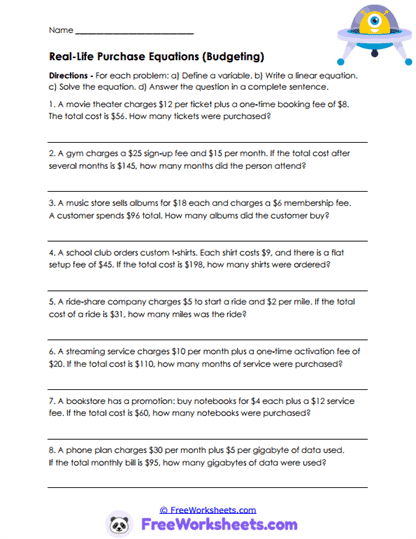
Budget Equations
- What Kids Do:
Students solve real-world budgeting and purchase problems by defining variables, writing equations, and calculating unknown costs or quantities. Learners analyze subscriptions, membership fees, and purchase totals while interpreting algebraic solutions within practical financial situations. - Target Skill:
This worksheet strengthens algebraic modeling, equation writing, and contextual reasoning aligned to Algebra I standards for linear equations and mathematical modeling. Students improve their ability to represent real-world relationships symbolically and interpret solutions meaningfully.
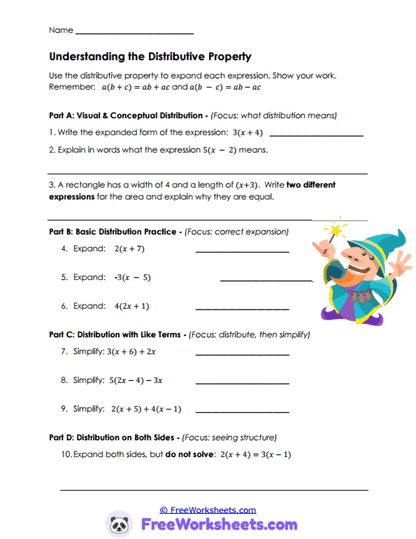
Distribution Basics
- What Kids Do:
Students apply the distributive property to expand and simplify algebraic expressions involving parentheses and variables. Learners rewrite equivalent expressions, combine like terms, and analyze how multiplication connects to algebraic structure. - Target Skill:
This activity reinforces distributive-property fluency, expression simplification, and algebraic structure understanding aligned to standards involving equivalent expressions. Students strengthen foundational algebra reasoning needed for solving equations and simplifying expressions accurately.
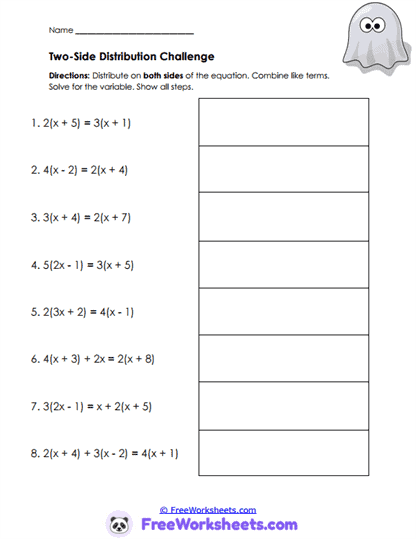
Distribution Challenge
- What Kids Do:
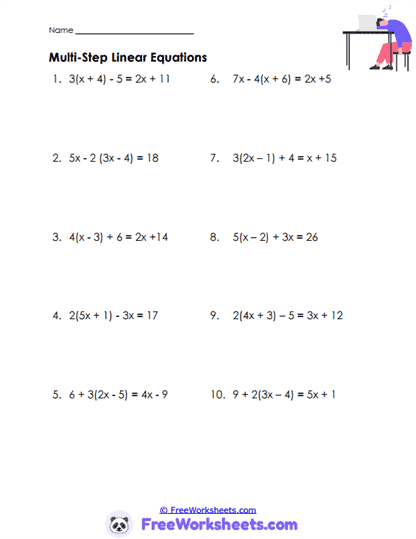
Students solve equations requiring distribution on one or both sides before simplifying and isolating variables. Learners combine like terms, organize multi-step calculations, and check solutions carefully after solving. - Target Skill:
This worksheet strengthens procedural fluency, equation-solving organization, and algebraic simplification aligned to Algebra I standards for multi-step equations. Students improve confidence handling variables on both sides and more complex equation structures.
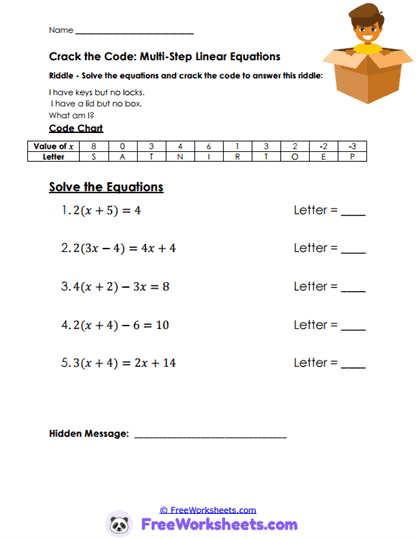
Equation Codes
- What Kids Do:
Students solve multi-step equations and use their answers to decode hidden messages or algebra puzzles. Learners distribute expressions, combine like terms, and apply inverse operations while organizing calculations carefully. - Target Skill:
This worksheet reinforces equation-solving accuracy, logical reasoning, and procedural fluency aligned to Algebra I standards. Students strengthen multi-step solving confidence through engaging puzzle-style algebra practice.
Equation Expansion
- What Kids Do:
Students solve multi-step linear equations involving distribution, combining like terms, and variables on both sides. Learners simplify equations carefully before isolating variables and checking their final solutions. - Target Skill:
This activity strengthens multi-step equation fluency, distribution accuracy, and algebraic organization aligned to Common Core equation-solving standards. Students improve procedural confidence and structured problem-solving skills.
Equation Foundations
- What Kids Do:
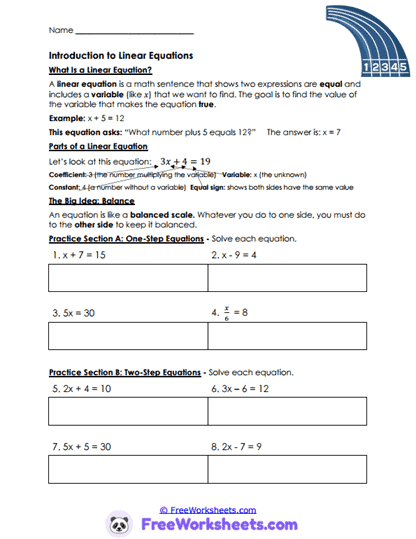
Students practice solving one-step and two-step equations while exploring variables, coefficients, constants, and equality. Learners apply inverse operations and maintain balance on both sides of equations through guided algebra practice. - Target Skill:
This worksheet develops foundational equation-solving understanding aligned to Algebra I standards. Students strengthen inverse-operation fluency, algebra vocabulary knowledge, and conceptual understanding of balanced equations.
Equation Matching
- What Kids Do:
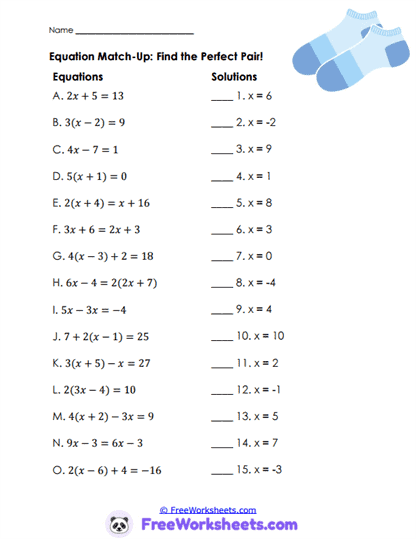
Students solve linear equations and match them to the correct solution values. Learners simplify expressions, apply equation-solving strategies, and verify solutions by substitution before completing matching activities. - Target Skill:
This worksheet strengthens equation-solving fluency, substitution checking, and algebraic reasoning aligned to standards involving linear equations. Students improve procedural accuracy and confidence through interactive matching practice.
Equation Review
- What Kids Do:
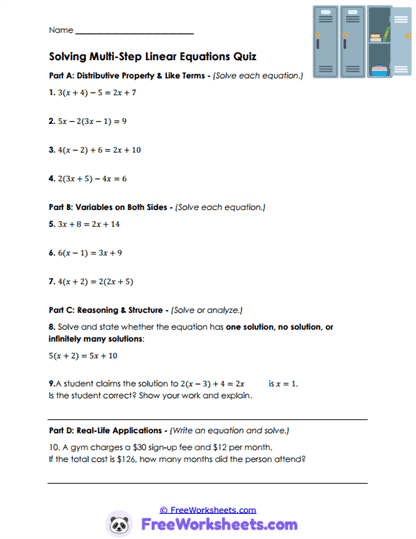
Students complete a mixed review involving equation solving, distribution, combining like terms, and classifying equation types. Learners solve contextual problems and analyze equations with one solution, no solution, or infinitely many solutions. - Target Skill:
This activity reinforces cumulative algebra fluency and problem-solving flexibility aligned to Algebra I standards for equations and expression analysis. Students strengthen long-term retention across multiple connected algebra concepts.
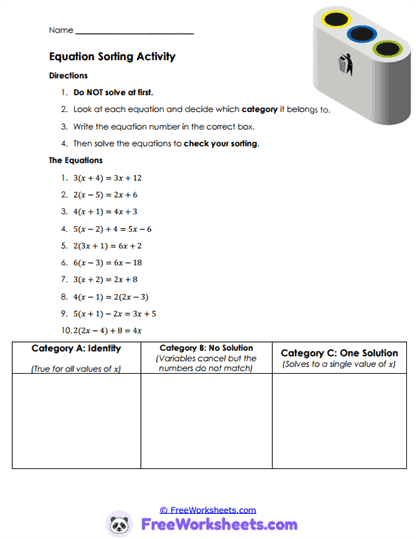
Equation Sorting
- What Kids Do:
Students classify equations as one-solution, no-solution, or infinitely-many-solutions equations after simplifying expressions and analyzing structure. Learners compare true statements, contradictions, and balanced relationships through equation analysis tasks. - Target Skill:
This worksheet strengthens structural reasoning and conceptual understanding of equation behavior aligned to Algebra I standards involving solution analysis. Students improve their ability to recognize and explain different equation outcomes logically.
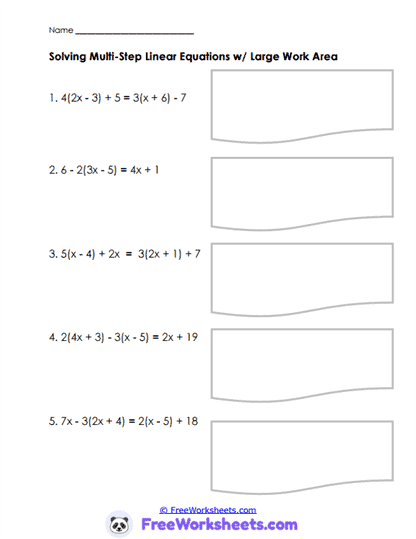
Equation Workspace
- What Kids Do:
Students solve multi-step equations while showing detailed step-by-step work in large organized workspaces. Learners simplify expressions, distribute carefully, and isolate variables using structured algebra layouts. - Target Skill:
This worksheet reinforces equation-solving organization, procedural fluency, and mathematical communication aligned to Common Core equation standards. Students strengthen accuracy and confidence through carefully structured multi-step solving practice.
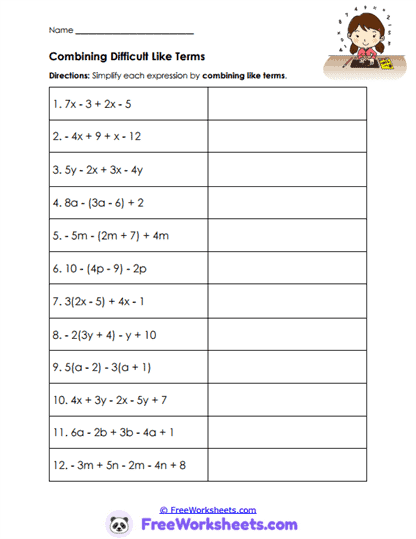
Like Terms
- What Kids Do:
Students simplify algebraic expressions by combining like terms after distributing and simplifying expressions. Learners identify matching variable terms, organize expressions carefully, and rewrite expressions in simplified form. - Target Skill:
This activity strengthens expression simplification, variable reasoning, and algebraic structure understanding aligned to standards involving equivalent expressions. Students improve procedural fluency and readiness for more advanced equation solving.
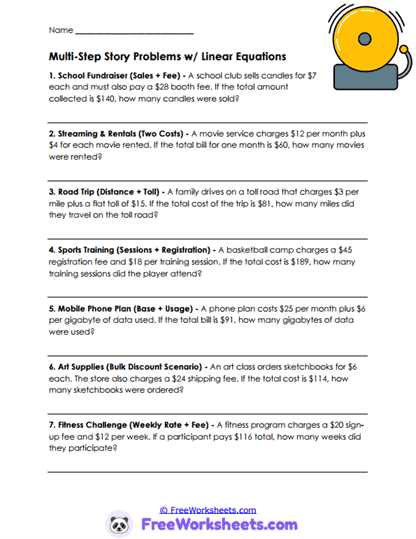
Story Equations
- What Kids Do:
Students write and solve multi-step equations from real-world word problems involving memberships, sales, subscriptions, and travel costs. Learners define variables, organize information, and interpret solutions within practical situations. - Target Skill:
This worksheet strengthens algebraic modeling, contextual reasoning, and multi-step equation fluency aligned to Algebra I standards for mathematical modeling. Students improve their ability to translate written situations into solvable equations.