
Solve Multi-Step Situations
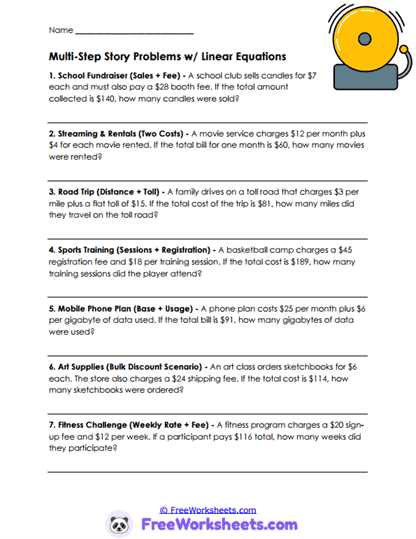
This worksheet teaches students how to use multi-step linear equations to solve real-world story problems involving costs, fees, and distance relationships. Learners define variables, create equations, and solve practical scenarios using algebraic reasoning. The activity strengthens understanding of how equations model real-life situations with fixed costs and changing rates. For example, students may determine how many candles were sold if a fundraiser included both item sales and a setup fee. The worksheet also reinforces interpreting algebra solutions within context.
Standards Connection
This worksheet supports Grade 9 algebra concepts involving linear modeling, multi-step equations, and problem solving. Students strengthen reasoning skills needed for financial literacy, algebraic modeling, and quantitative analysis. Learners should already understand equation-solving strategies and variable relationships before beginning this activity. The worksheet aligns with Common Core standard HSA-CED.A.1 through creating equations that represent relationships between quantities. It also supports Algebra I standards involving contextual equation solving and mathematical modeling.
Build And Solve Equations
On this worksheet, students will define variables, write multi-step equations, and solve real-world algebra situations. Learners analyze scenarios involving memberships, sales, travel costs, subscriptions, and usage fees. Some problems involve flat fees plus repeated costs, while others include rate-based relationships such as cost per mile or cost per item. Students also practice interpreting what each solution means in context. The activity strengthens both algebraic reasoning and practical problem-solving skills.
Frequent Errors
Many students struggle to identify which values represent fixed fees and which represent changing rates. Some learners write equations incorrectly because they misunderstand the role of the variable. Others solve equations correctly but fail to interpret answers using appropriate units or context. Students may also overlook important details in word problems before building equations. Teachers can support understanding by encouraging learners to underline key information and define variables clearly first.
Classroom Strategies
Teachers can use this worksheet during linear-modeling lessons, algebra application units, or collaborative problem-solving activities. Parents and homeschool educators may support students by discussing real-world examples involving memberships, subscriptions, and shopping costs. The worksheet also works well for partner learning where students explain how they translated words into equations. Students benefit from seeing how algebra helps solve everyday decision-making problems. Story-based equation practice strengthens both reading comprehension and algebra fluency.
Worksheet Features
The worksheet includes realistic story problems involving sales, memberships, subscriptions, and distance costs for meaningful algebra practice. Organized response spaces support equation writing, calculations, and written interpretations. Problems gradually vary in complexity to strengthen confidence and flexibility with modeling. Student-friendly directions support classroom instruction and independent completion. The printable design works well for Algebra I classrooms, tutoring sessions, and homeschool mathematics lessons.