
Solving Absolute Value Equations And Inequalities Worksheets
9th grade math solving absolute value equations and inequalities worksheets help students model distance, solve equations, and interpret bounded or unbounded solution sets. Free, ready-to-print worksheets in PDF format are designed for immediate classroom use, guided practice, homework, intervention, or homeschool lessons. Students strengthen equation solving, inequality reasoning, and graph interpretation while developing skills that support 9th grade curriculum expectations.
About This Collection of Worksheets
Absolute value equations and inequalities help 9th grade students connect algebra with the idea of distance. Students learn why an absolute value equation may split into two cases, why some equations have no solution, and how absolute value inequalities can describe values that fall inside or outside a pair of boundaries. These ideas give students a stronger foundation for working with Algebra 1 equations, compound inequalities, graphs, and real-world constraints.
This collection gives students varied practice with both equations and inequalities. Activities include splitting absolute value equations into positive and negative cases, isolating absolute value expressions, identifying two-solution and no-solution cases, checking answers by substitution, rewriting inequalities as AND or OR statements, solving and graphing absolute value inequalities, matching inequalities with number-line graphs, analyzing errors, selecting complete solution sets, and modeling tolerance ranges. Students work with symbolic, graphical, and real-world representations so the topic feels connected rather than procedural.
Teachers can use these worksheets throughout a 9th grade Algebra 1 unit for direct instruction, guided practice, independent work, homework, intervention, review, or formative assessment. Parents, tutors, and homeschool educators can also use individual pages to focus on one skill before combining equations, inequalities, and graphing. The collection gives students repeated opportunities to explain why a solution set makes sense and to connect algebraic rules with the distance meaning of absolute value.

Paul’s Teacher Tip
Keep bringing students back to the idea that absolute value represents distance, because that one idea explains many of the rules they are expected to remember. For equations, teach the routine isolate, split, solve, check, and require students to decide whether the isolated absolute value equals a positive or negative number before creating cases. For inequalities, use the language inside means AND and outside means OR so students can visualize where the solution belongs on a number line. When graphing, have students decide on the region first and endpoint type second so they do not confuse shading with open or closed circles. For extension, ask students to write a real-world situation that could be modeled by one of the completed absolute value inequalities.
Worksheet Collection Skill Spotlights
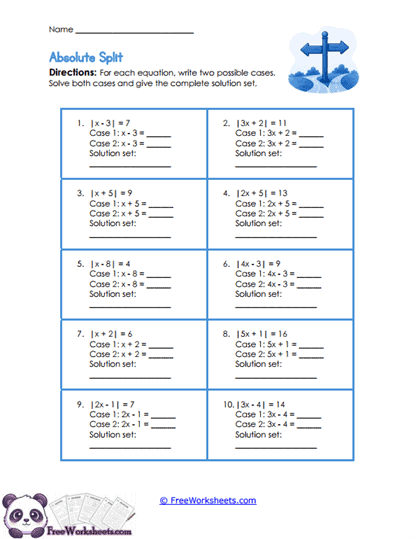
Absolute Split
What Kids Do:
Students solve ten absolute value equations in which the absolute value expression is already isolated. They rewrite each equation as one positive case and one negative case, solve both ordinary equations separately, and combine the resulting values into a complete solution set.
Target Skill:
Students strengthen the core idea that absolute value describes distance and that the same positive distance can occur in two directions. The activity reinforces two-case reasoning, inverse operations, and complete solution sets while building a strong 9th grade foundation for more advanced absolute value equations.
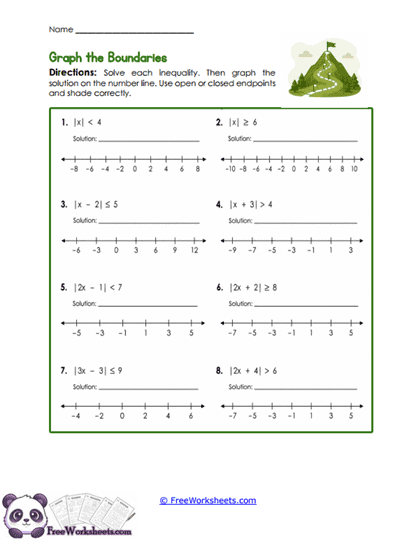
Boundary Graphs
What Kids Do:
Students solve eight absolute value inequalities and then graph each solution on a number line. They determine whether the answer lies between two boundaries or outside them, choose open or closed endpoints, and shade the correct region based on the final compound inequality.
Target Skill:
This activity connects symbolic absolute value inequalities with visual solution sets. Students practice inside-versus-outside reasoning, endpoint inclusion, compound inequalities, and number-line graphing while strengthening 9th grade understanding of how distance restrictions create bounded or unbounded regions.
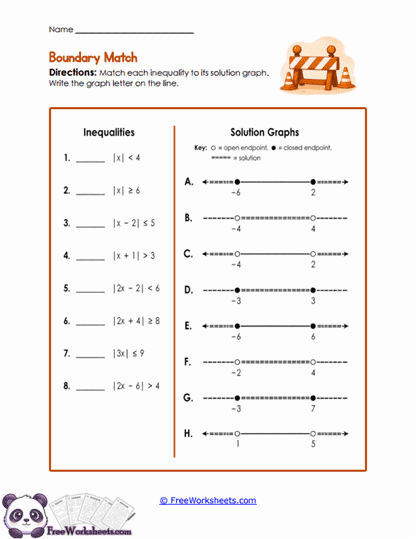
Boundary Match
What Kids Do:
Students work with eight absolute value inequalities and match each one to the number-line graph that shows the correct boundaries, endpoint types, and shaded region. They interpret the absolute value statement, decide whether the solution is inside or outside, and compare it with the available graph choices.
Target Skill:
Students strengthen their ability to move among absolute value notation, compound inequalities, and graphical representations. The activity reinforces boundary distance, AND versus OR reasoning, strict and inclusive inequalities, and the 9th grade skill of recognizing equivalent mathematical forms.
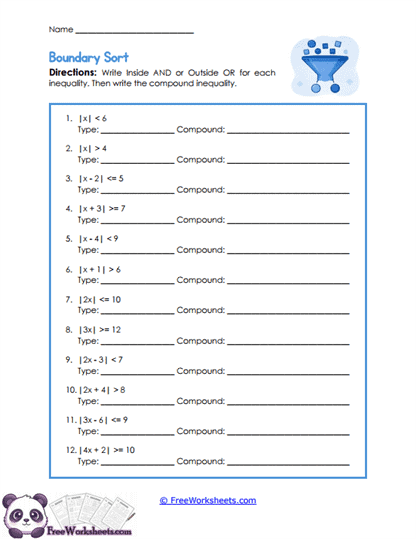
Boundary Sort
What Kids Do:
Students examine twelve absolute value inequalities and decide whether each one represents an inside boundary or an outside boundary. They then rewrite each problem as a compound inequality using AND or OR while preserving whether the boundary values are included.
Target Skill:
This worksheet develops the key pattern behind absolute value inequalities: less-than relationships usually describe values between boundaries, while greater-than relationships describe values outside them. Students strengthen compound inequality reasoning and connect symbolic rules with the distance meaning of absolute value.
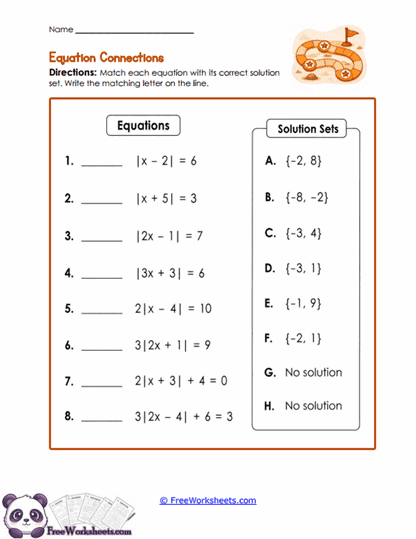
Equation Match
What Kids Do:
Students solve or reason through eight absolute value equations and match each one to a solution set from an answer bank. They isolate the absolute value when needed, determine whether the equation produces two solutions or no solution, and compare the complete result with the available choices.
Target Skill:
Students reinforce the full absolute value equation process while distinguishing valid two-solution cases from impossible equations. The activity strengthens isolation, case splitting, sign accuracy, and solution-set interpretation, helping 9th grade students avoid incomplete or unsupported answers.
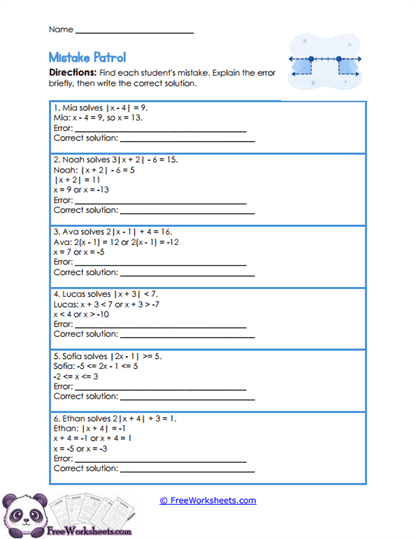
Error Patrol
What Kids Do:
Students analyze six incorrect solutions involving absolute value equations and inequalities. They identify the first faulty step, explain whether the mistake involves a missing case, sign error, incorrect compound inequality, or misunderstanding of absolute value, and then rewrite the solution correctly.
Target Skill:
Error analysis builds deeper conceptual understanding by requiring students to explain why a rule was used incorrectly. Students strengthen two-case reasoning, AND and OR logic, sign interpretation, and self-checking while developing clearer mathematical communication in 9th grade Algebra 1.
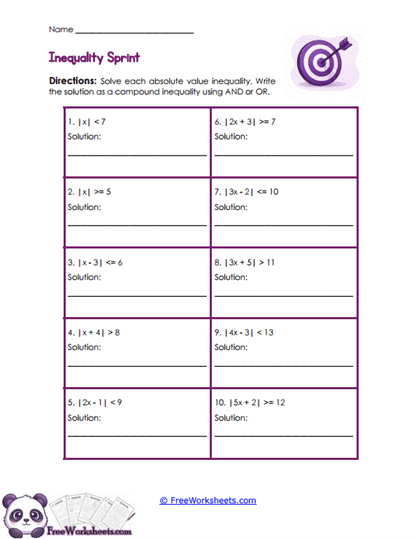
Inequality Bounds
What Kids Do:
Students solve ten absolute value inequalities involving expressions such as |x|, |x – 3|, |x + 4|, and expressions with coefficients. They determine whether the answer belongs inside two boundaries or outside them and write the final solution as a compound AND or OR inequality.
Target Skill:
Students build fluency with the complete absolute value inequality process. The worksheet reinforces distance interpretation, algebraic simplification, compound inequalities, and correct boundary direction while preparing students to graph solution sets and apply them to real-world tolerance problems.
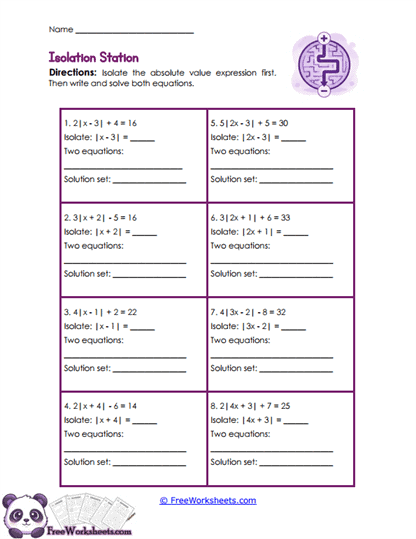
Isolate First
What Kids Do:
Students solve eight multi-step absolute value equations containing coefficients or constants outside the absolute value bars. They use inverse operations to isolate the absolute value expression first, then create positive and negative cases, solve both equations, and record the complete solution set.
Target Skill:
This activity develops an organized approach to more complex absolute value equations. Students strengthen multi-step equation solving and learn that the absolute value expression must stand alone before the two-case rule can be applied, reinforcing careful 9th grade algebraic sequencing.
Solution Cases
What Kids Do:
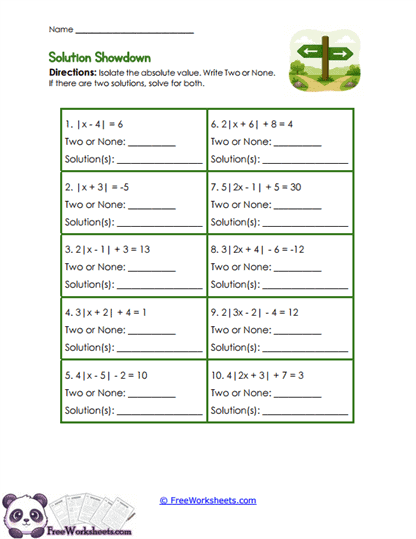
Students isolate the absolute value expression in ten equations and inspect the number on the other side before deciding what to do next. Positive values lead to two cases that must be solved, while negative values are identified as impossible and recorded as no solution.
Target Skill:
Students deepen their understanding that absolute value is always nonnegative. The activity helps them distinguish two-solution equations from no-solution equations and prevents automatic case splitting, strengthening conceptual reasoning and solution checking in 9th grade Algebra 1.
Solution Proof
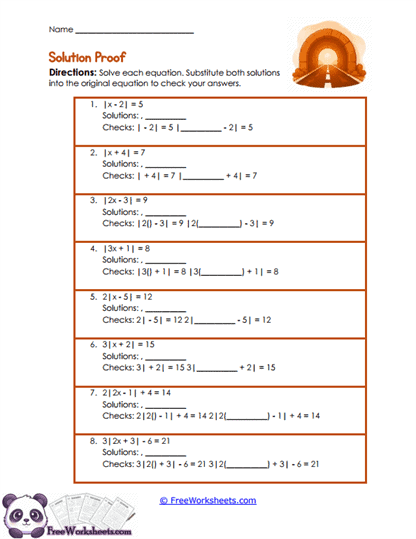
What Kids Do:
Students solve eight absolute value equations and then substitute every solution back into the original equation. They simplify inside the absolute value bars, evaluate each absolute value, and confirm that both proposed answers really make the original statement true.
Target Skill:
Students strengthen the habit of verifying solutions instead of stopping once values are found. The worksheet reinforces two-case solving, substitution, sign accuracy, and logical justification, giving 9th grade students a reliable method for checking absolute value equations.
Solution Sets
What Kids Do:
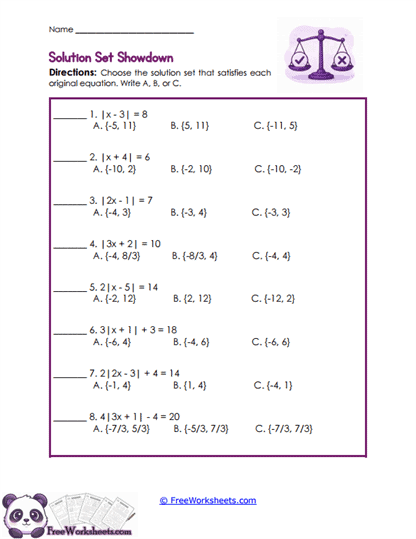
Students solve eight absolute value equations and choose the complete solution set from three answer choices. They create and solve both cases, compare the two resulting values with similar-looking options, and select the choice that includes every valid answer.
Target Skill:
This worksheet reinforces complete solution-set reasoning and helps students avoid leaving out one branch of an absolute value equation. Students strengthen equation solving, sign management, answer comparison, and 9th grade assessment readiness while still relying on full mathematical work rather than guessing.
Tolerance Ranges
What Kids Do:
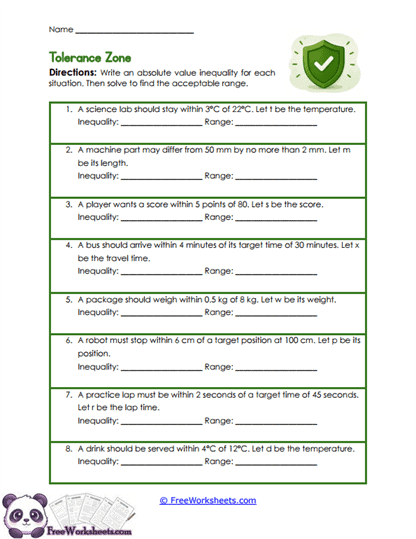
Students model eight real-world situations involving temperature, machine measurements, scores, arrival times, package weights, robot positions, lap times, and drink temperatures. They identify a target value and allowed variation, write an absolute value inequality, and solve for the acceptable range.
Target Skill:
Students apply absolute value to practical tolerance and constraint problems. The activity strengthens mathematical modeling, compound inequalities, inclusive boundaries, and interpretation of minimum and maximum acceptable values while showing 9th grade students why absolute value is useful outside the classroom.