
About This Worksheet
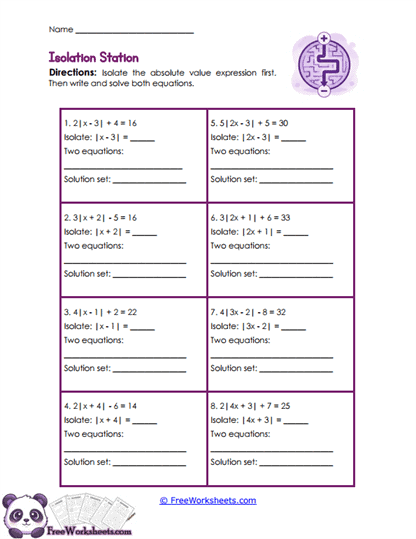
This worksheet helps ninth-grade students solve multi-step absolute value equations by isolating the absolute value expression before creating two cases. Each of the eight problems includes multiplication or an added constant outside the absolute value bars. Students must first undo those outside operations until the absolute value stands alone. Only then do they write the two equations and solve for the variable.
For example, an equation such as 2|x – 3| + 4 = 16 cannot be split immediately. Students first subtract 4 and divide by 2 to get |x – 3| = 6, and then they create x – 3 = 6 and x – 3 = -6. This teaches students that the order of the solving process matters.
What Students Practice
Students practice isolating an absolute value expression using inverse operations. Once it stands alone, they rewrite the equation as one positive case and one negative case before solving both. This combines familiar multi-step equation skills with the special structure of absolute value.
The worksheet also encourages students to organize their work into clear stages. There is space to record the isolated equation, the two resulting equations, and the final solution set. This layout helps students see that absolute value solving follows a logical sequence rather than one long calculation.
Why This Skill Matters
More advanced absolute value equations are rarely presented with the absolute value already isolated. Students need to know that they must remove coefficients and outside constants before applying the two-case rule. If they split the equation too soon, they can create incorrect equations and answers.
This process also strengthens general algebra habits. Students learn to simplify and isolate an important expression before applying a special rule. That same kind of careful order appears throughout Algebra 1 and later mathematics.
Common Challenges
Students may try to create two equations before isolating the absolute value expression. For an equation such as 3|x + 2| – 5 = 16, the entire left side should not immediately be set equal to both 16 and -16. Remind students to get the absolute value bars alone first.
Another common mistake is stopping after the isolation step. Once students reach something like |x + 2| = 7, they still need to create and solve both cases. Teachers can reinforce a simple routine: isolate, split, solve, check.
How To Use It
Teachers can use this worksheet after students have mastered basic absolute value equations where the bars are already isolated. It works well for guided instruction, independent practice, homework, or small-group review. Modeling one problem from beginning to end can help students see the difference between ordinary equation steps and the point where the equation splits.
Parents and homeschool teachers can help by asking, “Are the absolute value bars by themselves yet?” If the answer is no, students should keep using inverse operations. Once the bars are isolated, remind them that there are now two possible cases to solve.
Grade Alignment
This Grade 9 worksheet supports CCSS HSA-REI.A.1 by asking students to use a logical sequence of equivalent steps while solving equations. It also reinforces HSA-REI.B.3, which covers solving linear equations and inequalities in one variable. The absolute value structure gives students a meaningful application of those equation-solving skills.
Students should already know how to solve multi-step linear equations and basic absolute value equations. After completing this page, they are ready to handle equations with more complicated expressions and to check for unusual cases such as no solution.