
Solving Inequalities Worksheets
These worksheets help students strengthen algebraic reasoning, graph interpretation, and inequality-solving fluency. These free, ready-to-print worksheets come in PDF format for immediate classroom use during homework, intervention, review, or Algebra I instruction. Students develop curriculum aligned skills including solving inequalities, graphing solution sets, modeling real-world constraints, and interpreting inequality relationships.
About This Collection of Worksheets
This collection of Solving Inequalities worksheets gives students meaningful practice solving, graphing, interpreting, and modeling inequalities in one variable. Learners work through one-step inequalities, multi-step inequalities, graphing on number lines, variables-on-both-sides inequalities, and contextual algebra problems involving limits and constraints. The worksheets gradually increase in complexity so students strengthen both conceptual understanding and procedural fluency while learning how inequalities represent ranges of possible values instead of one exact solution.
Teachers can use these printable worksheets during Algebra I lessons, guided practice, intervention groups, collaborative review activities, or assessment preparation. Puzzle-style decoding activities, graphing tasks, matching exercises, and real-world budgeting situations help students stay engaged while reinforcing inequality-solving strategies. Practical examples involving spending limits, subscriptions, fundraising goals, travel distances, and score requirements help learners understand how inequalities connect to everyday decision-making and planning.
These worksheets align closely with Common Core standards HSA-REI.B.3 and HSA-CED.A.1 while supporting foundational Algebra I reasoning and graphing skills. Students practice solving and graphing inequalities, interpreting solution sets, writing inequalities from word problems, analyzing all-real-number and no-solution situations, and modeling constraints algebraically. The printable format makes this collection useful for classrooms, tutoring sessions, homeschool instruction, and additional algebra reinforcement at home.
Paul’s Teacher Tip
Students often solve inequalities correctly but lose points because they forget that inequalities behave differently from equations in a few important ways. One of the biggest trouble spots is remembering to reverse the inequality symbol when multiplying or dividing by a negative number. Encourage learners to say this rule aloud every time they encounter negatives during solving. Visual number-line models are also extremely helpful because students can immediately see whether a solution range extends left or right and whether endpoints should be open or closed. Real-world examples involving budgets, spending caps, and minimum requirements make inequalities feel more practical and meaningful. Frequent mixed practice with graphing, solving, and writing inequalities helps students connect symbolic notation to visual and contextual understanding.
Worksheet Collection Skill Spotlights
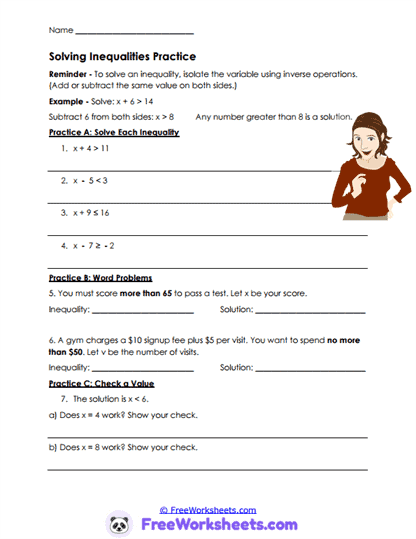
Boundary Practice
- What Kids Do:
Students solve one-step inequalities using inverse operations while interpreting the meaning of solution ranges. Learners isolate variables carefully, solve practical inequality problems, and determine whether values satisfy given conditions. - Target Skill:
This worksheet strengthens one-step inequality fluency, inverse-operation reasoning, and algebraic interpretation aligned to Algebra I standards for solving inequalities in one variable.
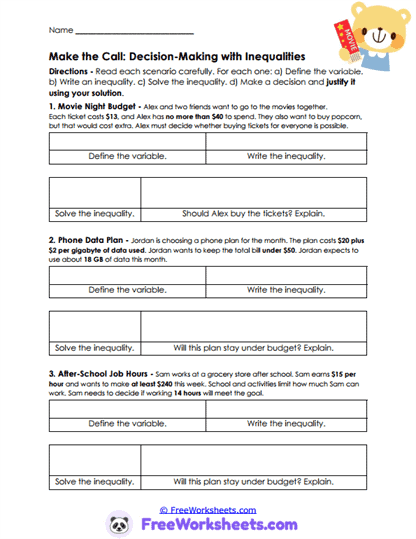
Budget Calls
- What Kids Do:
Students model budgeting and planning situations using inequalities involving spending limits, subscriptions, and earnings. Learners define variables, write inequalities, solve them, and explain solutions within practical decision-making scenarios. - Target Skill:
This activity reinforces algebraic modeling, financial reasoning, and contextual problem solving aligned to standards involving inequalities and real-world mathematical constraints.
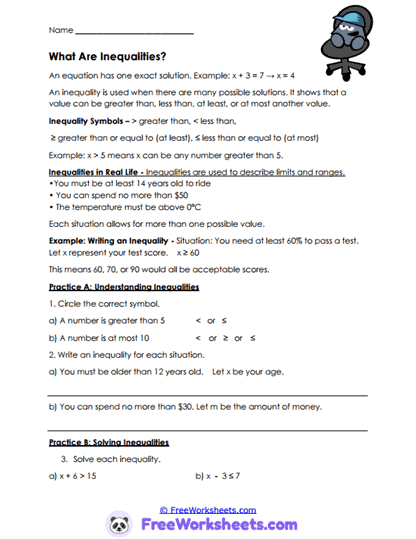
Inequality Basics
- What Kids Do:
Students identify inequality symbols and translate written phrases into algebraic inequalities. Learners interpret phrases such as “at least,” “greater than,” and “no more than” while solving introductory inequality problems. - Target Skill:
This worksheet develops foundational inequality understanding, symbolic reasoning, and algebra vocabulary fluency aligned to Algebra I standards involving interpreting and writing inequalities.
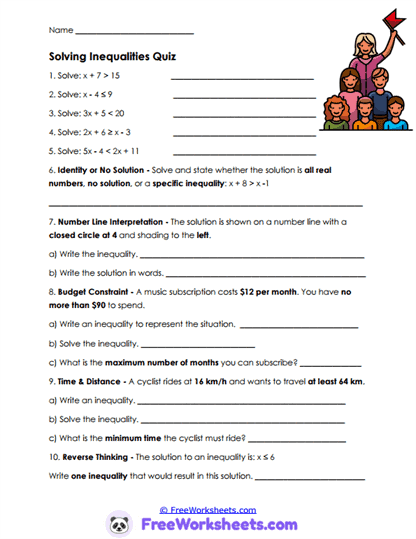
Limit Review
- What Kids Do:
Students complete a mixed review involving solving, graphing, interpreting, and writing inequalities from real-world situations. Learners practice graph interpretation, symbolic notation, and contextual inequality reasoning across multiple activities. - Target Skill:
This worksheet strengthens cumulative inequality fluency and graphing interpretation aligned to Common Core standards for solving and representing inequalities in one variable.
Line Decisions
- What Kids Do:
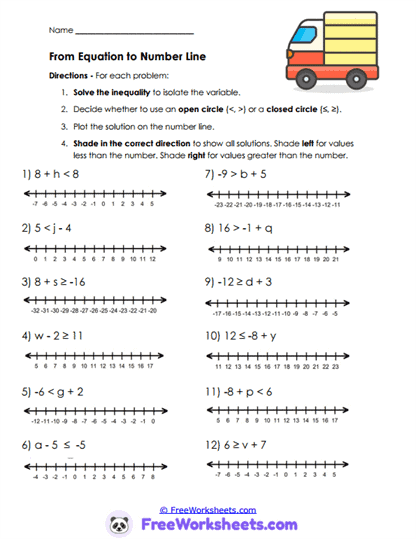
Students solve inequalities and graph their solutions on number lines using open circles, closed circles, and directional shading. Learners connect symbolic solutions to graphical representations carefully. - Target Skill:
This activity reinforces inequality-solving fluency, graph interpretation, and visual algebra reasoning aligned to standards involving graphical solution sets and number-line models.
Number Paths
- What Kids Do:
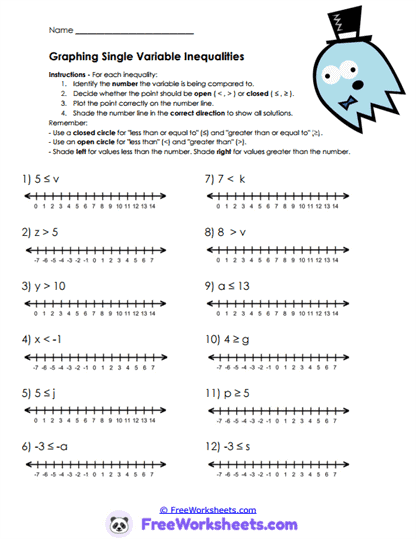
Students graph inequalities on number lines by selecting correct endpoints and shading directions. Learners determine whether inequalities require open or closed circles while interpreting greater-than and less-than relationships visually. - Target Skill:
This worksheet strengthens graphing accuracy, symbolic interpretation, and visual understanding of inequality solution ranges aligned to Algebra I graphing standards.
Puzzle Bounds
- What Kids Do:
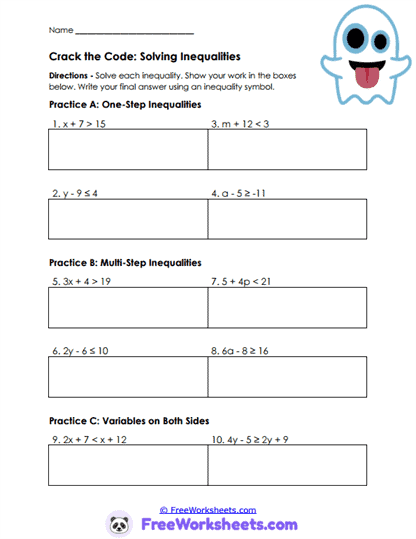
Students solve one-step and multi-step inequalities through puzzle and code-breaking activities. Learners organize algebra steps carefully while balancing variables, simplifying expressions, and interpreting inequality symbols correctly. - Target Skill:
This worksheet develops procedural fluency, multi-step inequality-solving skills, and algebraic persistence aligned to Common Core inequality standards.
Real Limits
- What Kids Do:
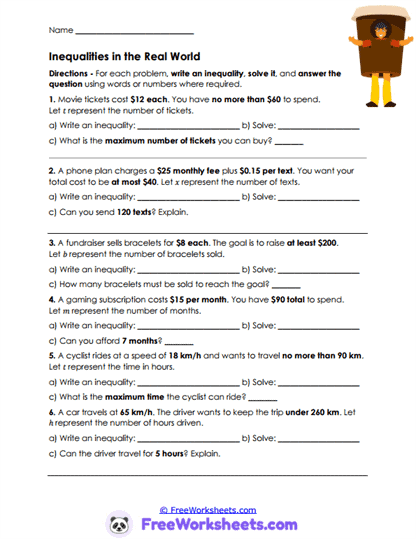
Students write and solve inequalities from real-world situations involving budgets, subscriptions, fundraising goals, and travel constraints. Learners interpret what inequality solutions mean within practical contexts. - Target Skill:
This activity strengthens algebraic modeling, contextual reasoning, and inequality interpretation aligned to standards involving real-world mathematical constraints and problem solving.
Reverse Thinking
- What Kids Do:
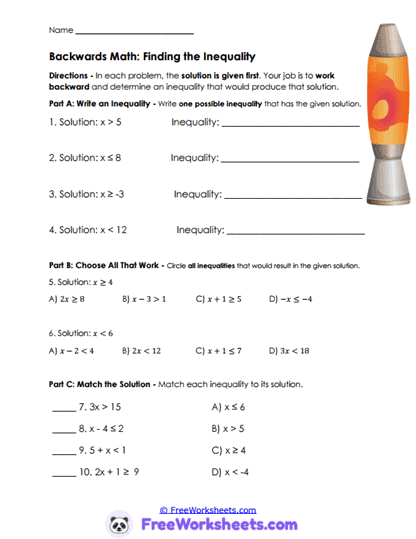
Students analyze solution ranges and create inequalities that would produce those solutions. Learners work backward from graphs and solution sets to build matching algebraic inequalities. - Target Skill:
This worksheet reinforces structural reasoning, symbolic flexibility, and conceptual understanding of inequality relationships aligned to Algebra I algebra-analysis standards.
Side Balance
- What Kids Do:
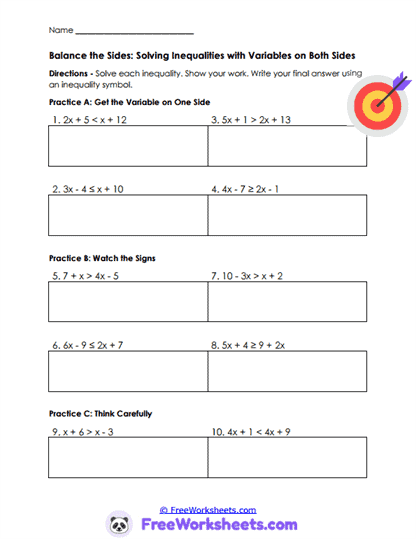
Students solve inequalities with variables on both sides by simplifying expressions, combining like terms, and balancing inequalities carefully. Learners organize multi-step solving processes and interpret solution ranges correctly. - Target Skill:
This worksheet strengthens balancing strategies, procedural fluency, and multi-step inequality-solving skills aligned to Common Core standards for algebraic reasoning.
Smart Choices
- What Kids Do:
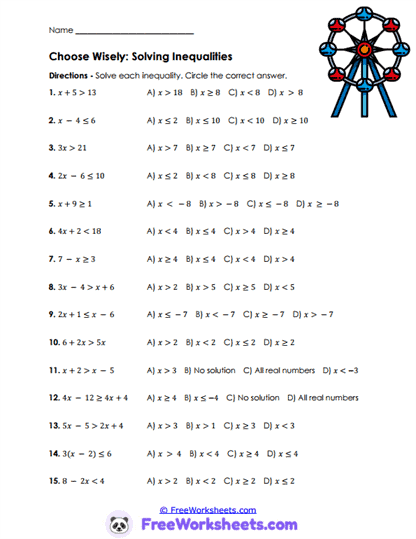
Students solve inequalities and select the correct solution from multiple-choice answer options. Learners compare similar inequality answers carefully and identify correct symbolic notation after solving. - Target Skill:
This activity strengthens inequality-solving accuracy, attention to detail, and symbolic interpretation aligned to Algebra I procedural fluency standards.
Solution Match
- What Kids Do:
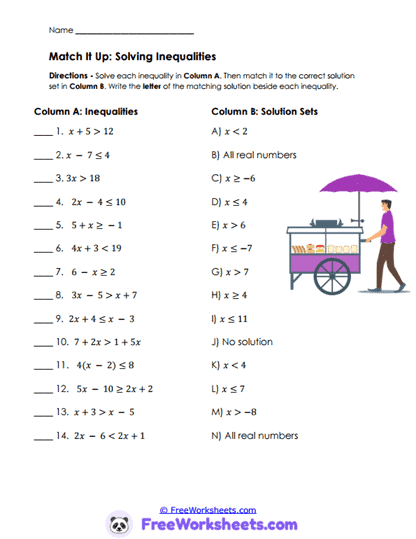
Students solve inequalities and match them to the correct solution sets, including special cases involving all real numbers or no solution. Learners simplify expressions and analyze algebraic structures carefully. - Target Skill:
This worksheet develops structural reasoning, inequality classification fluency, and algebraic interpretation aligned to standards involving analyzing and interpreting solution sets.