
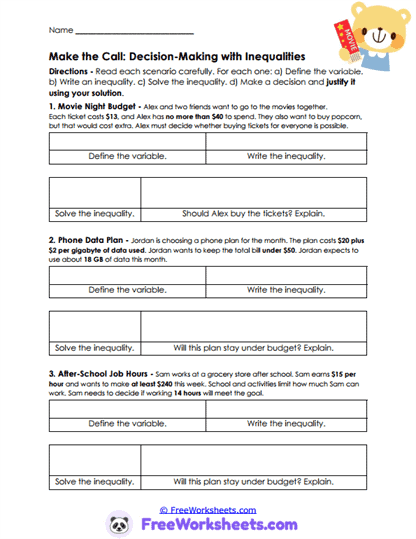
Make Smart Choices With Inequalities
This worksheet teaches students how inequalities can help make decisions involving budgets, spending limits, and planning situations. Learners define variables, write inequalities, solve them, and explain whether certain choices stay within given limits. The activity strengthens algebra modeling and shows how inequalities support real-world decision-making. For example, students may determine whether a concert ticket plan stays under a spending budget. The worksheet also reinforces interpreting algebra solutions in practical situations.
Standards Connection
This worksheet supports Grade 9 algebra concepts involving writing and solving inequalities from real-world scenarios. Students strengthen mathematical reasoning and modeling skills needed for financial literacy and everyday problem solving. Learners should already understand one-step and multi-step inequalities before beginning this activity. The worksheet aligns with Common Core standard HSA-CED.A.1 through representing constraints using inequalities. It also supports Algebra I standards involving contextual algebra modeling and interpretation.
Define And Decide
On this worksheet, students will read real-world situations, define variables, and create inequalities that model spending limits or planning goals. Learners solve the inequalities and determine whether specific decisions meet the required conditions. Some problems involve ticket costs and food purchases while others include phone data plans or after-school job earnings. Students also explain their reasoning in complete sentences. The activity strengthens algebra communication and practical problem-solving skills.
Frequent Errors
Many students confuse fixed costs with changing costs when building inequalities. Some learners write the inequality symbol backward after reading phrases such as “under budget” or “at most.” Others solve correctly but forget to explain what the answer means in the situation. Students may also overlook units such as dollars, gigabytes, or hours worked. Teachers can support understanding by encouraging students to underline important keywords before writing inequalities.
Classroom Strategies
Teachers can use this worksheet during financial literacy lessons, algebra modeling units, or collaborative problem-solving activities. Parents and homeschool educators may support students by discussing real-world budgeting examples before beginning the worksheet. The activity also works well for group learning where students compare solutions and justify their choices aloud. Students benefit from decision-making algebra tasks because they connect mathematics to everyday life. Practical modeling activities strengthen both engagement and conceptual understanding.
Worksheet Features
The worksheet includes budgeting, planning, and real-life decision scenarios for meaningful inequality practice. Organized response areas support variable definitions, calculations, and written explanations. Problems vary in context to strengthen flexibility with algebra modeling. Student-friendly directions support classroom instruction and independent completion. The printable design works well for Algebra I classrooms, tutoring sessions, and homeschool mathematics lessons.