
Solving Equations with Variables on Both Sides Worksheets
These worksheets help students strengthen equation-solving fluency, balancing strategies, and algebraic reasoning skills. These free, ready-to-print worksheets come in PDF format for immediate classroom use during homework, review, intervention, or Algebra I instruction. Students develop curriculum aligned skills including balancing equations, simplifying expressions, classifying solution types, and modeling real-world algebra situations.
About This Collection of Worksheets
This collection of Solving Equations with Variables on Both Sides worksheets gives students meaningful practice solving increasingly complex linear equations while strengthening procedural fluency and conceptual understanding. Learners simplify expressions, combine like terms, distribute carefully, and balance variables across both sides of equations using organized algebra strategies. The worksheets also help students recognize identities, contradictions, and equations with one solution while building confidence solving multi-step algebra problems.
Teachers can use these printable worksheets during Algebra I instruction, intervention support, collaborative review sessions, math stations, or assessment preparation. Puzzle activities, matching tasks, real-world applications, and error-analysis exercises help students stay engaged while reinforcing algebra structure and balancing strategies. Practical examples involving sports costs, subscriptions, fundraising, and financial comparisons help learners understand how algebra models real-world equality relationships.
These worksheets align closely with Common Core standards HSA-REI.B.3, HSA-REI.A.1, and HSA-CED.A.1 while supporting foundational Algebra I equation-solving and modeling skills. Students practice balancing equations, solving variables-on-both-sides equations, simplifying expressions involving fractions and decimals, identifying solution types, and writing equations from contextual situations. The printable format makes this collection useful for classrooms, tutoring sessions, homeschool instruction, and additional algebra reinforcement at home.
Paul’s Teacher Tip
Students are often successful with one-step equations but become overwhelmed when variables appear on both sides of the equal sign. Encourage learners to simplify each side completely before trying to move variables or constants. Visual balance models and “equation tug-of-war” language can help students remember that every algebra move must keep the equation balanced. Sign mistakes are also very common, especially when subtracting variables or distributing negatives, so organized step-by-step work is essential. Real-world comparison problems involving memberships, pricing plans, and subscriptions make these equations feel more meaningful because students can see how algebra helps compare equal relationships. Frequent mixed review with fractions, decimals, identities, and contradictions helps students develop stronger flexibility and long-term confidence with equation solving.
Worksheet Collection Skill Spotlights
Algebra Challenge
- What Kids Do:
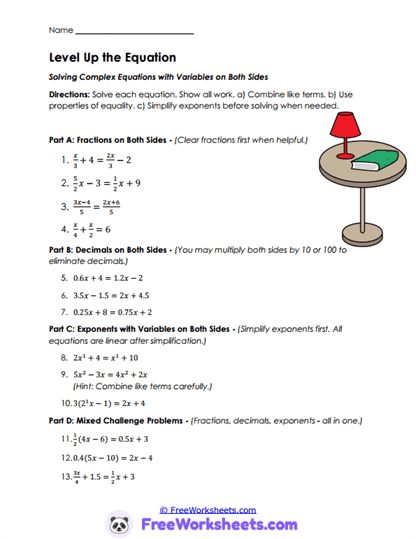
Students solve advanced multi-step equations involving variables on both sides, fractions, distribution, and simplifying expressions. Learners organize calculations carefully, apply multiple algebra strategies together, and identify efficient solving methods for complex problems. - Target Skill:
This worksheet strengthens advanced equation-solving fluency, procedural organization, and algebraic reasoning aligned to Algebra I standards for multi-step equations and structural analysis. Students improve flexibility handling fractions, balancing variables, and complex simplification.
Algebra Detectives
- What Kids Do:
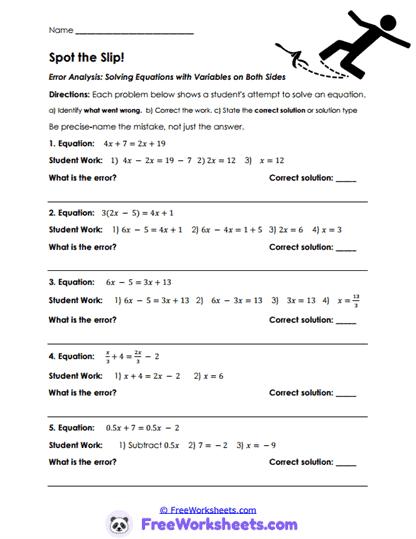
Students analyze incorrect algebra work, identify solving mistakes, and rewrite the correct solution process. Learners examine sign errors, balancing mistakes, incorrect distribution, and simplification problems while explaining why each error occurred. - Target Skill:
This activity reinforces mathematical reasoning, procedural accuracy, and error-analysis skills aligned to standards involving equation solving and algebraic structure. Students strengthen self-monitoring habits and deeper conceptual understanding of balanced equations.
Algebra Levels
- What Kids Do:
Students solve advanced variables-on-both-sides equations involving fractions, decimals, and exponents. Learners simplify expressions carefully before balancing variables and constants across equations using structured multi-step strategies. - Target Skill:
This worksheet strengthens procedural fluency, advanced simplification skills, and algebra organization aligned to Algebra I equation-solving standards. Students improve confidence solving equations involving multiple connected algebra concepts.
Equation Balance
- What Kids Do:
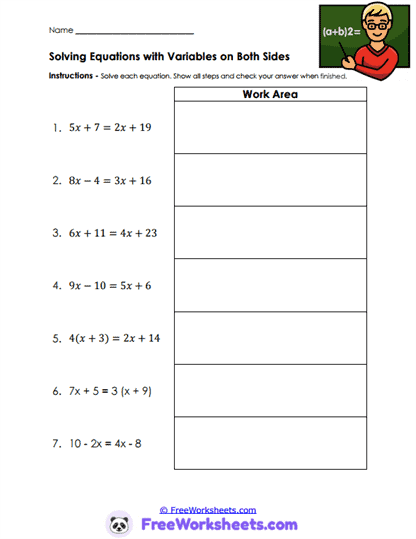
Students solve equations containing variables on both sides while simplifying expressions, combining like terms, and balancing equations carefully. Learners organize work step by step and check solutions after solving. - Target Skill:
This worksheet reinforces balancing strategies, equation-solving fluency, and algebraic organization aligned to Common Core standards for linear equations. Students strengthen procedural confidence and logical problem-solving accuracy.
Equation Match
- What Kids Do:
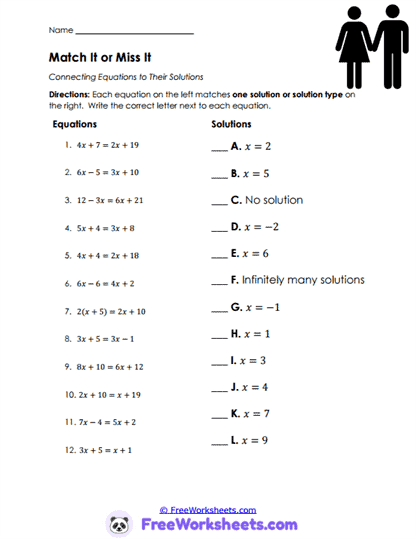
Students solve equations with variables on both sides and match each equation to the correct solution or solution type. Learners simplify expressions, classify identities and contradictions, and compare algebra outcomes carefully. - Target Skill:
This activity strengthens structural reasoning, equation classification, and procedural fluency aligned to Algebra I standards involving one-solution, no-solution, and infinitely-many-solutions equations.
Equation Patterns
- What Kids Do:
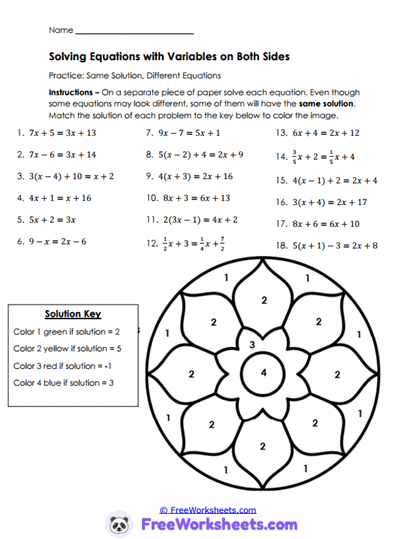
Students solve equations and compare their answers to identify patterns between equations with matching solutions. Learners simplify expressions, balance variables, and complete visual matching or coloring activities based on solution sets. - Target Skill:
This worksheet develops equation-analysis skills, pattern recognition, and algebraic reasoning aligned to standards involving equation structure and equivalent relationships. Students improve confidence recognizing shared algebra outcomes.
Equation Practice
- What Kids Do:
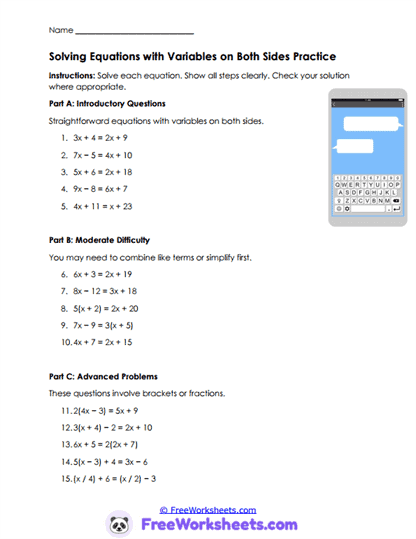
Students complete structured practice solving variables-on-both-sides equations involving distribution, balancing operations, and combining like terms. Learners progress from introductory equations to more advanced multi-step algebra problems. - Target Skill:
This worksheet strengthens procedural fluency, balancing strategies, and algebraic simplification aligned to Algebra I standards for linear equations. Students improve flexibility and confidence solving increasingly challenging equations.
Equation Stories
- What Kids Do:
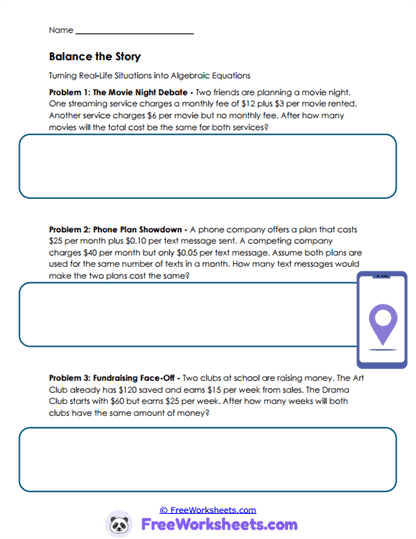
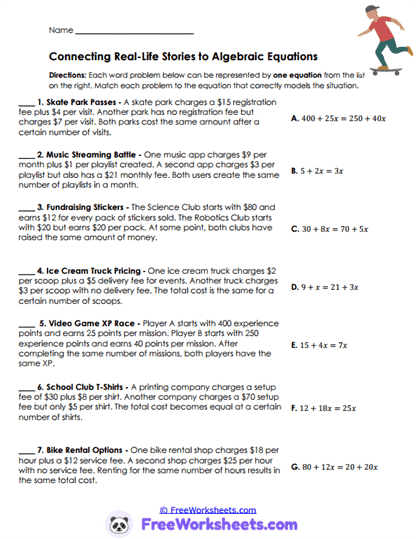
Students model real-world comparison situations involving subscriptions, fundraising totals, and pricing plans using equations with variables on both sides. Learners define variables, write equations, and interpret solutions within practical contexts. - Target Skill:
This activity reinforces algebraic modeling, contextual reasoning, and equation-writing fluency aligned to standards involving linear modeling and real-world problem solving. Students strengthen connections between algebra and everyday decision making.
Equation Tug
- What Kids Do:
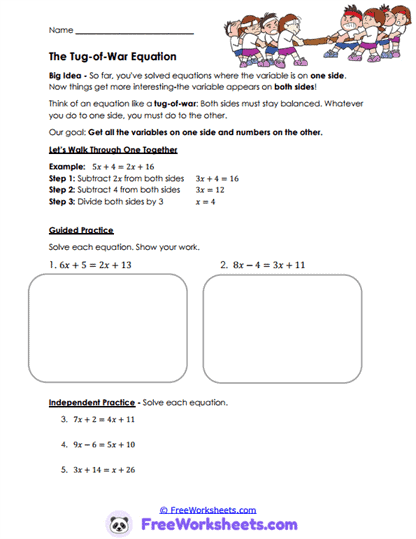
Students solve equations by moving variables to one side and constants to the other while maintaining equation balance. Learners practice inverse operations carefully and explore equations as balanced mathematical relationships. - Target Skill:
This worksheet develops foundational balancing strategies and variables-on-both-sides fluency aligned to Algebra I standards. Students strengthen conceptual understanding of equation balance and logical algebra organization.
Panda Review
- What Kids Do:
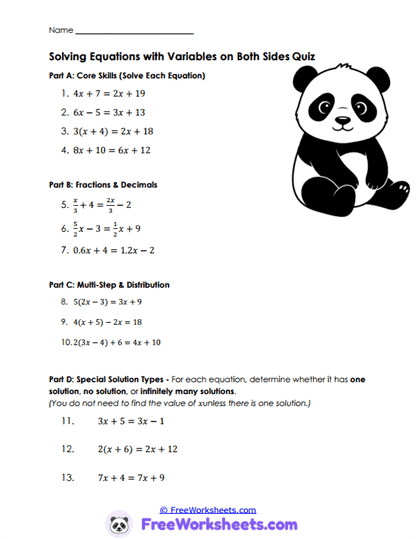
Students complete a mixed review involving variables-on-both-sides equations with fractions, decimals, distribution, and special solution types. Learners simplify expressions, isolate variables, and classify equations carefully. - Target Skill:
This worksheet strengthens cumulative equation-solving fluency and structural reasoning aligned to Common Core algebra standards. Students improve flexibility solving and classifying equations involving multiple connected algebra skills.
Solution Sort
- What Kids Do:
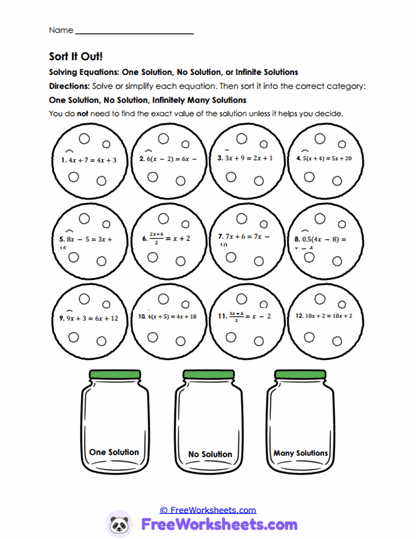
Students simplify equations and classify them as one-solution, no-solution, or infinitely-many-solutions problems. Learners compare simplified statements carefully and organize equations into matching categories. - Target Skill:
This activity reinforces equation-structure understanding and algebraic classification skills aligned to Algebra I standards involving identities and contradictions. Students strengthen reasoning about how equations behave after simplification.
Sports Algebra
- What Kids Do:
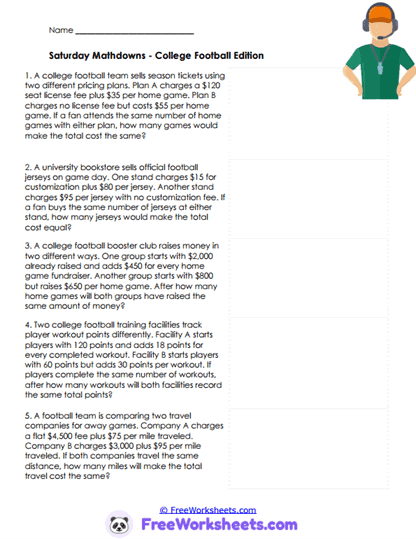
Students solve sports-themed algebra comparison problems involving ticket plans, fundraising totals, jersey costs, and travel expenses. Learners create balanced algebra relationships and solve for unknown values within practical scenarios. - Target Skill:
This worksheet strengthens contextual modeling, balancing equations, and real-world algebra reasoning aligned to standards involving linear relationships and mathematical modeling. Students improve engagement while applying algebra to familiar situations.