
Writing Linear Equations Worksheets
These worksheets help students strengthen equation-writing fluency, slope reasoning, and algebraic modeling skills. These free, ready-to-print worksheets come in PDF format for immediate classroom use during review, intervention, homework, or Algebra I instruction. Students develop curriculum aligned skills including writing equations in slope-intercept form, identifying rates of change, and modeling linear relationships.
About This Collection of Worksheets
This collection of Writing Linear Equations worksheets gives students meaningful practice creating linear equations from graphs, tables, ordered pairs, patterns, verbal descriptions, and real-world situations. Learners identify slope and y-intercepts, analyze rates of change, and build equations in slope-intercept form while strengthening both conceptual understanding and procedural fluency. The worksheets gradually increase in complexity so students gain confidence moving between visual, numerical, verbal, and symbolic representations of linear relationships.
Teachers can use these printable worksheets during Algebra I lessons, guided modeling instruction, intervention support, collaborative graphing activities, or assessment preparation. Pattern-analysis tasks, graph interpretation activities, equation-matching exercises, and real-world modeling problems help students stay engaged while reinforcing equation-writing strategies. Situations involving memberships, subscriptions, travel, savings, rentals, and budgeting help learners understand how linear equations describe repeated change and practical relationships in everyday life.
These worksheets align closely with Common Core standards HSA-CED.A.2, HSF-IF.A.1, and HSF-IF.C.7 while supporting foundational Algebra I function and graphing skills. Students practice writing equations from slopes and intercepts, graphs, tables, ordered pairs, verbal rules, and contextual situations while analyzing rates of change and graph behavior. The printable format makes this collection useful for classrooms, tutoring sessions, homeschool instruction, and additional algebra reinforcement at home.

Paul’s Teacher Tip
Students often know how to use the equation form y = mx + b but struggle to decide what the slope and y-intercept actually represent in different situations. Encourage learners to identify the “starting value” and the “change each time” before writing any equation. Visual models, tables, and real-world examples help students connect abstract algebra to meaningful patterns. Many mistakes happen when students confuse the slope with the y-intercept or forget that negative slopes represent decreasing relationships. Repeated practice moving between graphs, tables, verbal rules, and equations helps students develop stronger flexibility with linear relationships. Organizing information clearly before writing equations also helps learners avoid common algebra structure errors.
Worksheet Collection Skill Spotlights
Equation Review
- What Kids Do:
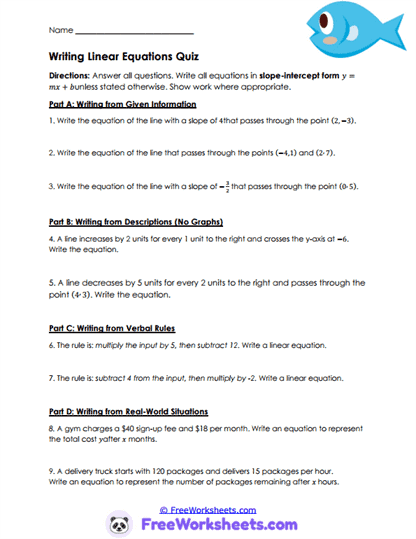
Students complete a mixed review involving graphs, tables, verbal descriptions, points, and real-world situations while writing linear equations in slope-intercept form. Learners apply multiple equation-writing strategies together across varied Algebra I problem types. - Target Skill:
This worksheet strengthens cumulative equation-writing fluency, slope reasoning, and algebraic flexibility aligned to Common Core standards for linear relationships and symbolic representation.
Graph Connections
- What Kids Do:
Students analyze graphs and match them to the correct linear equations by identifying slope direction, steepness, and y-intercepts. Learners compare graph behavior carefully while connecting visual information to symbolic equations. - Target Skill:
This activity reinforces graph interpretation, slope analysis, and visual algebra reasoning aligned to Algebra I standards involving graphing and linear-function interpretation.
Graph Decoder
- What Kids Do:
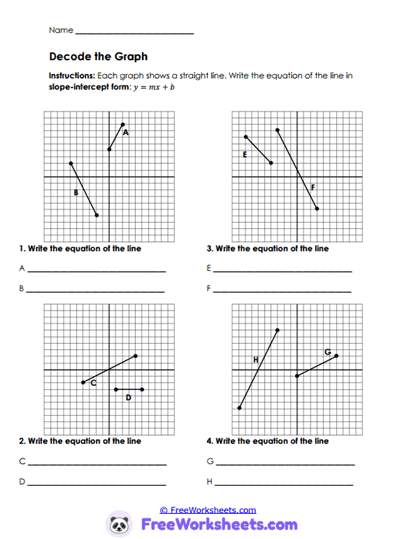
Students write linear equations directly from graphs by identifying rise, run, and y-intercepts visually. Learners analyze positive, negative, and horizontal slopes before creating equations in slope-intercept form. - Target Skill:
This worksheet strengthens graph-reading accuracy, slope calculation fluency, and symbolic representation aligned to Common Core graphing standards.
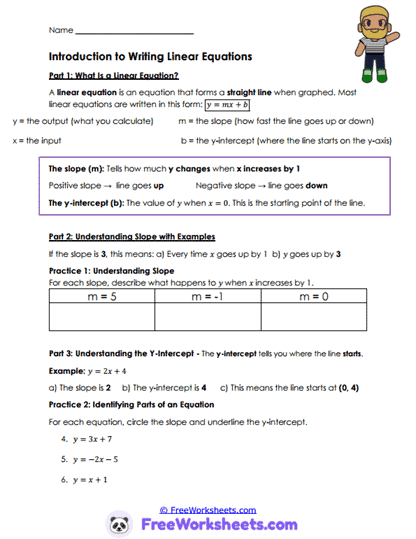
Line Foundations
- What Kids Do:
Students identify slopes and y-intercepts from equations written in slope-intercept form. Learners analyze how slope affects line direction and steepness while interpreting graph behavior from equation structure. - Target Skill:
This worksheet develops foundational understanding of slope-intercept form, graph interpretation, and algebra vocabulary aligned to Algebra I linear-equation standards.
Pattern Builders
- What Kids Do:
Students analyze numerical patterns and sequences to create matching linear equations. Learners identify rates of change, determine starting values, and build equations that model repeated growth or decrease. - Target Skill:
This activity reinforces pattern recognition, slope reasoning, and equation-building fluency aligned to standards involving functions and linear modeling.
Pattern Detectives
- What Kids Do:
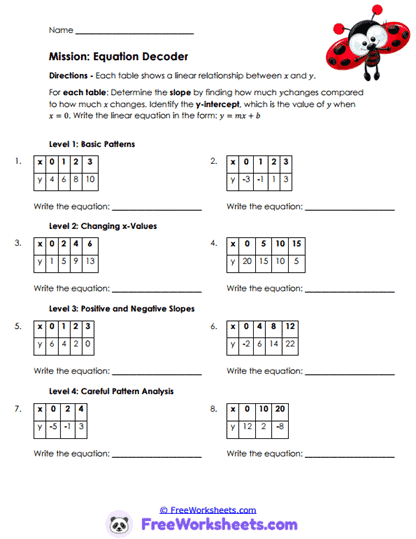
Students examine tables of values to identify patterns, calculate slopes, determine y-intercepts, and write matching linear equations. Learners compare how values change across tables carefully. - Target Skill:
This worksheet strengthens numerical reasoning, table analysis, and equation-writing skills aligned to Algebra I standards involving linear relationships and rates of change.
Point Clues
- What Kids Do:
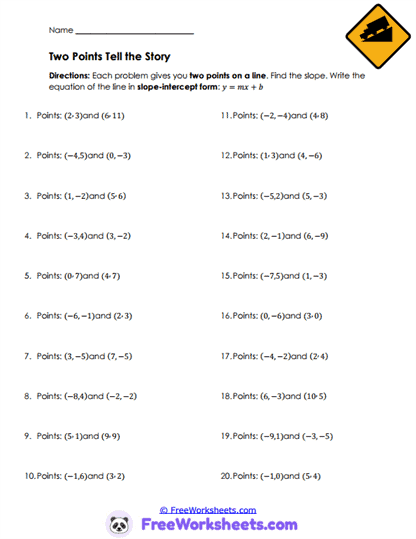
Students calculate slope from ordered pairs and write equations using two coordinate points. Learners organize rise-over-run calculations carefully and determine y-intercepts step by step. - Target Skill:
This worksheet develops coordinate reasoning, slope-formula fluency, and linear-equation writing aligned to standards involving graph interpretation and coordinate geometry.
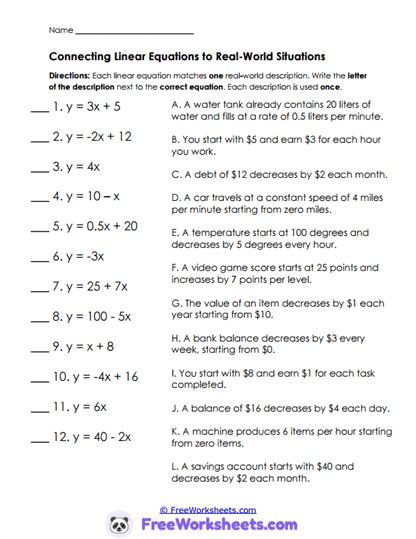
Real Connections
- What Kids Do:
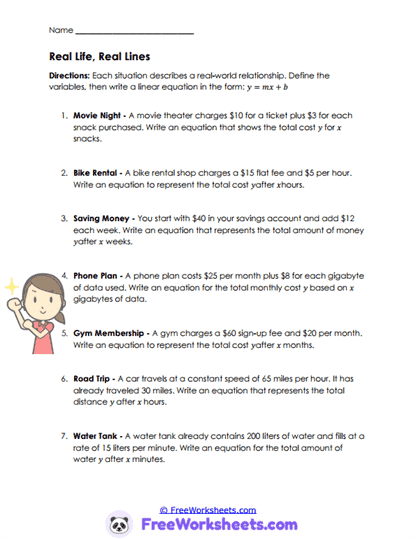
Students model real-world situations involving rentals, subscriptions, savings, and travel using linear equations in slope-intercept form. Learners identify starting values and rates of change from contextual situations. - Target Skill:
This activity strengthens algebraic modeling, contextual interpretation, and mathematical communication aligned to Common Core standards involving real-world function relationships.
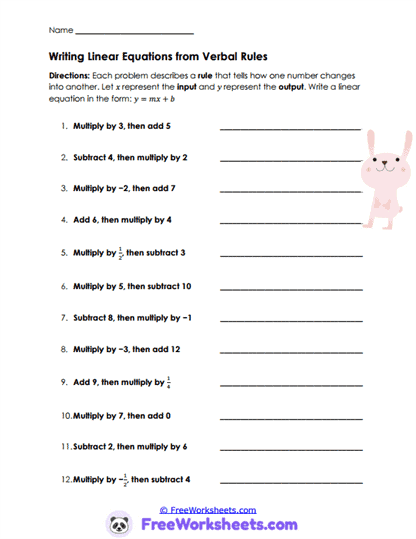
Rule Makers
- What Kids Do:
Students translate verbal instructions and numerical rules into linear equations written in slope-intercept form. Learners identify multiplication as slope and addition or subtraction as intercept values. - Target Skill:
This worksheet reinforces symbolic reasoning, verbal-to-algebra translation, and equation structure understanding aligned to Algebra I function and modeling standards.
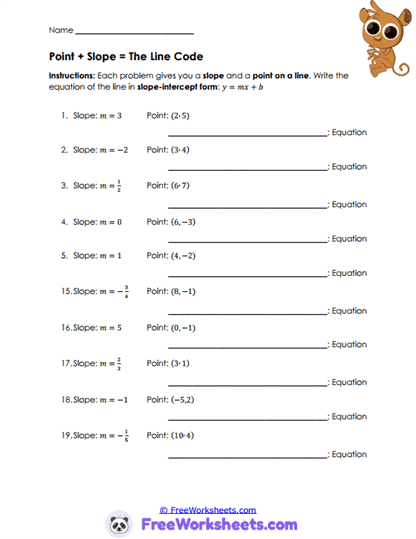
Slope Builders
- What Kids Do:
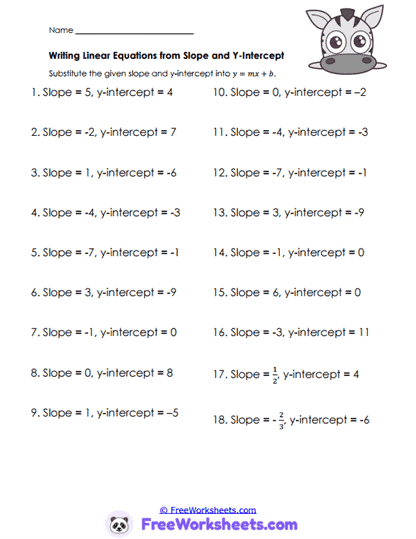
Students substitute given slopes and y-intercepts into slope-intercept form to write complete linear equations. Learners simplify equations involving positive, negative, fractional, and zero slopes. - Target Skill:
This worksheet strengthens procedural fluency, substitution accuracy, and understanding of slope-intercept structure aligned to Common Core linear-equation standards.
Table Trends
- What Kids Do:
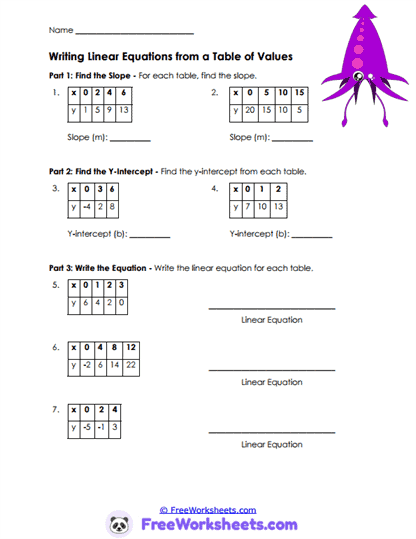
Students analyze tables of values to calculate rates of change and determine matching linear equations. Learners compare x- and y-value changes carefully while identifying constant rates of change. - Target Skill:
This activity develops table-analysis fluency, slope reasoning, and symbolic equation-writing skills aligned to Algebra I standards involving functions and linear relationships.
Word Patterns
- What Kids Do:
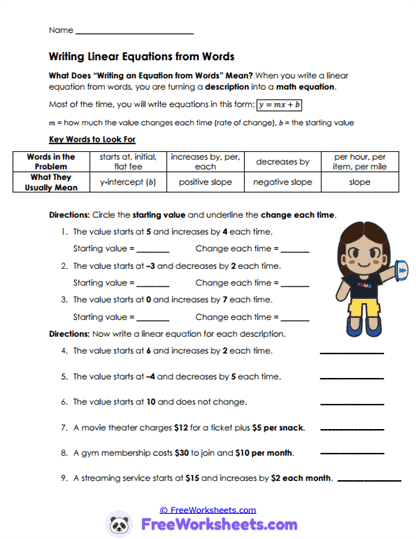
Students write linear equations from written descriptions involving memberships, subscriptions, tickets, and numerical patterns. Learners identify starting values and rates of change from contextual language. - Target Skill:
This worksheet strengthens algebraic modeling, verbal interpretation, and equation-writing fluency aligned to standards involving mathematical modeling and linear relationships.