
Understand Slope And Intercepts
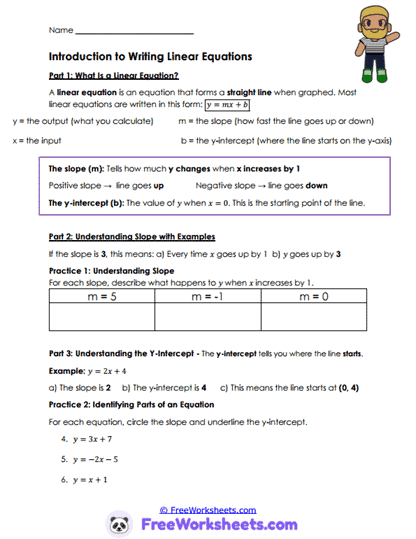
This worksheet introduces students to writing linear equations using slope-intercept form. Learners explore how slope describes the rate of change and how the y-intercept shows where a line begins on a graph. The activity strengthens foundational Algebra I understanding by connecting equations to graph behavior and real-world meaning. For example, students learn that a positive slope means a line rises from left to right while a negative slope means it falls. The worksheet also reinforces identifying slope and intercept values directly from equations.
Standards Connection
This worksheet supports Grade 9 algebra concepts involving linear equations and slope-intercept form. Students strengthen conceptual understanding needed for graphing, modeling, and analyzing linear relationships. Learners should already understand basic coordinate graphing and algebra vocabulary before beginning this activity. The worksheet aligns with Common Core standard HSA-CED.A.2 through creating and interpreting linear equations. It also supports Algebra I standards involving slope and graph interpretation.
Identify Key Parts
On this worksheet, students will examine equations written in slope-intercept form and identify the slope and y-intercept. Learners practice recognizing how slope affects the direction and steepness of a line. Some problems ask students to explain slope behavior in words while others focus on locating intercept values. Students also compare positive, negative, and zero slopes. The activity strengthens algebra vocabulary and equation analysis skills.
Common Difficulties
Many students confuse the slope and y-intercept when reading equations. Some learners struggle to understand why the y-intercept represents the starting value on a graph. Others misinterpret negative slopes or believe slope always means “going up.” Students may also overlook hidden slope values such as 1 or 0. Teachers can support understanding by connecting equations to visual graph examples and real-world rate-of-change situations.
Teaching Applications
Teachers can use this worksheet during introductory Algebra I lessons, guided graphing instruction, or intervention support. Parents and homeschool educators may support students by discussing real-world examples of increasing and decreasing patterns before beginning the worksheet. The activity also works well for collaborative learning where students explain slope behavior aloud. Students benefit from conceptual slope practice because it builds a strong foundation for graphing and modeling. Repeated equation analysis strengthens long-term algebra understanding.
Worksheet Features
The worksheet includes guided notes, slope interpretation activities, and equation analysis practice for foundational Algebra I review. Organized layouts support clear written responses and conceptual understanding. Problems gradually increase in complexity to strengthen confidence with slope-intercept form. Student-friendly directions support classroom instruction and independent completion. The printable format works well for Algebra I classrooms, tutoring programs, and homeschool mathematics lessons.