
Finding Slope Worksheets
These worksheets help students strengthen graph interpretation, linear reasoning, and rate-of-change understanding. These free, ready-to-print worksheets come in PDF format for immediate classroom use during review, homework, intervention, or Algebra I practice. Students develop curriculum aligned skills including calculating slope from graphs and ordered pairs, interpreting slope direction, and analyzing linear relationships.
About This Collection of Worksheets
This collection of Finding Slope worksheets gives students meaningful practice identifying and calculating slope from graphs, tables, ordered pairs, geometric figures, and real-world situations. Learners work with rise and run, slope formulas, slope classification, and rate-of-change interpretation while building confidence with linear relationships and coordinate reasoning. The worksheets gradually increase in complexity so students strengthen both conceptual understanding and procedural fluency across multiple representations of slope.
Teachers can use these printable worksheets during introductory slope lessons, graphing review, algebra intervention, math stations, collaborative activities, or assessment preparation. Puzzle-style decoding activities, graph interpretation tasks, and real-world modeling problems help students stay engaged while strengthening linear-function reasoning. Activities involving travel, cost, geometry, and coordinate analysis help learners understand how slope connects to practical situations and future algebra concepts.
These worksheets align closely with Common Core standards HSF-IF.B.6 and HSG-GPE.B.5 while supporting foundational Algebra I skills involving linear equations and function analysis. Students practice finding slope from graphs and coordinates, identifying positive and negative trends, interpreting slope as rate of change, and comparing linear relationships across tables, graphs, and contextual situations. The printable format makes this collection useful for classrooms, tutoring sessions, homeschool instruction, and additional algebra reinforcement at home.

Paul’s Teacher Tip
Many students understand the slope formula mechanically but struggle to connect slope to movement and direction on a graph. Encourage learners to physically trace “rise” and “run” with arrows on coordinate grids before calculating. Color coding vertical and horizontal movement can also help students avoid reversing the slope fraction. Real-world examples involving hills, ramps, driving speed, and pricing patterns make slope feel more meaningful and easier to interpret. Students also benefit from comparing positive, negative, zero, and undefined slopes side by side because visual repetition strengthens long-term understanding. Frequent mixed practice using graphs, tables, ordered pairs, and real-world contexts helps learners recognize that slope represents the same rate-of-change idea across many algebra situations.
Worksheet Collection Skill Spotlights
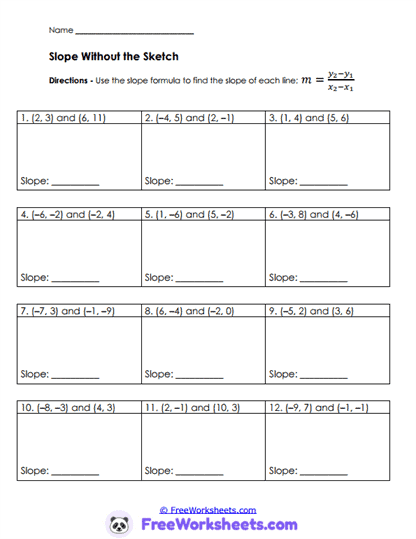
Formula Slopes
- What Kids Do:
Students calculate slope using the slope formula and pairs of ordered coordinates instead of graphs. Learners substitute x-values and y-values carefully into the formula, simplify fractions, and solve problems involving positive, negative, zero, and fractional slopes. - Target Skill:
This worksheet strengthens procedural fluency, coordinate reasoning, and algebraic accuracy aligned to Algebra I standards for slope and linear relationships. Students improve formula substitution skills while building confidence calculating slope directly from ordered pairs.
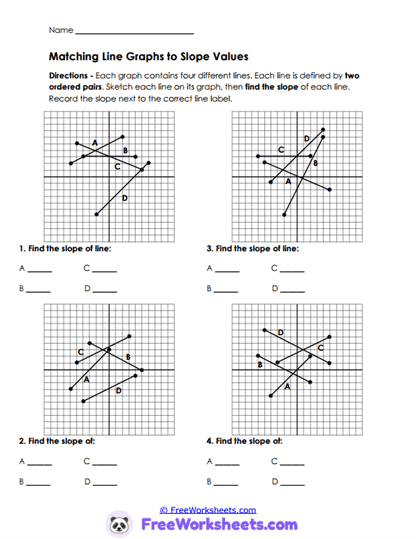
Graph Matching
- What Kids Do:
Students calculate slope from graphed lines and match each line to the correct slope value. Learners analyze rise and run visually, compare steepness, and identify positive, negative, and zero slopes from coordinate graphs. - Target Skill:
This activity reinforces graph interpretation, slope calculation fluency, and visual reasoning aligned to standards involving linear functions and graph analysis. Students strengthen connections between graph appearance and numerical slope values through repeated graph-based practice.
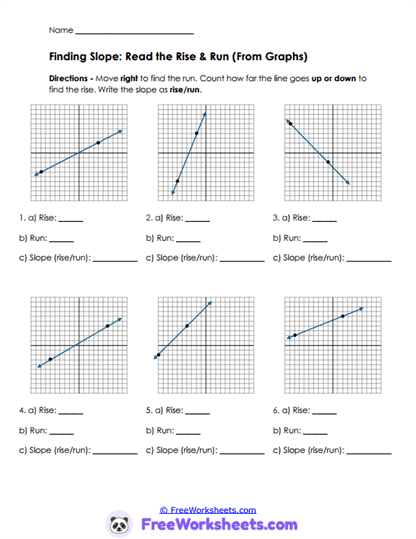
Graph Slopes
- What Kids Do:
Students calculate slope directly from graphs by counting rise and run between plotted points. Learners determine how far lines move vertically and horizontally while solving problems involving positive and negative linear relationships. - Target Skill:
This worksheet strengthens graph-reading accuracy, slope interpretation, and rise-over-run understanding aligned to Algebra I slope standards. Students improve procedural confidence while connecting coordinate movement to rate-of-change reasoning.
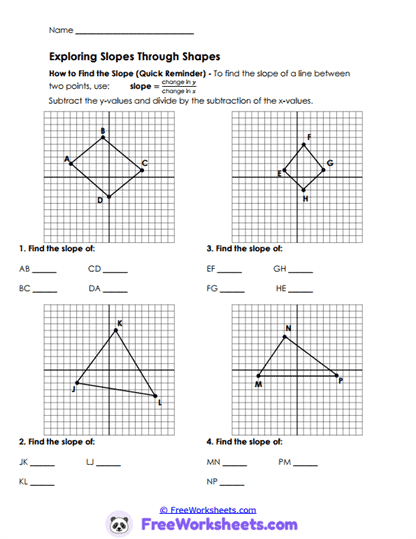
Shape Slopes
- What Kids Do:
Students find slope by analyzing line segments inside polygons and geometric figures on coordinate grids. Learners compare the slopes of sides, identify patterns in geometric shapes, and interpret horizontal and vertical segments. - Target Skill:
This worksheet develops coordinate geometry reasoning and slope-analysis fluency aligned to standards involving graph interpretation and geometric relationships. Students strengthen understanding of how slope applies to geometry and spatial reasoning.
Slope Basics
- What Kids Do:
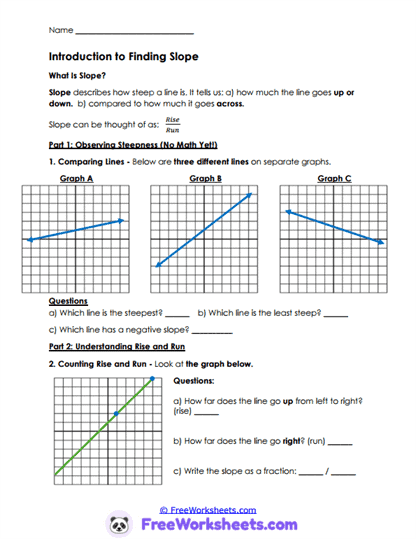
Students explore rise and run visually by comparing graphed lines with different steepness and directions. Learners identify positive and negative slopes, count graph movement, and describe how lines behave from left to right. - Target Skill:
This activity reinforces foundational slope concepts, graph interpretation, and linear reasoning aligned to Algebra I standards. Students strengthen understanding of steepness, direction, and rise-over-run relationships before applying slope formulas.
Slope Connections
- What Kids Do:
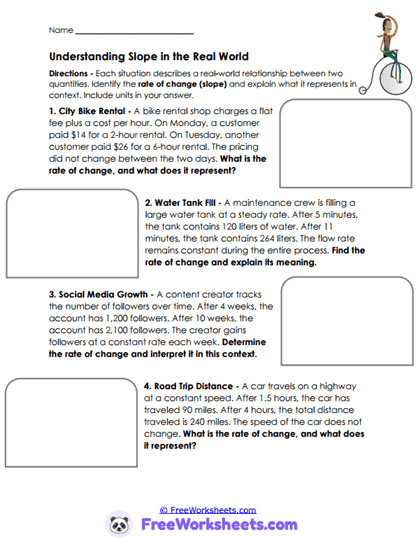
Students interpret slope as rate of change in real-world situations involving travel, cost, growth, and pricing relationships. Learners calculate slope values and explain what the rates mean within practical contexts. - Target Skill:
This worksheet strengthens linear modeling, contextual interpretation, and rate-of-change reasoning aligned to standards involving functions and proportional relationships. Students improve their ability to explain slope meaningfully using units and real-world examples.
Slope Direction
- What Kids Do:
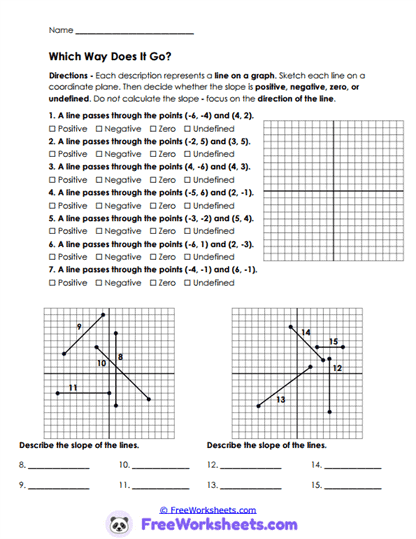
Students determine whether lines have positive, negative, zero, or undefined slope using graphs and ordered pairs. Learners analyze line movement across the coordinate plane and classify slope types visually and numerically. - Target Skill:
This worksheet develops conceptual understanding of slope behavior and graph interpretation aligned to Algebra I standards. Students strengthen classification fluency while improving recognition of horizontal, vertical, increasing, and decreasing line relationships.
Slope Puzzle
- What Kids Do:
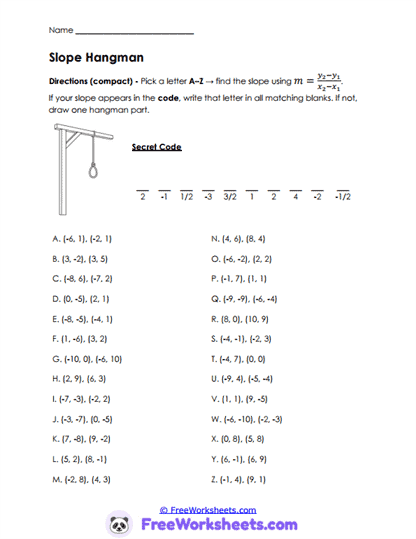
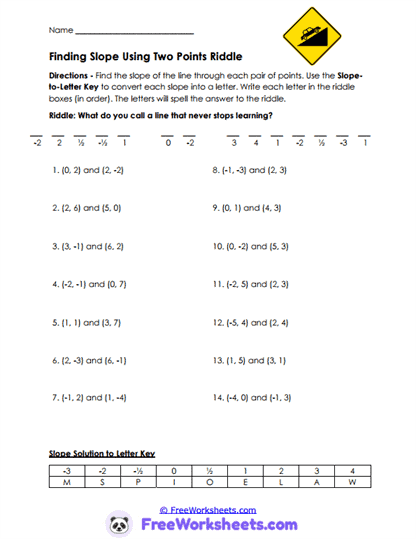
Students solve slope problems using ordered pairs and decode a puzzle or secret message using their answers. Learners apply the slope formula repeatedly while organizing calculations and simplifying fractions carefully. - Target Skill:
This activity reinforces slope-formula fluency, integer subtraction accuracy, and logical reasoning aligned to Algebra I standards. Students strengthen procedural confidence through engaging puzzle-style algebra practice.
Slope Review
- What Kids Do:
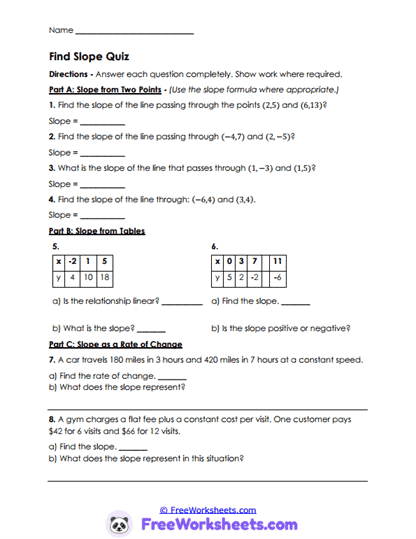
Students complete mixed review practice involving slope from points, graphs, tables, and real-world situations. Learners switch between multiple slope methods while analyzing linear relationships and identifying constant rates of change. - Target Skill:
This worksheet strengthens cumulative slope fluency and algebra readiness aligned to standards involving linear equations and function analysis. Students improve flexibility applying slope concepts across different mathematical representations and contexts.
Slope Riddles
- What Kids Do:
Students calculate slope from ordered pairs and use their answers to solve coded riddles. Learners organize substitutions carefully, simplify slope values, and interpret positive, negative, and fractional slopes while decoding messages. - Target Skill:
This worksheet reinforces slope-formula accuracy, algebraic reasoning, and procedural organization aligned to Algebra I standards. Students strengthen slope fluency and attention to detail through interactive review practice.
Table Trends
- What Kids Do:
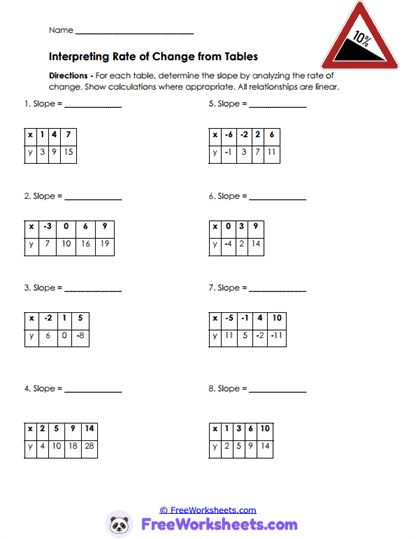
Students determine slope and rate of change from tables of values by analyzing how y-values change compared to x-values. Learners identify whether relationships are linear and calculate consistent rates of change. - Target Skill:
This activity strengthens pattern recognition, table analysis, and rate-of-change reasoning aligned to standards involving functions and linear relationships. Students improve understanding of slope through numerical data instead of graphs alone.
Trend Reading
- What Kids Do:
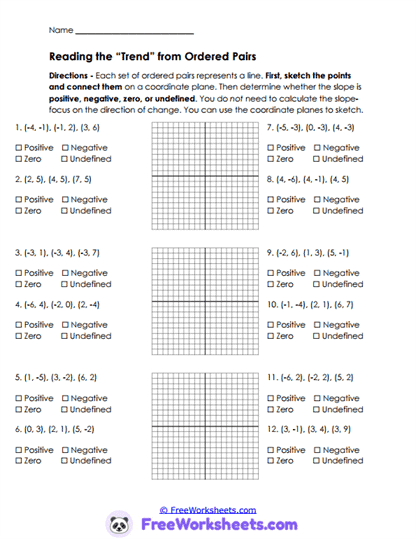
Students analyze sets of ordered pairs to determine whether relationships have positive, negative, zero, or undefined slope. Learners interpret coordinate trends and classify slope direction without always graphing the relationships. - Target Skill:
This worksheet develops slope-classification fluency, coordinate reasoning, and pattern analysis aligned to Algebra I standards. Students strengthen conceptual understanding of line direction and rate of change through repeated trend interpretation practice.