
Relate Slope To Real Life
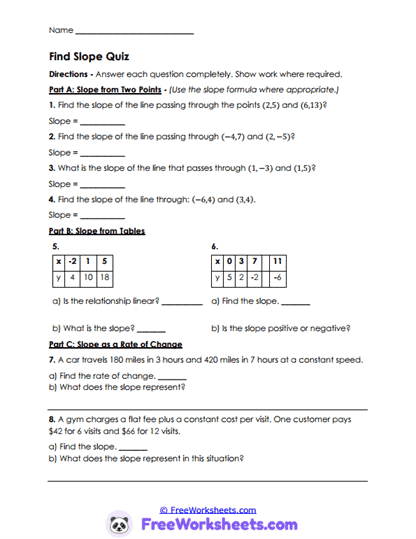
This worksheet teaches students how slope represents rate of change in real-world situations involving travel, cost, growth, and comparisons. Learners connect algebraic slope concepts to practical examples that show how quantities change together. The activity strengthens understanding of linear relationships and helps students interpret what slope means in context. For example, students may calculate how many miles are traveled each hour or determine the cost increase per item purchased. The worksheet also reinforces interpreting slope as a meaningful relationship rather than just a number.
Standards Connection
This worksheet supports Grade 9 algebra concepts involving slope, linear functions, and rate of change interpretation. Students strengthen reasoning skills needed for modeling and analyzing real-world situations with equations and graphs. Learners should already understand slope calculations and proportional relationships before beginning this activity. The worksheet aligns with Common Core standard HSF-IF.B.6 through interpreting rate of change in contextual situations. It also supports Algebra I standards involving linear modeling and function interpretation.
Interpret Real Situations
On this worksheet, students will analyze situations involving travel distance, speed, cost, and other changing quantities to determine slope or rate of change. Learners calculate how much one quantity changes compared to another and explain what the slope represents. Some problems involve constant speed while others focus on cost per item or repeated increases. Students also practice deciding whether relationships are positive or negative based on context. The activity strengthens algebraic reasoning and practical interpretation skills.
Common Struggles
Many students can calculate slope correctly but struggle to explain what the value means in a real-world situation. Some learners confuse which quantity belongs in the numerator or denominator when interpreting rate of change. Others overlook units and describe slope without meaningful context. Students may also struggle to identify whether a situation represents increasing or decreasing change. Teachers can support understanding by encouraging learners to write slope values with units and explain them in complete sentences.
Classroom Uses
Teachers can use this worksheet during linear-modeling lessons, algebra discussions, or real-world math applications. Parents and homeschool educators may support students by discussing everyday examples involving driving speed, shopping costs, or earning money over time. The activity also works well for collaborative learning where learners compare interpretations of slope values. Students benefit from seeing that slope describes meaningful change in practical situations. Real-life slope applications help learners understand why linear relationships matter outside the classroom.
Worksheet Features
The worksheet includes contextual slope problems involving travel, pricing, and growth for meaningful algebra practice. Organized answer spaces support careful calculations and written explanations. Problems vary in structure to strengthen flexibility with interpreting rate of change. Student-friendly directions support classroom instruction and independent completion. The printable format works well for Algebra I classrooms, tutoring sessions, and homeschool mathematics lessons.