
Solving Literal Equations Worksheets
Solving literal equations in 9th grade math gives students the flexibility to rewrite formulas so a chosen variable stands alone. This free collection of ready-to-print PDF worksheets is built for immediate classroom use, homework, intervention, tutoring, or independent practice with both familiar and unfamiliar formulas. As students isolate variables, preserve equivalent expressions, and work with fractions and multi-step formulas, they develop algebraic reasoning that supports 9th grade curriculum goals.
About This Collection of Worksheets
Literal equations show 9th grade students that formulas are not fixed in only one form. A relationship such as y = mx + b can be rearranged to solve for x, m, or b depending on which quantity is needed, and the same idea applies to formulas from geometry, science, measurement, motion, and other subjects. Learning to isolate a chosen variable strengthens equation-solving skills while helping students understand how algebra can be used flexibly.
The worksheets in this collection move from straightforward variable isolation into more demanding formula work. Students rearrange simple and multi-step equations, match equivalent formulas, fill in missing algebraic steps, work with geometry and science formulas, choose correct rearrangements, analyze errors, manipulate fractional expressions, factor a target variable that appears more than once, complete formula blanks, and audit proposed solutions. This range of activities helps students focus not only on getting a variable alone but also on preserving the meaning and structure of the original equation.
Teachers can use the collection throughout a 9th grade Algebra 1 unit on literal equations, formula manipulation, or equation structure. Some pages work especially well for introducing inverse-operation thinking, while others are suited for partner discussion, error analysis, cross-curricular applications, homework, or assessment review. Parents, tutors, and homeschool educators can also use the worksheets to build confidence gradually, moving from simple rearrangements toward formulas involving fractions, factoring, and several variables.

Paul’s Teacher Tip
Have students circle the target variable before doing any algebra so they never lose sight of what must end up alone. Instead of telling them to “move” terms, ask what operation is being performed on the target variable and which inverse operation will undo it while keeping the equation balanced. When a full expression must be divided, encourage students to use parentheses or a clear fraction bar so every term stays grouped correctly. If the target variable appears more than once, pause the usual inverse-operation routine and have students collect those terms together before factoring out the variable. A useful final check is to compare the rearranged formula with the original and ask whether reversing the steps would return to the starting equation.
Worksheet Collection Skill Spotlights
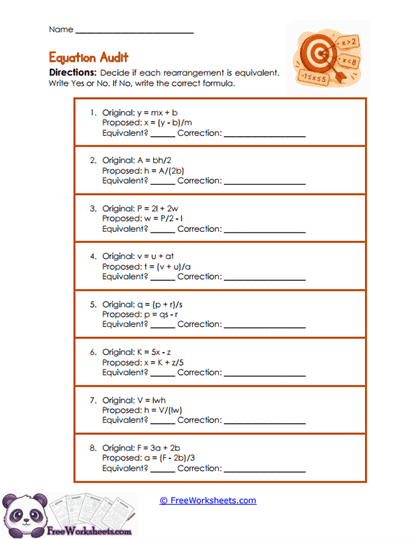
Formula Audit
What Kids Do:
Students inspect eight original formulas alongside proposed rearrangements and decide whether each new form is equivalent. When a rearrangement is incorrect, they identify issues involving signs, grouping, denominators, coefficients, or incomplete variable isolation and rewrite the formula correctly.
Target Skill:
This activity develops the ability to verify literal-equation work rather than simply produce it. Students strengthen equivalent-equation reasoning, grouping awareness, variable isolation, and algebraic accuracy while building a dependable 9th grade habit of checking whether every transformation preserves the original relationship.
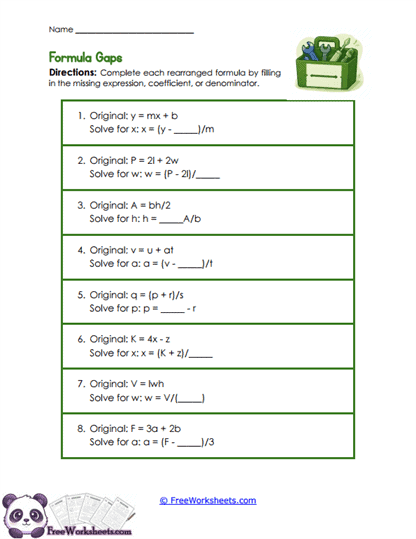
Formula Blanks
What Kids Do:
Students study original formulas and nearly completed rearranged versions that contain one missing term, coefficient, sign, factor, or denominator. They compare the two forms, determine which inverse operation must have been used, and fill in the missing algebraic piece so the new formula remains equivalent.
Target Skill:
Students strengthen their understanding of formula structure by tracing where every part of an equation goes during rearrangement. The activity reinforces inverse operations, denominators, grouping, and coefficient placement while helping 9th grade students recognize how equivalent forms are built step by step.
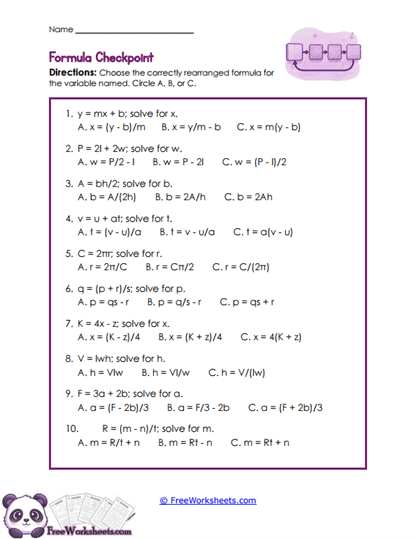
Formula Choice
What Kids Do:
Students read ten literal equations, identify the variable that must be isolated, and choose the correct rearranged version from three answer choices. They compare signs, fraction bars, grouping, and operations to eliminate formulas that look similar but do not preserve the original equation.
Target Skill:
This worksheet builds recognition of valid algebraic transformations and helps students distinguish a truly equivalent formula from a tempting incorrect one. Students practice inverse-operation reasoning, structural comparison, and precise variable isolation, supporting both 9th grade Algebra 1 work and assessment preparation.
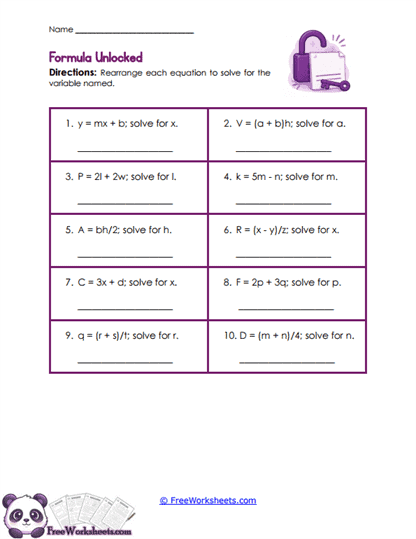
Formula Focus
What Kids Do:
Students rearrange ten multi-step formulas containing addition, subtraction, multiplication, division, and grouped expressions. They work backward through the operations surrounding the requested variable until it stands alone, keeping full expressions together when division or multiplication affects more than one term.
Target Skill:
Students develop fluency with multi-step literal equations by learning to sequence inverse operations carefully. The activity strengthens equation balance, fraction structure, grouping, and symbolic reasoning while supporting the 9th grade goal of rearranging formulas to highlight a quantity of interest.
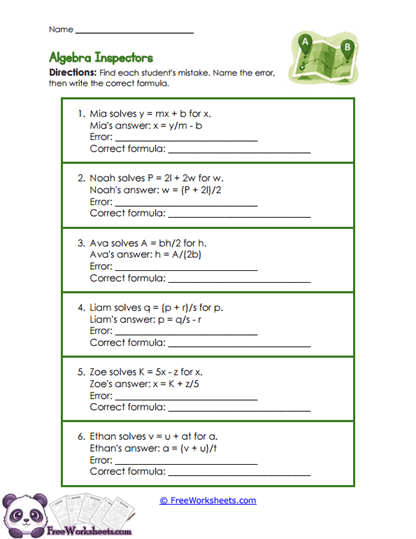
Formula Inspectors
What Kids Do:
Students analyze attempted literal-equation solutions and determine where the rearrangement first becomes incorrect. They examine subtraction, division, signs, fraction structure, and grouping, explain the mistake in mathematical language, and then rewrite the formula so the requested variable is isolated properly.
Target Skill:
Error analysis encourages students to understand why formula transformations work instead of memorizing finished forms. They strengthen self-checking, equivalent-equation reasoning, grouping awareness, and precise explanation, all of which support more independent 9th grade algebra problem solving.
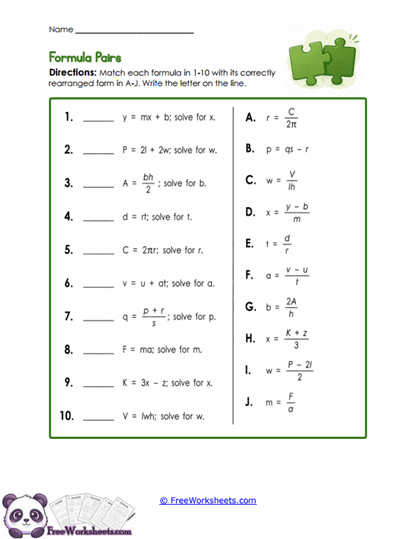
Formula Match
What Kids Do:
Students connect ten original formulas with rearranged versions that correctly isolate a named variable. They compare the operations used in each form, pay close attention to parentheses and denominators, and identify which expression preserves the same relationship as the starting equation.
Target Skill:
Students strengthen their ability to recognize equivalent formulas across different algebraic arrangements. The matching format reinforces inverse operations, variable isolation, fraction interpretation, and structural reasoning while helping 9th grade students see that one formula can be written correctly in several useful forms.
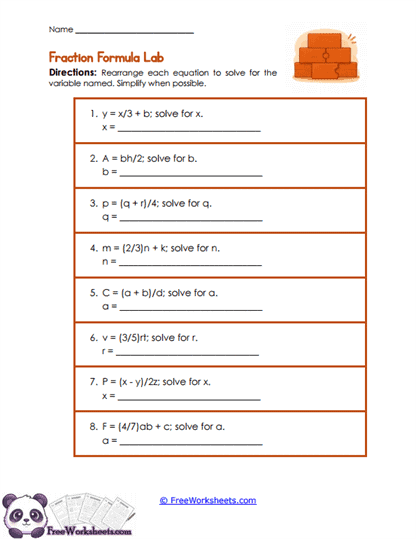
Fraction Formulas
What Kids Do:
Students rearrange eight literal equations containing fractions, fractional coefficients, grouped numerators, and multi-step operations. They use multiplication and division strategically, preserve grouped expressions, simplify when appropriate, and isolate the requested variable without losing terms or changing the formula’s meaning.
Target Skill:
This focused practice develops confidence with fractional literal equations, an area where grouping and denominator errors are common. Students strengthen inverse-operation skills, fraction reasoning, symbolic organization, and equivalent transformations needed for more advanced 9th grade algebra and science formulas.
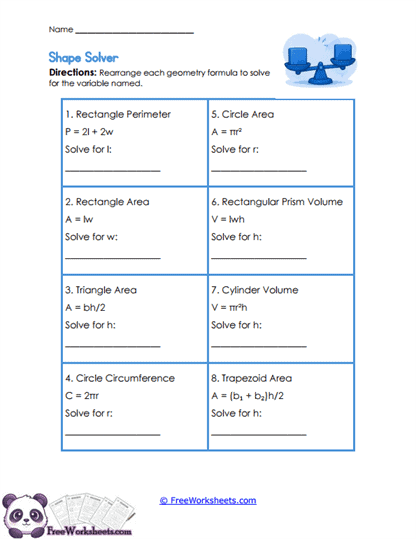
Geometry Formulas
What Kids Do:
Students rearrange familiar formulas for perimeter, area, circumference, and volume to solve for a different dimension. They isolate variables representing length, width, height, radius, or other measurements while working symbolically with products, fractions, pi, and several variables.
Target Skill:
Students connect literal-equation solving with practical geometry by learning how a familiar formula can be rewritten when a different measurement is unknown. The activity strengthens 9th grade algebraic flexibility, formula interpretation, inverse operations, and cross-curricular reasoning with geometric quantities.
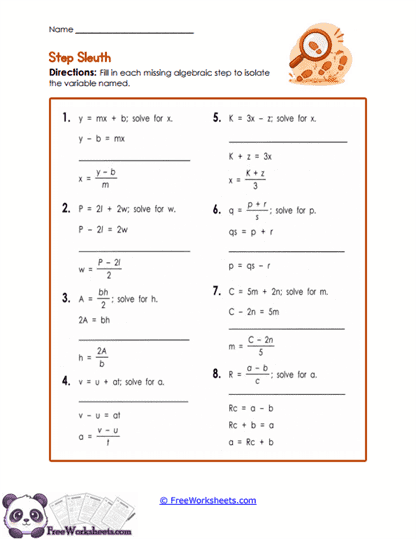
Missing Steps
What Kids Do:
Students examine partially completed literal-equation solutions in which one algebraic move has been removed. They compare the line before the blank with the line after it, identify the inverse operation that must have occurred, and supply the missing step while keeping the equation equivalent.
Target Skill:
This activity develops step-by-step reasoning by requiring students to understand how one correct transformation leads to the next. Students reinforce operation order, equation balance, grouping, and symbolic structure while becoming better at explaining and checking 9th grade literal-equation work.
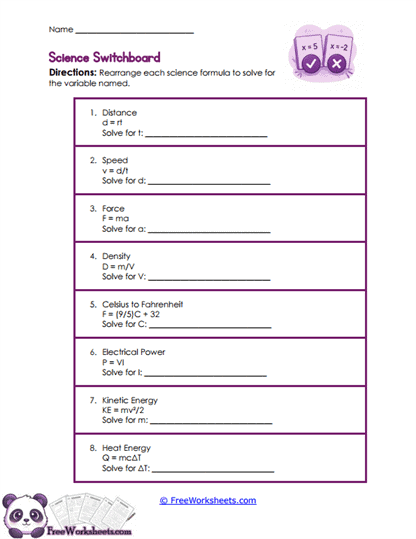
Science Formulas
What Kids Do:
Students rearrange eight formulas drawn from science topics such as distance, speed, force, density, temperature conversion, electrical power, kinetic energy, and heat. They isolate a specified variable symbolically so the formula is ready to use when that quantity becomes the unknown.
Target Skill:
Students apply algebraic rearranging to authentic formulas used beyond math class. The worksheet strengthens 9th grade understanding of inverse operations, symbolic quantities, exponents, and equivalent equations while showing how literal-equation skills support physics, chemistry, engineering, and other technical subjects.
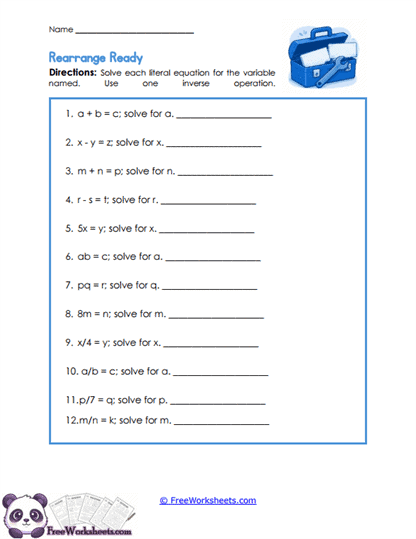
Variable Moves
What Kids Do:
Students work through twelve short literal equations and use addition, subtraction, multiplication, or division to isolate the named variable. Because the equations are intentionally straightforward, students can concentrate on identifying what operation affects the target letter and undoing it correctly.
Target Skill:
This worksheet establishes the foundation for solving literal equations by showing that the same balancing principles used with numerical equations also work when every quantity is represented by a variable. Students build confidence with inverse operations, equation structure, and 9th grade symbolic reasoning.
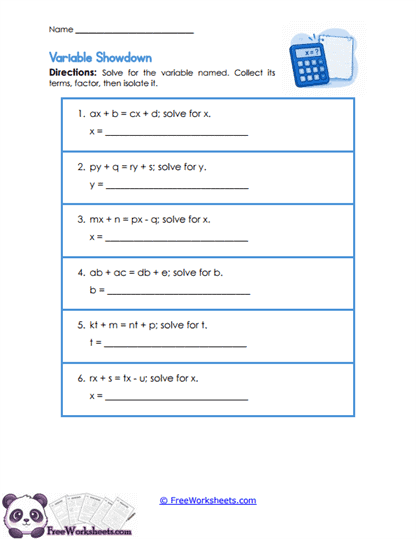
Variable Showdown
What Kids Do:
Students solve six advanced literal equations in which the requested variable appears in multiple terms or on both sides. They collect all terms containing that variable, move other terms appropriately, factor the common variable out, and divide by the remaining expression to isolate it completely.
Target Skill:
Students learn the important collect-factor-divide strategy needed when ordinary inverse operations are not enough. The activity combines literal-equation solving with factoring and expression structure, preparing 9th grade students for more sophisticated symbolic manipulation in later algebra and science work.