
About This Worksheet
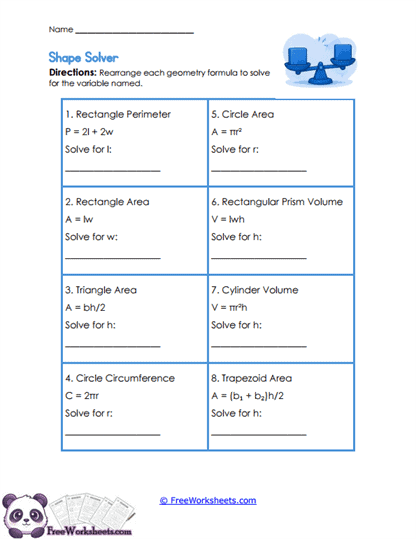
This worksheet helps ninth-grade students rearrange common geometry formulas to solve for a different measurement. Students work with formulas for rectangle perimeter, rectangle area, triangle area, circle circumference, circle area, rectangular prism volume, cylinder volume, and trapezoid area. Instead of plugging in numbers, they isolate the named variable in each formula. For example, if A = lw and students need to solve for w, they divide both sides by l to get w = A/l.
The worksheet gives students a practical way to see why literal equations matter. Each problem is tied to a familiar geometry formula, so students can connect algebraic rearranging with real measurements. This makes the skill feel less abstract.
What Students Practice
Students practice using inverse operations to isolate length, width, height, radius, or another requested variable. They must recognize multiplication and division structures inside familiar formulas. This reinforces both algebra and geometry knowledge.
The worksheet also gives students experience working with formulas that contain fractions, pi, and several variables. Students learn to treat those symbols just like ordinary numbers when rearranging the equation. That helps them become more confident using formulas in different forms.
Why This Skill Matters
Geometry formulas are not always used in the form students first learn them. Sometimes area is known and height is unknown, or volume is known and one dimension must be found. Rearranging the formula lets students solve for the measurement they actually need.
This skill is also important in science and technical subjects. Many formulas must be rewritten before values can be substituted. Learning how to isolate a variable gives students more flexibility across different areas of math.
Common Challenges
Students may try to plug in numbers even though none are given. Remind them that the goal is to rewrite the formula, not calculate a numerical answer. The final answer should still contain variables.
Another common mistake is moving only part of a denominator or product. Encourage students to identify the full factor attached to the target variable before dividing. Writing the operation on both sides can help keep the equation balanced.
How To Use It
Teachers can use this worksheet as a bridge between Algebra 1 and geometry. It works well for guided practice, independent work, homework, or review before a geometry application lesson. You might ask students to name what each variable represents before rearranging the formula.
Parents and homeschool teachers can remind students to focus on the letter they need to isolate. Ask, “What is being multiplied or divided with this variable?” Then use the opposite operation to get that variable alone.
Grade Alignment
This Grade 9 worksheet directly supports CCSS HSA-CED.A.4, which focuses on rearranging formulas to highlight a quantity of interest. It also connects with geometry formulas students use throughout high school. The activity strengthens students’ ability to move between algebraic and geometric reasoning.
Students should already know common geometry formulas and basic equation solving. After this practice, they can apply rearranged formulas to numerical geometry problems.