
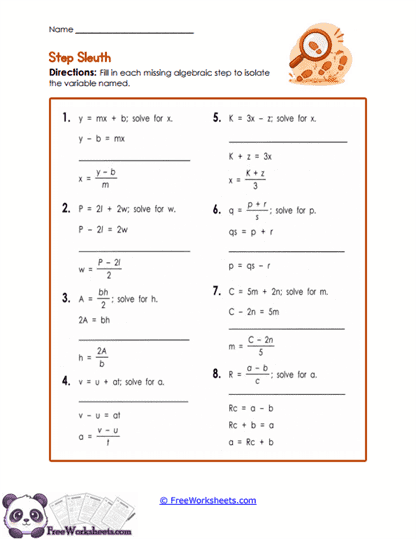
About This Worksheet
This worksheet helps ninth-grade students practice finding the missing algebraic step while rearranging literal equations. Each problem shows part of a formula-solving process, but one important step is left blank. Students must study what comes before and after the blank and decide which operation correctly isolates the requested variable. For example, if y – b = mx and the next line is x = (y – b)/m, the missing step is dividing both sides by m.
The worksheet includes formulas with addition, subtraction, multiplication, division, and fractions. Students are not starting every problem from scratch, so the focus is on understanding how one correct step leads to the next. This makes the page especially useful for checking whether students really understand the structure of a literal equation.
What Students Practice
Students practice reading a worked solution carefully and identifying the inverse operation that belongs in the missing space. They must pay attention to the variable being isolated and the operations surrounding it. This builds stronger understanding of equation-solving order.
The activity also reinforces equivalent transformations. Students learn that each line of algebra must still represent the same relationship as the original equation. That makes the worksheet useful for both procedural practice and mathematical reasoning.
Why This Skill Matters
Students sometimes memorize a finished formula without understanding how it was created. Missing-step practice forces them to think about the reason for each move. That helps them become more independent when they face a new literal equation.
The skill is also useful for checking work. If students can recognize which step should come next, they are more likely to catch an incorrect operation in their own solutions. This kind of reasoning is valuable throughout Algebra 1.
Common Challenges
Students may look only at the final line and guess what happened. Encourage them to compare the line directly above the blank with the line directly below it. That usually makes the missing operation easier to see.
Another common mistake is forgetting that an operation must apply to the entire side of an equation. If a whole expression is divided, students need to keep all of its terms together. Using parentheses or a fraction bar can help make that structure clearer.
How To Use It
Teachers can use this worksheet after students have already practiced rearranging literal equations independently. It works well for guided review, partner work, homework, or a quick formative check. Asking students to explain why the missing step works can reveal whether they understand the algebra.
Parents and homeschool teachers can ask, “What changed from this line to the next?” Then have the student name the operation that caused that change. This keeps the focus on reasoning instead of memorizing formulas.
Grade Alignment
This worksheet is designed for Grade 9 Algebra 1 and supports CCSS HSA-CED.A.4, which asks students to rearrange formulas to highlight a quantity of interest. It also supports HSA-REI.A.1 through reasoning about equivalent algebraic steps. The missing-step format strengthens students’ ability to explain how formulas are transformed.
Students should already know inverse operations and basic literal equation solving. After this practice, they can move into more complicated formulas and error-analysis tasks.