
Build Linear Rules From Descriptions
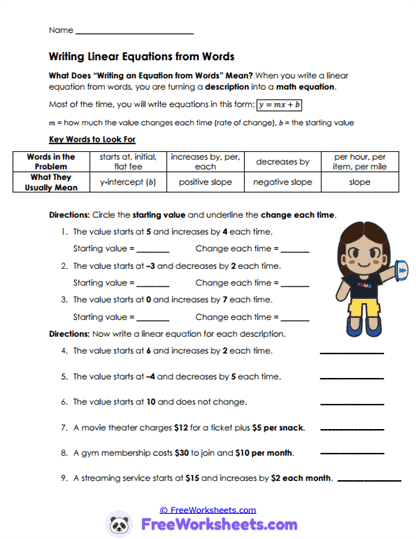
This worksheet teaches students how to write linear equations from written descriptions and real-world situations. Learners identify starting values and rates of change before translating the information into slope-intercept form. The activity strengthens algebra modeling skills and helps students connect verbal language to symbolic equations. For example, students may write an equation for a gym membership that starts with a joining fee and increases each month. The worksheet also reinforces recognizing key vocabulary linked to slope and intercepts.
Standards Connection
This worksheet supports Grade 9 algebra concepts involving writing linear equations from verbal descriptions. Students strengthen algebraic reasoning and modeling skills needed for graphing and real-world problem solving. Learners should already understand slope-intercept form and rate of change before beginning this activity. The worksheet aligns with Common Core standard HSA-CED.A.2 through creating equations from contextual information. It also supports Algebra I standards involving linear relationships and mathematical modeling.
Translate Words Into Equations
On this worksheet, students will identify starting values and rates of change from written descriptions and use them to create linear equations. Learners practice recognizing phrases such as “starts at,” “increases by,” and “decreases by” to determine intercepts and slopes. Some problems involve simple number patterns while others connect to real-world situations involving tickets, memberships, or subscriptions. Students also underline important information before writing equations. The activity strengthens algebra interpretation and symbolic reasoning.
Frequent Errors
Many students confuse the starting value with the changing value in a situation. Some learners place the slope and intercept in the wrong positions when writing equations. Others overlook negative rates of change in situations involving decreases. Students may also struggle to identify when a value stays constant. Teachers can support understanding by encouraging learners to label “starting value” and “change each time” before writing the equation.
Classroom Strategies
Teachers can use this worksheet during algebra modeling lessons, guided practice, or collaborative equation-writing activities. Parents and homeschool educators may support students by discussing real-world examples involving subscriptions, costs, or repeated changes before beginning the worksheet. The activity also works well for partner learning where students explain how they identified slope and intercept values. Students benefit from verbal-to-symbol translation because it strengthens deeper conceptual understanding. Real-world modeling practice increases engagement and confidence.
Worksheet Features
The worksheet includes equation-writing practice from verbal rules, patterns, and real-life situations for meaningful Algebra I review. Organized response spaces support careful reading and equation construction. Problems vary in context to strengthen flexibility with linear modeling. Student-friendly directions support classroom instruction and independent completion. The printable design works well for Algebra I classrooms, tutoring sessions, and homeschool mathematics lessons.