
Balance Variables On Both Sides
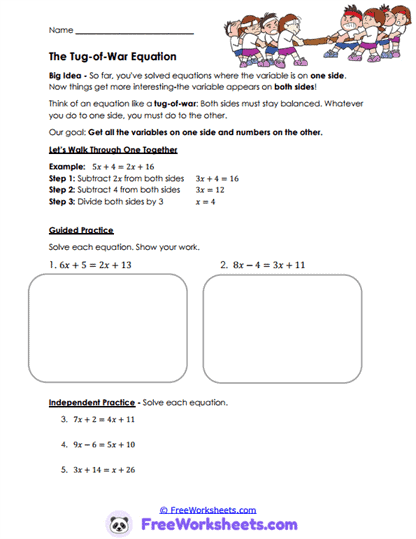
This worksheet teaches students how to solve equations where variables appear on both sides of the equal sign. Learners discover that equations must stay balanced while moving variables and constants to opposite sides step by step. The activity strengthens algebraic reasoning by helping students understand why the same operation must be applied to both sides. For example, students may solve equations such as 6x + 5 = 2x + 13 by moving variables together before isolating x. The worksheet also reinforces the idea of equations as balanced mathematical relationships.
Standards Connection
This worksheet supports Grade 9 algebra concepts involving solving linear equations with variables on both sides. Students strengthen procedural fluency and equation-solving strategies needed for advanced algebra topics. Learners should already understand one-step and multi-step equations before beginning this activity. The worksheet aligns with Common Core standard HSA-REI.B.3 through solving linear equations in one variable. It also supports Algebra I standards involving balancing equations and algebraic structure.
Move Variables Strategically
On this worksheet, students will solve equations by moving variable terms to one side and constants to the other. Learners practice subtracting or adding terms carefully while maintaining equation balance. Some equations involve simple variable movement while others require combining like terms first. Students also practice checking their answers after solving. The activity strengthens algebra organization and logical problem-solving.
Common Difficulties
Many students move variables incorrectly and accidentally change signs during subtraction. Some learners forget that every operation must happen on both sides of the equation. Others combine unlike terms while simplifying equations. Students may also isolate constants before grouping variables together, which creates unnecessary confusion. Teachers can support understanding by modeling equations visually as balanced scales or tug-of-war situations.
Teaching Applications
Teachers can use this worksheet during introductory lessons on variables on both sides, guided practice, or intervention review. Parents and homeschool educators may support students by discussing why equations must stay balanced at every step. The activity also works well for collaborative learning where students explain why they moved certain terms first. Learners benefit from repeated balancing practice because it strengthens algebra fluency and confidence. Conceptual equation models help students understand algebra more deeply.
Worksheet Features
The worksheet includes guided examples, supported practice, and independent problems involving variables on both sides. Large workspaces support organized calculations and step-by-step reasoning. Problems gradually increase in complexity to strengthen confidence and accuracy. Student-friendly directions support classroom instruction and independent completion. The printable format works well for Algebra I classrooms, tutoring programs, and homeschool mathematics lessons.