
Understand Greater Than And Less Than
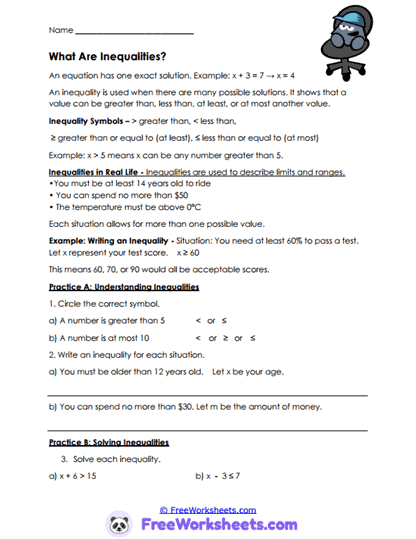
This worksheet introduces students to inequalities and helps them understand how inequality symbols describe ranges of possible values instead of one exact answer. Learners explore symbols such as greater than, less than, at least, and at most through simple examples and real-world situations. The activity strengthens foundational algebra understanding and prepares students for solving and graphing inequalities. For example, students may write an inequality showing that test scores must be at least 60 to pass. The worksheet also reinforces interpreting inequalities in everyday language.
Standards Connection
This worksheet supports Grade 9 algebra concepts involving interpreting and solving simple inequalities in one variable. Students strengthen mathematical reasoning and symbolic understanding needed for Algebra I problem solving. Learners should already understand basic equations and inverse operations before beginning this activity. The worksheet aligns with Common Core standard HSA-CED.A.1 through representing relationships using inequalities. It also supports Algebra I standards involving inequality notation and algebraic reasoning.
Read And Write Inequalities
On this worksheet, students will identify inequality symbols and write inequalities from written statements. Learners practice translating phrases such as “at least,” “no more than,” and “greater than” into mathematical notation. Some problems involve comparing numbers while others connect inequalities to real-life situations involving age, money, or scores. Students also solve introductory one-step inequalities. The activity strengthens algebra vocabulary and symbolic reasoning.
Common Difficulties
Many students confuse the meaning of greater-than and less-than symbols. Some learners struggle to translate phrases like “at most” or “no less than” correctly into inequalities. Others forget that inequalities represent many possible answers instead of one exact value. Students may also reverse symbols accidentally while writing statements. Teachers can support understanding by connecting inequality symbols to visual number-line examples and everyday situations.
Teaching Applications
Teachers can use this worksheet during introductory inequality lessons, guided algebra instruction, or intervention review. Parents and homeschool educators may support students by discussing real-life examples involving spending limits, age requirements, or temperature ranges. The worksheet also works well for collaborative learning where students explain inequality phrases in their own words. Students benefit from verbal-to-symbol translation practice because it strengthens conceptual understanding. Repeated exposure to inequality language builds long-term algebra confidence.
Worksheet Features
The worksheet includes symbol identification, writing inequalities from situations, and introductory solving practice for foundational Algebra I review. Organized layouts support clear written responses and step-by-step solving. Problems gradually increase in complexity to strengthen confidence and understanding. Student-friendly directions support classroom instruction and independent completion. The printable format works well for Algebra I classrooms, tutoring sessions, and homeschool mathematics lessons.