
About This Worksheet
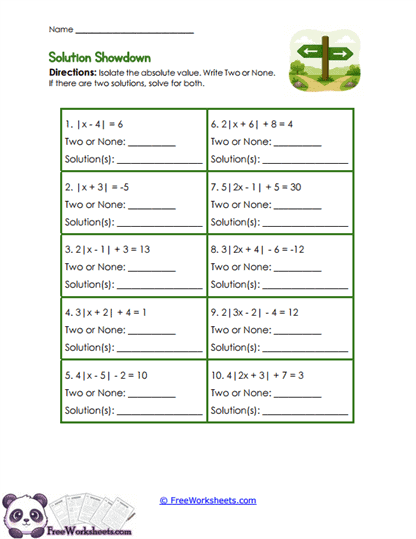
This worksheet helps ninth-grade students determine whether an absolute value equation has two solutions or no solution. Students first isolate the absolute value expression in each of ten problems and then examine the value on the other side. Because absolute value can never be negative, an equation that asks an absolute value to equal a negative number has no solution. When the isolated value is positive, students solve the two resulting cases.
For example, |x – 4| = 6 produces two possible solutions because a distance of 6 is possible in two directions. On the other hand, |x + 3| = -5 has no solution because no absolute value can equal -5. The worksheet helps students learn to recognize this difference before doing unnecessary work.
What Students Practice
Students practice isolating absolute value expressions and then deciding what kind of solution is possible. When the isolated equation equals a positive number, they create two equations and solve both. When it equals a negative number, they correctly write that there is no solution.
This activity also reinforces the meaning of absolute value as nonnegative distance. Students are not simply following a procedure; they must judge whether the equation is mathematically possible. That extra reasoning makes the worksheet especially useful for building conceptual understanding.
Why This Skill Matters
Students need to know that absolute value equations do not always have two answers. The value on the other side of the equation determines what can happen. Recognizing impossible equations helps students avoid creating fake solutions from an equation that could never be true.
This idea becomes even more important when students study absolute value inequalities and functions. Understanding that absolute value is always zero or positive gives them a stronger foundation for reasoning about ranges, boundaries, and solution sets. It also encourages students to think about whether an answer makes sense before calculating.
Common Challenges
Students may automatically split every absolute value equation into two cases. That approach fails when the isolated absolute value is equal to a negative number. Encourage students to stop after isolation and inspect the right side before deciding what to do next.
Another mistake is assuming that a negative number appearing somewhere in the original equation automatically means no solution. The important value is the number remaining after the absolute value expression has been isolated. Have students complete the isolation first and make their solution decision second.
How To Use It
Teachers can use this worksheet after students are comfortable solving basic and multi-step absolute value equations. It works well as independent practice, partner discussion, homework, or a formative assessment because it checks both procedures and conceptual understanding. Asking students to explain why one selected problem has no solution can make the lesson especially useful.
Parents and homeschool teachers can remind students of one simple fact: absolute value describes distance, and distance cannot be negative. After the bars are isolated, ask, “Could an absolute value actually equal this number?” That question helps students decide whether to solve two cases or write no solution.
Grade Alignment
This worksheet is intended for Grade 9 Algebra 1 and supports CCSS HSA-REI.A.1, which emphasizes reasoning through the steps of solving equations. It also reinforces HSA-REI.B.3 as students isolate expressions and solve the resulting linear equations. Distinguishing valid equations from impossible ones adds an important reasoning component to the work.
Students should already know how to isolate absolute value expressions and solve two resulting equations. After this practice, they can move into checking absolute value solutions and solving absolute value inequalities.