
About This Worksheet
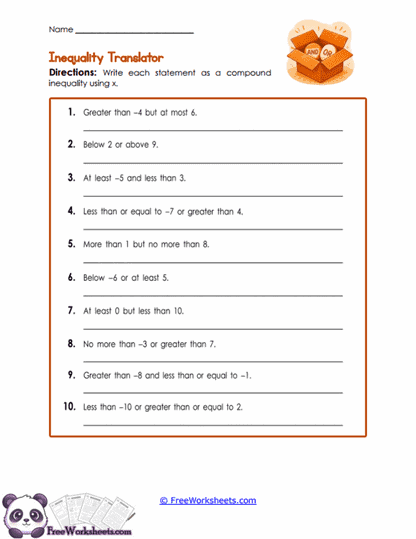
This worksheet helps ninth-grade students translate verbal statements into compound inequalities using x. Students read ten phrases such as “greater than -4 but at most 6” or “below 2 or above 9” and write the matching symbolic inequality. This gives them practice turning everyday language into precise algebra. The problems include both AND and OR relationships, so students must decide whether the condition describes one interval or two separate regions.
For example, “at least -5 and less than 3” becomes x ≥ -5 AND x < 3. A statement such as “below -6 or at least 5” becomes x < -6 OR x ≥ 5. These translations help students connect common words with mathematical symbols.
What Students Practice
Students practice interpreting phrases such as “at least,” “at most,” “more than,” “below,” and “no more than.” They then choose the correct inequality symbols and connect the statements with AND or OR. This strengthens both reading comprehension and algebraic notation.
The worksheet also helps students think about range and boundary meaning. Some statements include the boundary value, while others do not. Careful word choice determines whether students use <, >, ≤, or ≥.
Why This Skill Matters
Many real-world inequality problems begin with words rather than symbols. Students need to be able to translate those words accurately before they can solve or graph the situation. This worksheet focuses directly on that important first step.
The skill is also useful in later algebra topics involving constraints and systems. A small wording difference such as “less than” versus “at most” changes the solution set. Learning to notice those differences improves mathematical accuracy.
Common Challenges
Students often confuse “at least” with “at most.” Remind them that “at least” means the value can be equal to or greater than the boundary, while “at most” means equal to or less than it. Writing a small vocabulary reminder can help.
Another common mistake is using AND when the sentence clearly gives two separate choices. Words such as “or,” “below one value or above another,” signal a split solution. Encourage students to picture the statement on a number line.
How To Use It
Teachers can use this worksheet before students begin writing compound inequalities from full word problems. It works well for guided practice, independent work, homework, or a vocabulary-focused review. You might have students underline the key phrase in each statement before writing the inequality.
Parents and homeschool teachers can ask, “Is this giving one range between two limits, or two separate choices?” Then focus on words like at least, at most, greater than, and less than. This helps students build the inequality one piece at a time.
Grade Alignment
This Grade 9 worksheet supports CCSS HSA-CED.A.1, which involves creating equations and inequalities to represent relationships and constraints. It also reinforces HSA-REI.B.3 by preparing students to solve the compound inequalities they write. The focus on translation strengthens algebraic communication.
Students should already know the main inequality symbols and basic AND/OR logic. After this practice, they can move into writing compound inequalities from more detailed real-world situations.