
About This Worksheet
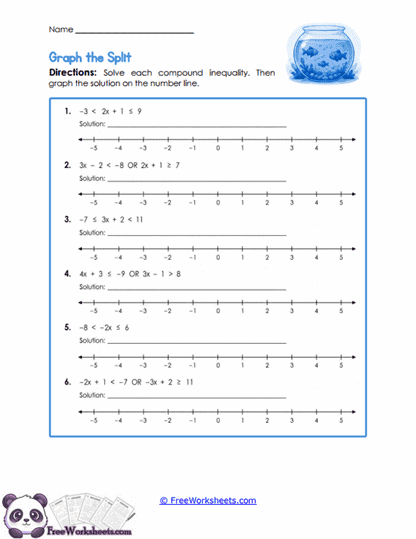
This worksheet helps ninth-grade students solve compound inequalities and graph the resulting solution sets on number lines. Students work through six problems that include both three-part AND inequalities and separate OR inequalities. After solving each one, they represent the answer visually using endpoints and shading. This gives students practice connecting symbolic solutions with the number-line picture they create.
For example, a solution such as -3 < x ≤ 4 should be graphed between -3 and 4, using an open circle at -3 and a closed circle at 4. An OR solution such as x < -2 or x ≥ 3 should be shown as two separate rays. These contrasting cases help students see the difference between connected and split solution sets.
What Students Practice
Students practice solving both AND and OR compound inequalities before graphing them. They must choose open or closed circles based on the symbols and shade either between the endpoints or outward in two directions. This combines algebraic solving with visual interpretation.
The worksheet also reinforces negative-number placement on a number line. Students need to locate endpoints carefully and make sure their shading matches the final inequality. This helps build stronger number sense along with algebra skills.
Why This Skill Matters
A graph makes a compound inequality much easier to understand. Students can see whether the solution forms one connected interval or two separate regions. That visual meaning helps reinforce the logical difference between AND and OR.
This skill is also useful later when students work with interval notation, absolute value inequalities, and systems of inequalities. Being able to move between symbolic and graphical forms is a key Algebra 1 habit.
Common Challenges
Students may solve correctly but graph the wrong region. Remind them that AND usually shades between the boundaries, while OR usually shades outward into separate regions. Reading the final solution aloud can help them decide where the shading belongs.
Another common mistake is using the wrong endpoint style. Strict inequalities use open circles, while inequalities that include equality use closed circles. Encourage students to check each symbol before drawing.
How To Use It
Teachers can use this worksheet after students have practiced solving compound inequalities symbolically. It works well for independent classwork, guided review, homework, or a graphing station. Completing one AND example and one OR example together can make the visual difference clear.
Parents and homeschool teachers can ask, “Is the solution between two numbers or outside them?” Then ask whether each endpoint is included. Those two questions guide most of the graphing decisions.
Grade Alignment
This Grade 9 worksheet supports CCSS HSA-REI.B.3 through solving and graphing linear inequalities in one variable. It also strengthens students’ ability to represent the same solution set in symbolic and visual forms. The mixed AND and OR format makes it useful for broader compound inequality review.
Students should already understand how to solve basic compound inequalities. After this practice, they can move into matching graphs with inequalities and interpreting real-world solution ranges.