
About This Worksheet
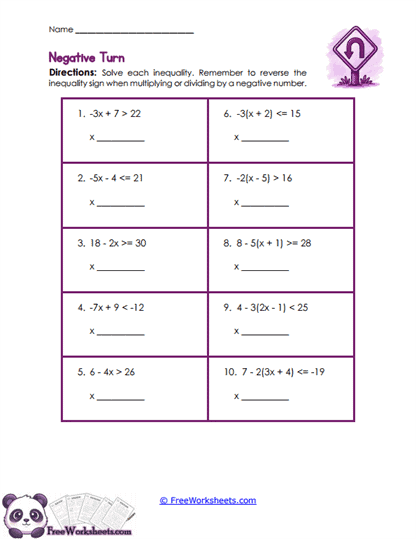
This worksheet helps ninth-grade students solve multi-step linear inequalities that involve negative coefficients and sign reversals. Students work through ten problems containing distribution, subtraction, addition, and negative multipliers. The main goal is to isolate x while remembering to reverse the inequality whenever the final solving step divides or multiplies by a negative value. This gives students repeated practice with a rule that becomes harder to spot as the equations grow longer.
For example, in an inequality such as -3x + 7 > 22, students first subtract 7 and then divide by -3. Because that last operation uses a negative divisor, the inequality symbol must reverse. Other problems require distribution before students can reach the step where x is isolated.
What Students Practice
Students practice simplifying linear inequalities and keeping track of negative signs throughout the process. They use inverse operations, distribute when needed, and reverse the inequality symbol at the correct moment. This develops both algebra fluency and careful attention to signs.
The worksheet also gives students practice with several inequality symbols. Some problems use strict inequalities, while others include equality. Students must preserve the correct symbol type even when its direction changes.
Why This Skill Matters
Negative coefficients are one of the biggest sources of errors in inequality work. Students may understand the algebra but forget that dividing by a negative changes the order relationship. Focused practice helps turn that extra rule into a normal part of the solving routine.
The skill also prepares students for more complicated inequalities with variables on both sides. Once students can manage negative coefficients confidently, they are better able to focus on other steps such as distribution and combining terms.
Common Challenges
Students may reverse the sign too early, such as when subtracting a number from both sides. The inequality should reverse only when the operation is multiplication or division by a negative quantity. Encourage students to mark that exact step before changing the symbol.
Another common mistake is doing the algebra correctly but forgetting that ≤ and ≥ must also reverse direction. The equality part remains, but the direction changes. Reading the finished inequality aloud can help students check whether it makes sense.
How To Use It
Teachers can use this worksheet after students understand basic one- and two-step inequality solving. It works well for independent practice, guided review, homework, or intervention for students who continue to miss sign reversals. Modeling one problem with distribution can show how the sign rule fits into a longer solution.
Parents and homeschool teachers can have students solve normally until they reach the step that divides by the coefficient of x. At that point, ask whether the coefficient is positive or negative. If it is negative, remind them to turn the inequality sign around.
Grade Alignment
This Grade 9 worksheet supports CCSS HSA-REI.B.3 through solving linear inequalities in one variable. It also reinforces equation-solving reasoning and the properties of inequality. The negative-coefficient focus gives students important preparation for more complex Algebra 1 problems.
Students should already know how to distribute and solve basic inequalities. After this practice, they can move into inequalities with variables on both sides and more complicated expressions.