
Sequences (Arithmetic & Geometric) Worksheets
These worksheets help students identify patterns, write formulas, compare growth, and model real-world situations using arithmetic and geometric relationships. These free, ready-to-print worksheets come in PDF format for immediate classroom use, homework assignments, intervention support, or independent review. Students strengthen algebra reasoning, recursive thinking, formula writing, graph interpretation, and sequence modeling skills through structured practice and applied problem-solving activities.
About This Collection of Worksheets
This collection of arithmetic and geometric sequence worksheets gives students meaningful practice identifying patterns, classifying sequences, writing recursive and explicit formulas, and analyzing growth behavior. Students work with tables, graphs, formulas, verbal descriptions, real-world models, and discrete functions while building both conceptual understanding and procedural fluency. The activities help learners recognize how sequences grow through repeated addition or repeated multiplication and connect those patterns to algebraic representations.
The worksheets include sequence classification activities, formula-writing exercises, missing-term challenges, recursive and explicit formula matching, graph interpretation tasks, growth comparisons, and real-world applications involving finance, social media, depreciation, subscriptions, and population growth. Students practice finding common differences and common ratios, analyzing long-term behavior, interpreting sequence graphs, and justifying why patterns behave mathematically the way they do. The progression of activities supports both foundational sequence understanding and deeper reasoning about linear versus exponential growth.
Teachers can use these printable PDF worksheets for guided instruction, independent practice, review lessons, homework, intervention, enrichment, or assessment preparation. The layouts provide organized workspaces for calculations, written explanations, graph sketches, and formula development. The mix of symbolic reasoning and practical modeling also helps students connect sequence concepts to real-world growth situations and long-term prediction skills.

Paul’s Teacher Tip
Students are usually more successful with sequences when they slow down and focus on how the pattern changes between terms before writing formulas. Encourage learners to compare consecutive terms carefully and decide whether the pattern grows through addition or multiplication. Many mistakes happen because students assume every growing pattern is arithmetic or because they confuse percentage growth with repeated addition. Writing out several terms from a formula before committing to an answer can help students catch errors quickly. It also helps students understand long-term behavior when they compare arithmetic growth to geometric growth side by side. Asking students to explain why a sequence is arithmetic or geometric in words often strengthens both reasoning and formula accuracy.
Worksheet Collection Skill Spotlights
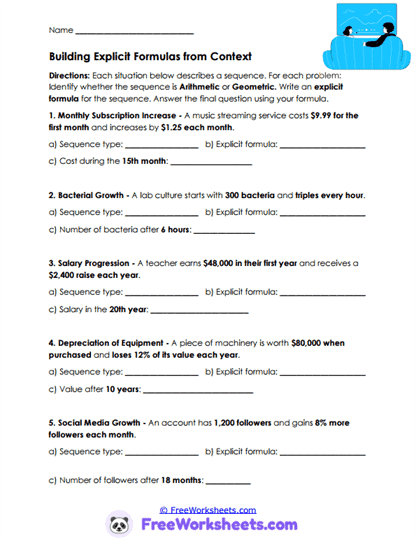
Formula Builder
- What Kids Do:
Students write explicit formulas for arithmetic and geometric sequences involving subscriptions, salaries, depreciation, bacterial growth, and follower counts. - Target Skill:
Students strengthen sequence modeling and formula-writing skills by connecting common differences and ratios to explicit algebraic representations.
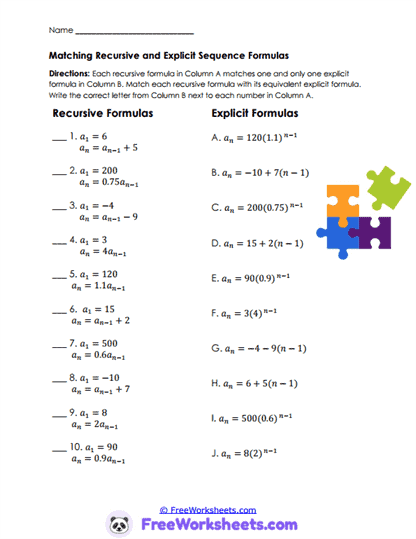
Formula Match
- What Kids Do:
Students compare recursive and explicit formulas, generate sample terms, and match formulas that produce the same arithmetic or geometric sequence. - Target Skill:
Students improve flexibility with sequence notation by connecting recursive rules to equivalent explicit formulas and pattern structures.
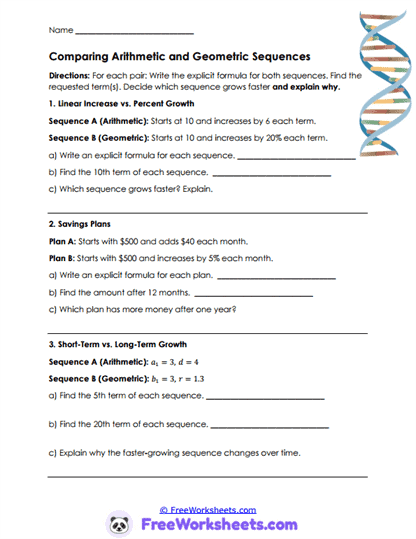
Growth Battle
- What Kids Do:
Students compare arithmetic and geometric growth patterns using formulas, tables, and real-world situations involving savings, subscribers, and percent growth. - Target Skill:
Students strengthen understanding of long-term growth behavior by analyzing how linear and exponential patterns change over time.
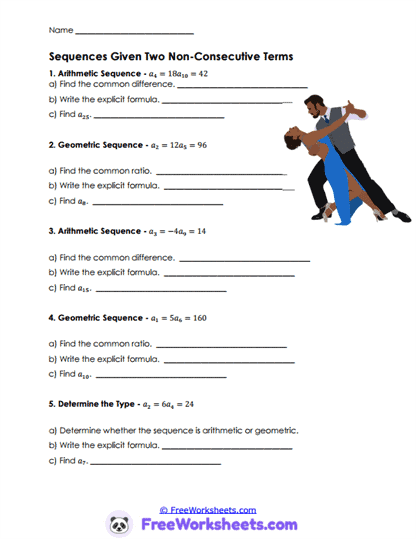
Hidden Rules
- What Kids Do:
Students determine sequence formulas from non-consecutive terms while identifying whether patterns are arithmetic or geometric. - Target Skill:
Students improve algebraic reasoning and pattern reconstruction skills by solving for common differences, ratios, and explicit formulas.
Missing Terms
- What Kids Do:
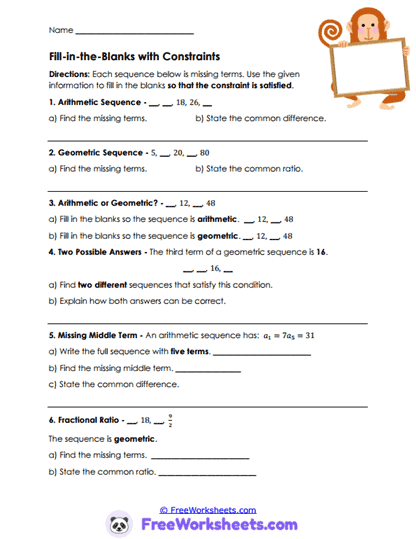
Students complete arithmetic and geometric sequences by finding missing values, middle terms, and possible pattern rules. - Target Skill:
Students strengthen sequence fluency and pattern analysis by identifying consistent changes between terms accurately.
Pattern Hunt
- What Kids Do:
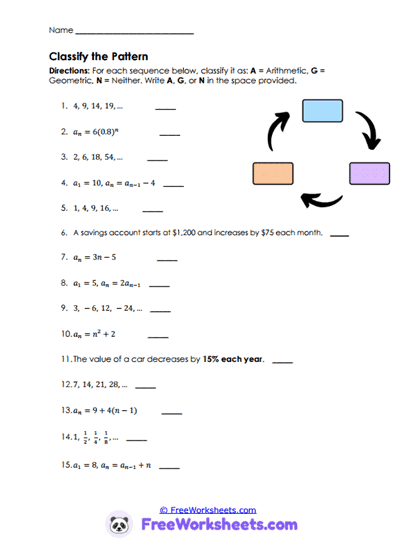
Students classify number patterns, formulas, recursive rules, and contextual situations as arithmetic, geometric, or neither. - Target Skill:
Students improve sequence classification skills by analyzing common differences and common ratios across multiple representations.
Pattern Proof
- What Kids Do:
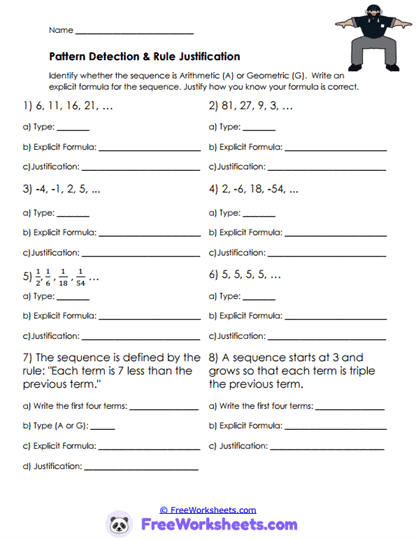
Students write formulas, classify sequences, and explain why arithmetic or geometric rules correctly model each pattern. - Target Skill:
Students strengthen mathematical communication and sequence reasoning by defending formulas with written explanations and evidence.
Sequence Clues
- What Kids Do:
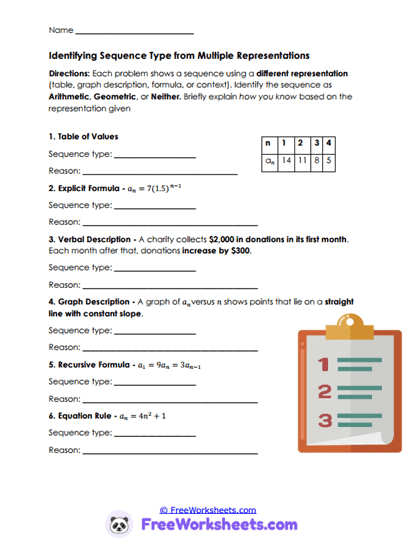
Students analyze tables, graphs, formulas, recursive rules, and verbal descriptions to identify hidden arithmetic and geometric patterns. - Target Skill:
Students deepen conceptual understanding of sequences by comparing multiple representations and justifying conclusions mathematically.
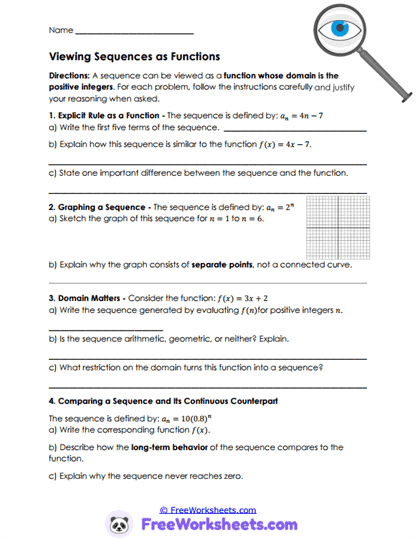
Sequence Lens
- What Kids Do:
Students graph sequence terms, compare sequences to continuous functions, and analyze why sequence graphs use discrete points. - Target Skill:
Students strengthen understanding of sequences as discrete functions by connecting formulas, domains, and graph behavior.
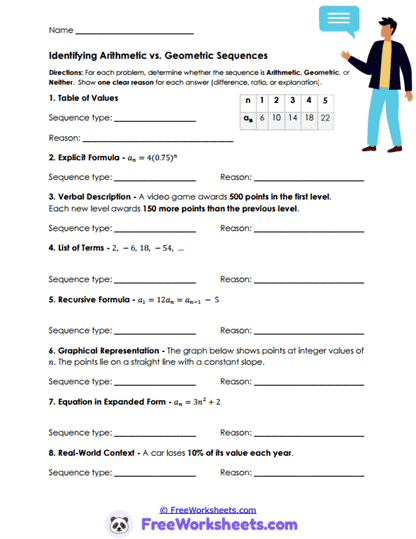
Sequence Types
- What Kids Do:
Students classify sequences shown through tables, formulas, graphs, and verbal descriptions using common differences and ratios. - Target Skill:
Students build foundational sequence reasoning by distinguishing between arithmetic growth, geometric growth, and unrelated patterns.
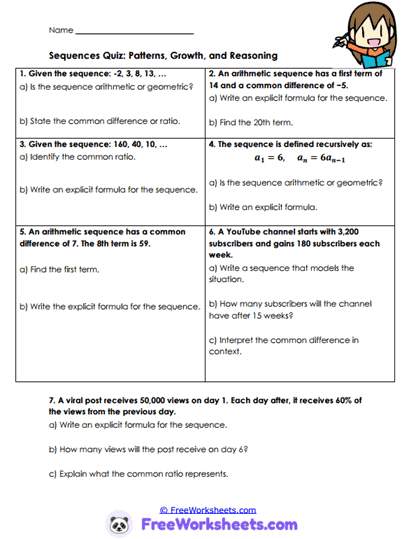
Trend Check
- What Kids Do:
Students complete mixed review problems involving recursive rules, explicit formulas, missing terms, and real-world sequence modeling. - Target Skill:
Students reinforce overall sequence fluency by combining classification, formula writing, growth analysis, and interpretation skills.
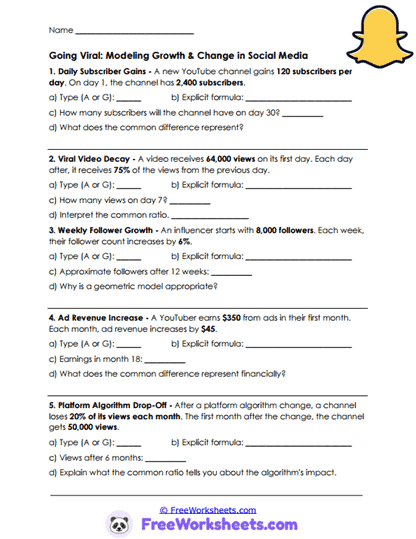
Viral Growth
- What Kids Do:
Students model subscriber growth, views, revenue, and online trends using arithmetic and geometric sequences tied to social media scenarios. - Target Skill:
Students improve applied sequence modeling skills by connecting formulas and growth patterns to realistic digital and online contexts.