
About This Worksheet
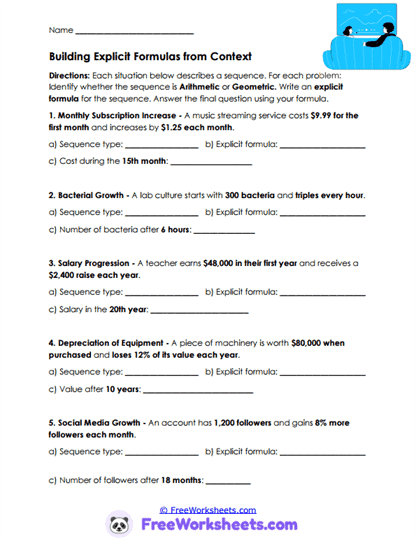
Explicit formulas help describe sequences efficiently without listing every term. This worksheet helps students create formulas from real-world contexts involving growth, depreciation, salaries, and subscriptions. Students identify whether situations are arithmetic or geometric before writing formulas. The activity strengthens modeling skills and sequence reasoning.
Curriculum and Grade Alignment
This worksheet supports Algebra 2 standards involving explicit formulas for arithmetic and geometric sequences. The main learning goal is to write formulas from contextual information and evaluate future terms. Students should already understand common differences and common ratios before beginning. The next learning step is recursive formulas and advanced sequence modeling. This aligns with high school algebra sequence standards.
Student Tasks
On this worksheet, students will determine whether situations are arithmetic or geometric and write explicit formulas. They will model subscriptions, bacterial growth, salary increases, depreciation, and follower growth. Students also calculate future values using the formulas they create. Several problems require interpreting real-world growth patterns.
Common Challenges and Misconceptions
Some students may confuse arithmetic increases with percentage growth. Others may incorrectly identify the starting value or ratio in geometric situations. A common mistake is using the wrong exponent or term number in explicit formulas. Teachers can help by emphasizing how each term changes from the previous one.
Implementation Guidance
This worksheet works well after students understand sequence classification. Teachers can model one arithmetic and one geometric example before assigning practice. Parents helping at home can encourage students to explain why a situation grows additively or multiplicatively. Discussion helps reinforce understanding.
Details and Features
The worksheet includes contextual sequence modeling involving finance, growth, and depreciation. Students practice writing and evaluating explicit formulas for multiple types of patterns. The printable format supports organized work and formula writing. The application-based structure helps students connect algebra to realistic situations.