
Matrices Worksheets
These worksheets help students organize data, perform matrix operations, solve systems, and apply transformations using structured numerical arrays. These free, ready-to-print worksheets come in PDF format for immediate classroom use, homework assignments, intervention support, or independent review. Students strengthen reasoning skills involving dimensions, matrix multiplication, determinants, inverses, transformations, and numerical modeling through guided practice and applied problem solving.
About This Collection of Worksheets
This collection of matrices worksheets gives students meaningful practice interpreting matrix notation, identifying dimensions, performing operations, and applying matrices to real-world situations. Students work with matrix addition, subtraction, scalar multiplication, matrix multiplication, determinants, inverses, transformations, and systems of equations while building both procedural fluency and conceptual understanding. The activities help learners connect organized numerical structures to algebraic reasoning, modeling, and problem solving.
The worksheets include dimension analysis, operation checks, determinant calculations, inverse matrix problems, vector transformations, input-output models, data organization tasks, and matrix-based applications involving prices, quantities, and systems. Students practice determining whether operations are defined, performing row-column multiplication carefully, organizing structured calculations, and interpreting matrix results in context. The progression of activities supports both foundational understanding and more advanced matrix applications.
Teachers can use these printable PDF worksheets for guided instruction, independent practice, review lessons, homework, intervention, enrichment, or assessment preparation. The layouts provide organized workspaces for calculations, written explanations, tables, and matrix notation. The variety of conceptual and application-based problems also helps students strengthen logical reasoning while connecting matrix operations to practical modeling situations.

Paul’s Teacher Tip
Students are usually more successful with matrices when they slow down and organize dimensions before beginning any calculations. Encourage learners to label rows and columns clearly and check compatibility rules before attempting operations like multiplication or addition. Many mistakes happen because students rush through row-column multiplication or confuse operation rules between addition and multiplication. It also helps students to describe what each row and column represents in real-world modeling problems before solving. Visual organization is especially important when working with determinants, inverses, and systems because one small arithmetic error can affect the entire result. Asking students to explain why an operation is or is not possible often improves both conceptual understanding and calculation accuracy.
Worksheet Collection Skill Spotlights
Data Models
- What Kids Do:
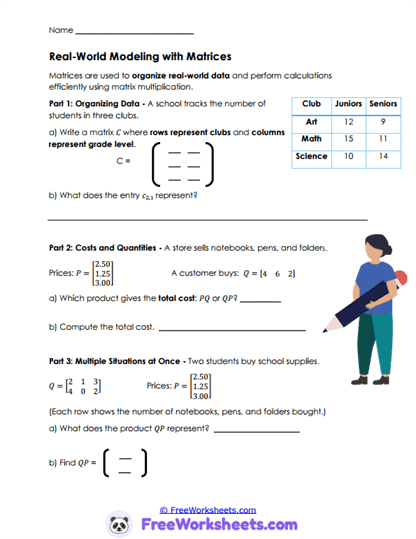
Students organize real-world information into rows and columns, calculate totals using multiplication operations, and interpret numerical models involving prices and quantities. - Target Skill:
Students strengthen mathematical modeling skills by connecting organized numerical structures to practical situations involving multiplication and data interpretation.
Grid Review
- What Kids Do:
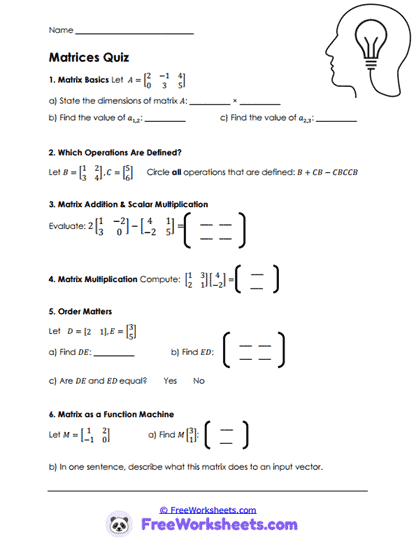
Students review dimensions, operations, multiplication, and vector transformations while solving mixed problems involving organized number grids. - Target Skill:
Students reinforce overall matrix fluency by combining dimension analysis, operations, transformations, and structured calculations across multiple formats.
Input Arrays
- What Kids Do:
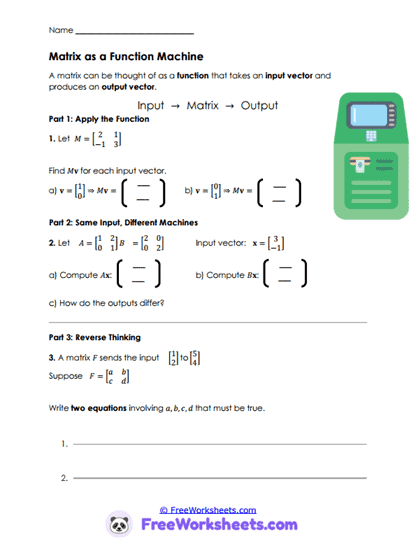
Students apply numerical arrays to vectors, calculate transformed outputs, and compare how different arrays affect the same input values. - Target Skill:
Students improve transformation reasoning by connecting row-column multiplication to input-output behavior and coordinate changes.
Matrix Inverses
- What Kids Do:
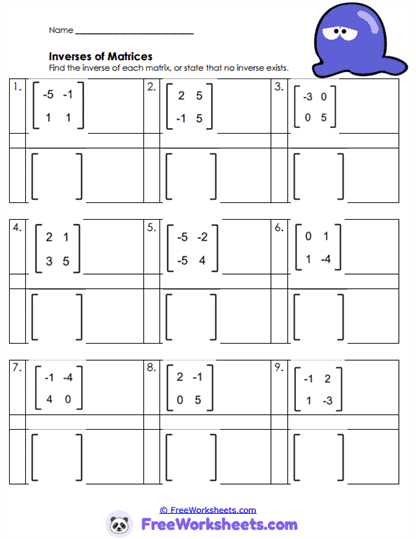
Students determine whether matrices are invertible, compute determinants, and calculate inverses of 2×22 \times 22×2 matrices using structured formulas. - Target Skill:
Students strengthen inverse-matrix fluency by applying determinant rules carefully and organizing multi-step calculations accurately.
Matrix Mixing
- What Kids Do:
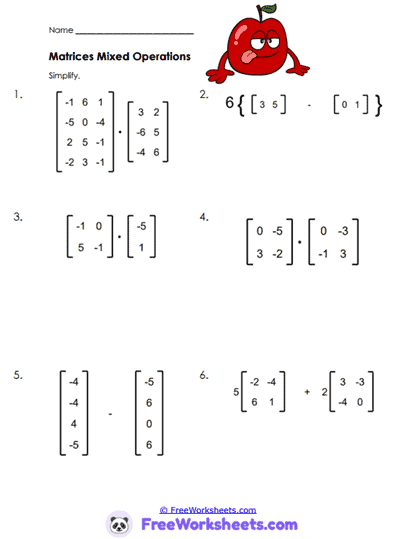
Students simplify expressions involving matrix addition, subtraction, scalar multiplication, and multiplication while checking dimension compatibility. - Target Skill:
Students improve operation fluency by distinguishing between matrix rules and applying each operation correctly within mixed expressions.
Matrix Products
- What Kids Do:
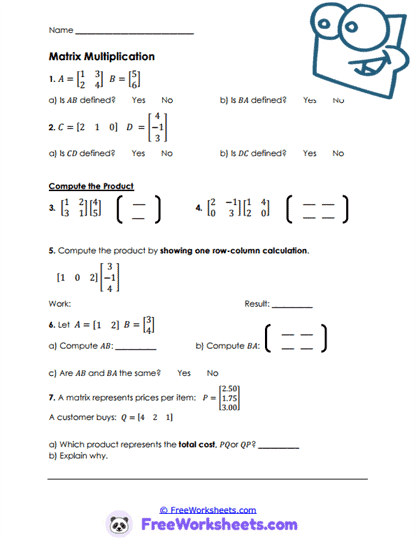
Students determine whether matrix products are defined and perform row-column multiplication to calculate matrix products step by step. - Target Skill:
Students strengthen multiplication reasoning by analyzing dimensions carefully and applying row-column procedures accurately.
Number Arrays
- What Kids Do:
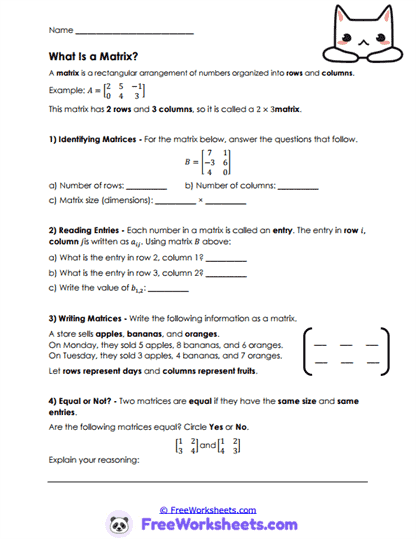
Students identify rows, columns, dimensions, and entries while organizing and interpreting information displayed inside numerical arrays. - Target Skill:
Students build foundational matrix understanding by reading matrix notation accurately and recognizing organized numerical structures.
Number Grids
- What Kids Do:
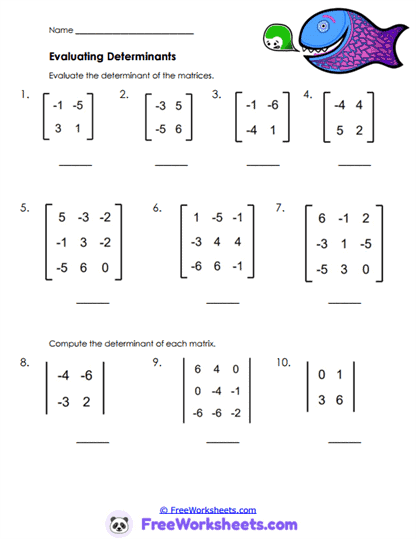
Students evaluate determinants of 2×22 \times 22×2 and 3×33 \times 33×3 arrays using organized multiplication and subtraction procedures. - Target Skill:
Students strengthen determinant fluency by applying structured arithmetic carefully and interpreting determinant notation accurately.
Number Stories
- What Kids Do:
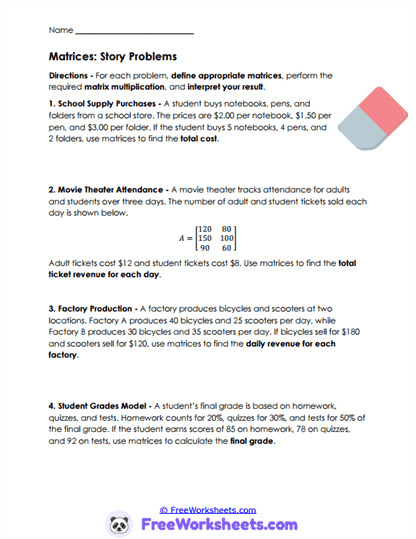
Students solve real-world problems involving attendance, grades, production totals, and revenue using organized numerical operations and structured calculations. - Target Skill:
Students improve applied reasoning skills by organizing information into numerical structures and interpreting results within practical contexts.
Operation Choices
- What Kids Do:
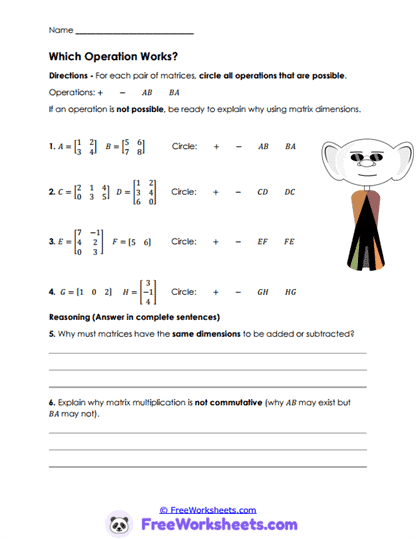
Students determine whether addition, subtraction, or multiplication operations are possible by comparing dimensions and analyzing compatibility rules. - Target Skill:
Students strengthen conceptual matrix understanding by applying dimension rules correctly and explaining why certain operations work or fail.
Rule Solvers
- What Kids Do:
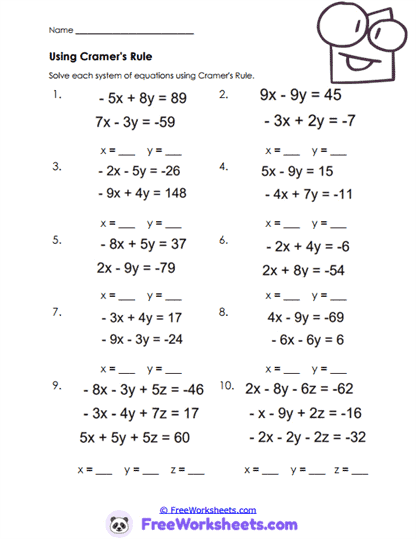
Students solve systems of equations using determinants and Cramer’s Rule while organizing substitution formulas and multi-step calculations carefully. - Target Skill:
Students improve system-solving fluency by connecting determinants to algebraic solutions and organizing structured matrix reasoning accurately.
Variable Arrays
- What Kids Do:
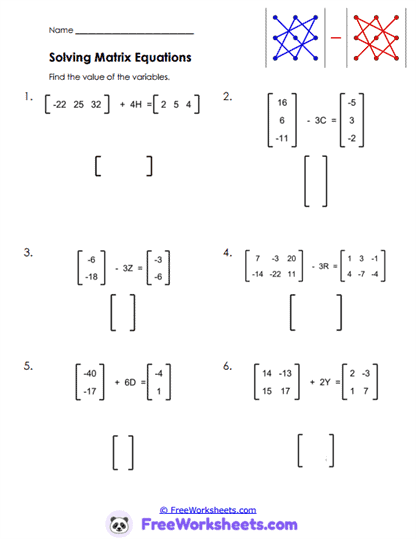
Students solve equations involving unknown values inside numerical arrays using subtraction, scalar operations, and algebraic reasoning. - Target Skill:
Students strengthen equation-solving and matrix reasoning skills by applying operations consistently across every entry in an array.