
Derivatives Worksheets
These worksheets help students explore rates of change, derivative notation, polynomial differentiation, and real-world calculus applications through structured practice activities. These free, ready-to-print worksheets come in PDF format for immediate classroom use, homework assignments, intervention support, or independent review. Students strengthen conceptual understanding, algebra fluency, and differentiation skills while connecting derivatives to motion, growth, speed, and changing behavior in functions.
About This Collection of Worksheets
This collection of derivatives worksheets gives students meaningful practice interpreting rates of change, estimating derivatives from tables, differentiating polynomial functions, and applying derivative reasoning to practical situations. Students work with average and instantaneous rates of change, derivative notation, the power rule, derivative evaluation, and real-world motion problems while strengthening both conceptual understanding and procedural fluency. The activities help learners connect algebraic differentiation to changing behavior in functions and real-life contexts.
The worksheets include polynomial differentiation exercises, derivative notation interpretation, table-based derivative estimation, conceptual comparison problems, and applied rate-of-change situations involving motion, speed, growth, and data analysis. Students practice applying the power rule, simplifying derivatives, evaluating derivatives at specific values, and explaining what derivatives represent in context. The progression of activities supports a gradual transition from conceptual derivative ideas to formal differentiation skills and applications.
Teachers can use these printable PDF worksheets for guided instruction, independent practice, homework, intervention, review lessons, enrichment, or assessment preparation. The layouts provide organized workspaces for calculations, tables, written explanations, and symbolic reasoning. The variety of conceptual and procedural activities also helps students build stronger confidence connecting calculus ideas to graphs, functions, and everyday change.

Paul’s Teacher Tip
Students usually understand derivatives more clearly when they think about them as descriptions of change instead of just algebra rules. Encourage learners to connect every derivative problem back to the idea of speed, growth, slope, or change at a specific moment. Many mistakes happen because students rush through the power rule without checking coefficients or exponents carefully, so organized line-by-line work is important. It also helps students to explain what a derivative means in words before solving symbolically. Motion examples involving speed, distance, and changing movement often make derivatives feel much more intuitive. Asking students whether a function is changing quickly or slowly before calculating can strengthen both conceptual understanding and procedural accuracy.
Worksheet Collection Skill Spotlights
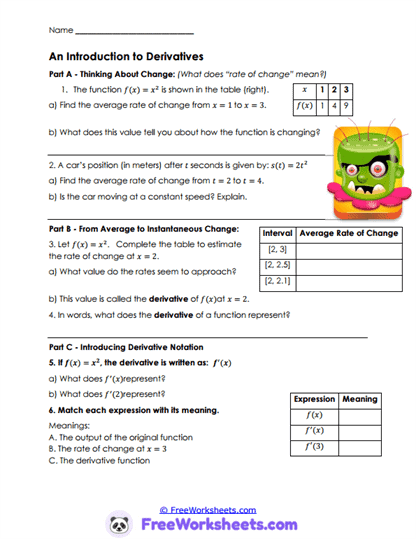
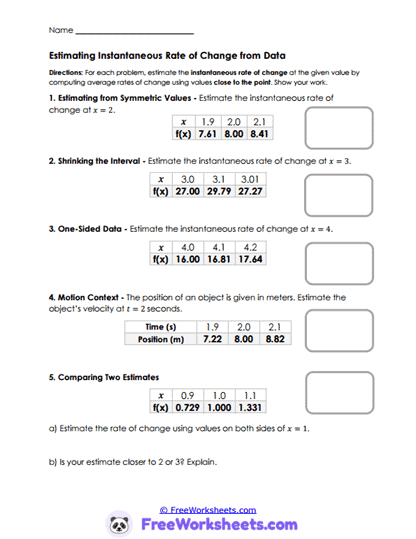
Change Rates
- What Kids Do:
Students calculate average rates of change from tables and estimate instantaneous rates of change by comparing intervals that shrink around a specific point. - Target Skill:
Students strengthen conceptual understanding of derivatives by connecting average change to instantaneous rates of change and interpreting derivatives as changing behavior.
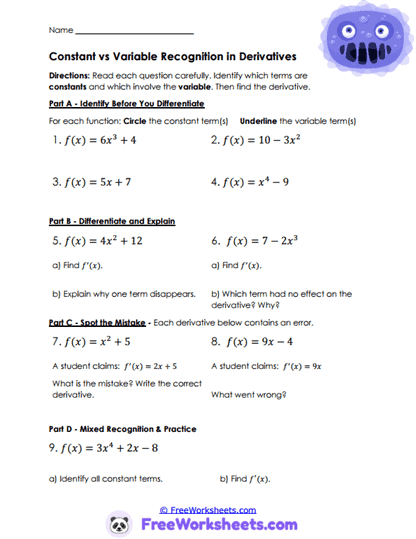
Constant Clues
- What Kids Do:
Students identify constants and variable terms, compute derivatives, and analyze why constant terms disappear during differentiation. - Target Skill:
Students improve derivative reasoning by distinguishing between changing and non-changing terms and applying foundational differentiation rules accurately.
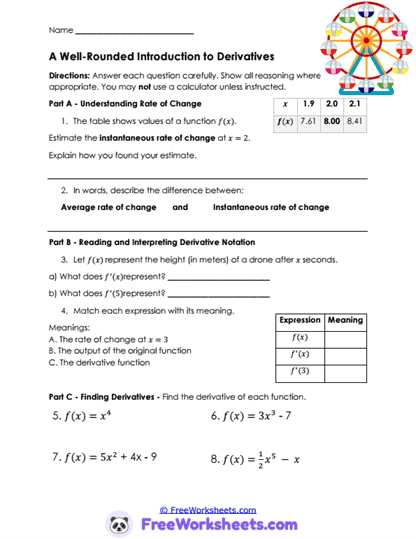
Derivative Basics
- What Kids Do:
Students interpret derivative notation, estimate rates of change from tables, and differentiate polynomial expressions using the power rule. - Target Skill:
Students strengthen foundational calculus fluency by connecting derivative notation, rates of change, and polynomial differentiation together.
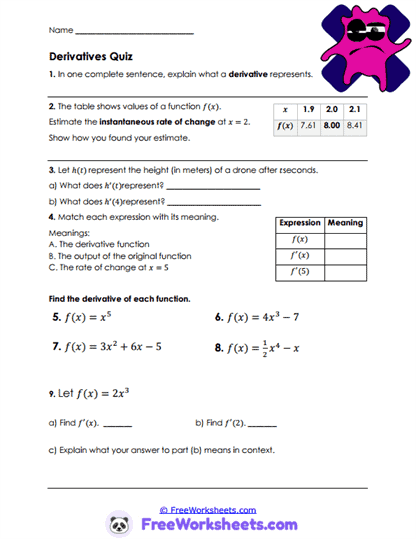
Derivative Review
- What Kids Do:
Students complete mixed review problems involving derivative notation, polynomial differentiation, derivative evaluation, and instantaneous rate-of-change estimation. - Target Skill:
Students reinforce overall derivative fluency by combining conceptual understanding, algebraic differentiation, and interpretation skills across multiple formats.
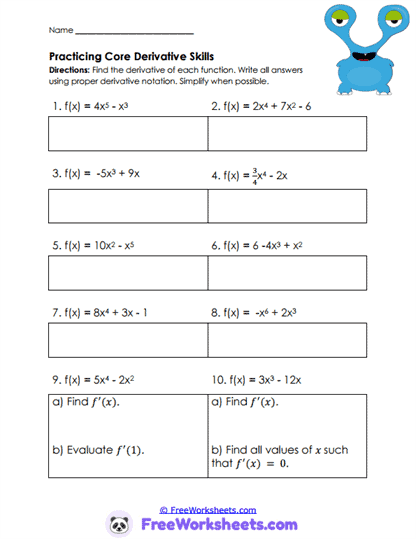
Derivative Skills
- What Kids Do:
Students differentiate polynomial functions, simplify derivative expressions, and evaluate derivatives at specific values of xxx. - Target Skill:
Students improve procedural differentiation fluency by applying the power rule carefully and connecting algebraic simplification to derivative notation.
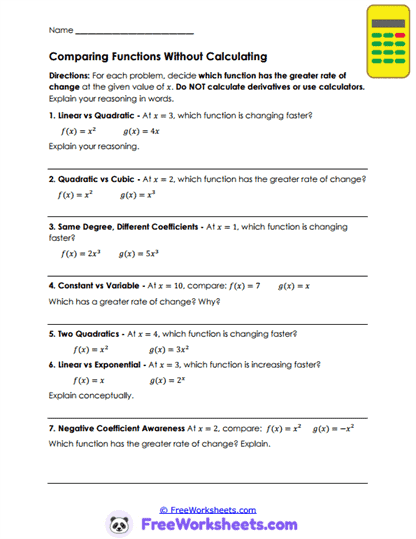
Function Speeds
- What Kids Do:
Students compare how quickly different functions change by analyzing linear, quadratic, cubic, and exponential behavior conceptually. - Target Skill:
Students strengthen conceptual rate-of-change reasoning by comparing function behavior without relying only on formal derivative calculations.
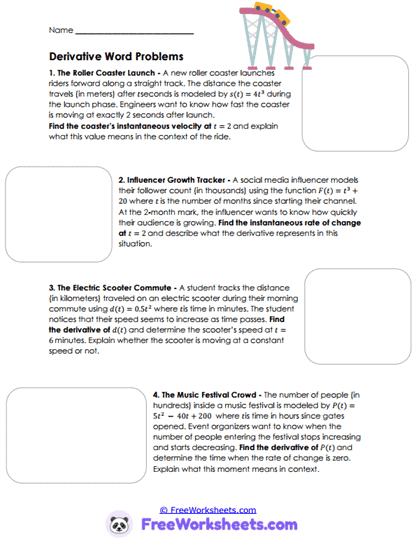
Motion Rates
- What Kids Do:
Students solve real-world derivative problems involving roller coasters, scooters, attendance growth, and changing motion situations. - Target Skill:
Students apply derivatives as rates of change by interpreting velocity, growth, and changing quantities within practical contexts.
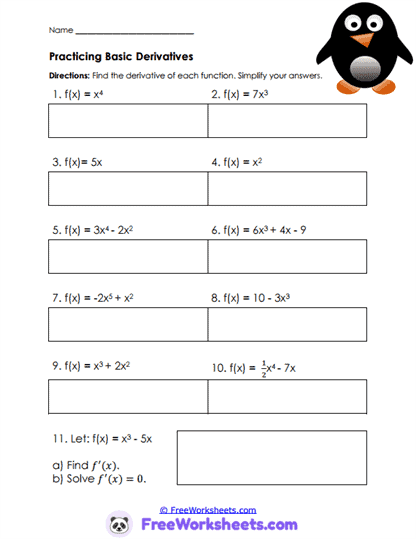
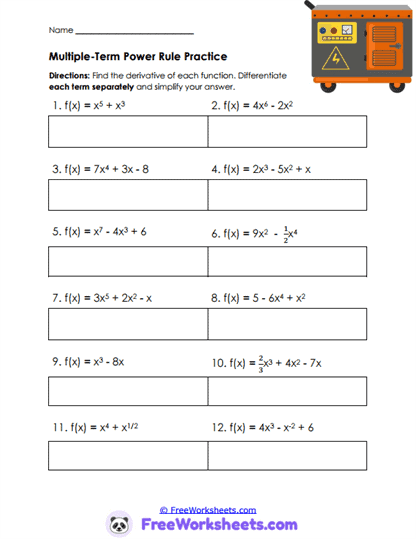
Power Practice
- What Kids Do:
Students differentiate polynomial expressions using the power rule and solve simple equations involving derivative expressions. - Target Skill:
Students strengthen procedural differentiation skills by applying the power rule consistently across multi-term polynomial functions.
Power Steps
- What Kids Do:
Students differentiate longer polynomial expressions involving multiple terms, coefficients, radicals, and fractional exponents. - Target Skill:
Students improve algebra accuracy and derivative fluency by applying the power rule carefully to every term in a function.
Rate Estimates
- What Kids Do:
Students estimate instantaneous rates of change from numerical tables by comparing nearby values around target points. - Target Skill:
Students develop intuitive derivative understanding by using small interval slopes to estimate rates of change numerically.
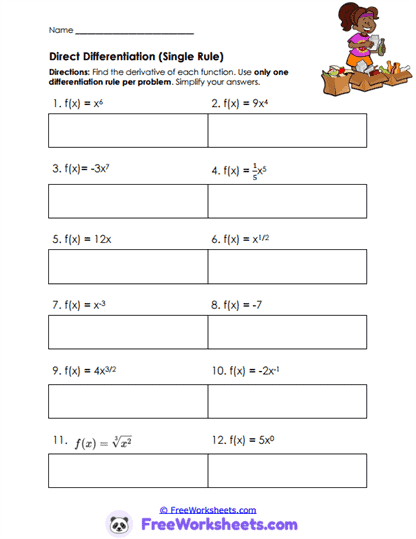
Single Rules
- What Kids Do:
Students differentiate single-term expressions involving powers, constants, radicals, and fractional exponents using one differentiation rule. - Target Skill:
Students strengthen foundational derivative fluency by applying the power rule accurately across different exponent forms.
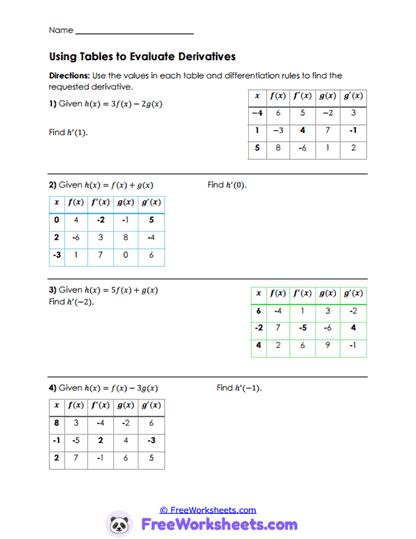
Table Changes
- What Kids Do:
Students use tables of function values and derivative values to calculate derivatives of combined functions using derivative operation rules. - Target Skill:
Students improve derivative-operation reasoning by applying addition, subtraction, and product rules using organized numerical data tables.