
About This Worksheet
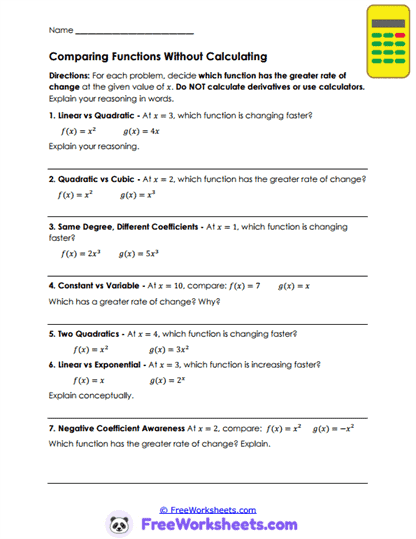
Different functions can change at very different speeds, even without calculating exact derivatives. This worksheet helps students compare how quickly functions change at certain values of x. Students use reasoning, patterns, and function behavior to decide which function grows or changes faster. For example, students compare quadratic, cubic, exponential, and linear functions at specific points. The activity helps students think about derivatives conceptually before focusing only on formulas.
Curriculum and Grade Alignment
This worksheet supports introductory calculus standards involving rates of change and derivative reasoning. The main learning goal is to compare function behavior without directly calculating derivatives. Students should already understand function families and basic growth patterns before beginning. The next learning step is formally computing and interpreting derivative values. This aligns with introductory calculus standards involving conceptual analysis of changing functions.
Student Tasks
On this worksheet, students will compare rates of change between different functions. They will explain which function changes faster at specific values of xxx. Students also analyze linear, quadratic, cubic, and exponential behavior conceptually. Several problems ask learners to justify their thinking using words instead of calculations.
Common Challenges and Misconceptions
Some students may assume larger function outputs always mean faster rates of change. Others may confuse growth size with growth speed. A common mistake is focusing only on coefficients while ignoring exponents and function types. Teachers can help by encouraging students to think about how steeply functions increase near the chosen value.
Implementation Guidance
This worksheet works well before or alongside formal derivative calculations. Teachers can model visual comparisons between functions using graphs or tables. Parents helping at home can ask students to describe which function “climbs faster” and why. Everyday language about speed and growth often strengthens conceptual understanding.
Details and Features
The worksheet includes conceptual comparison problems involving polynomial, linear, and exponential functions. Students explain changing behavior without computing exact derivatives. The printable format provides space for written explanations and reasoning practice. The progression encourages deeper understanding of rates of change and function behavior.