
Polynomial Expressions And Equations Worksheets
These worksheets help students simplify expressions, solve polynomial equations, analyze graphs, and model real-world situations using algebraic reasoning. These free, ready-to-print worksheets come in PDF format for immediate classroom use, homework assignments, intervention support, or independent review. Students strengthen skills involving factoring, roots, graph behavior, polynomial structure, algebraic modeling, and equation solving through structured practice and application-based activities.
About This Collection of Worksheets
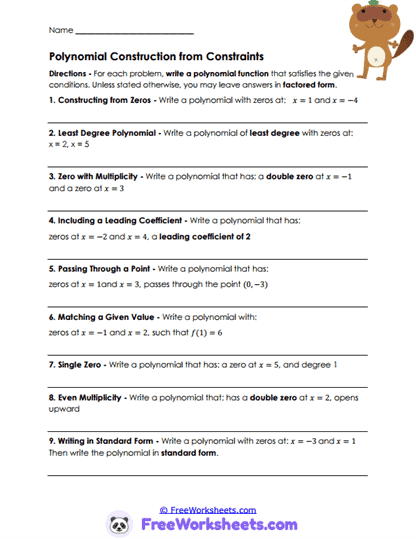
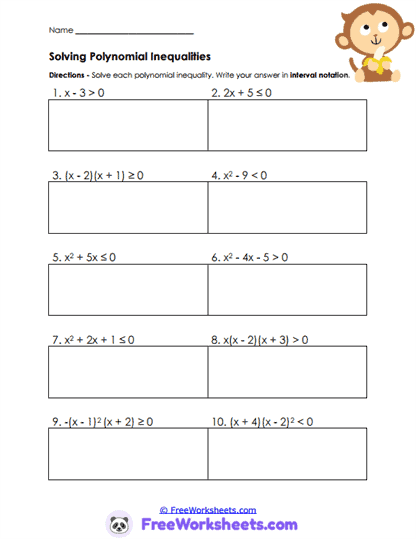
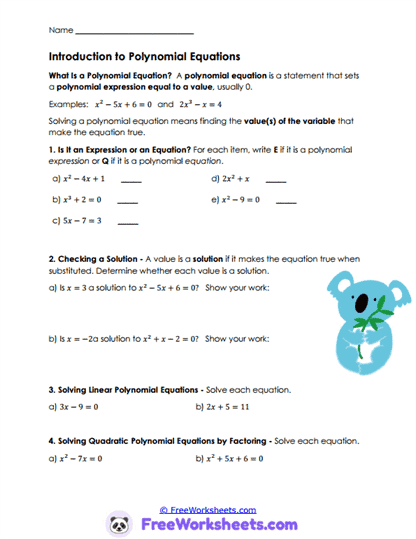
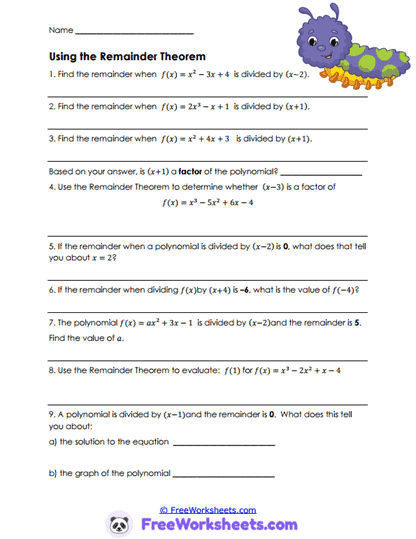
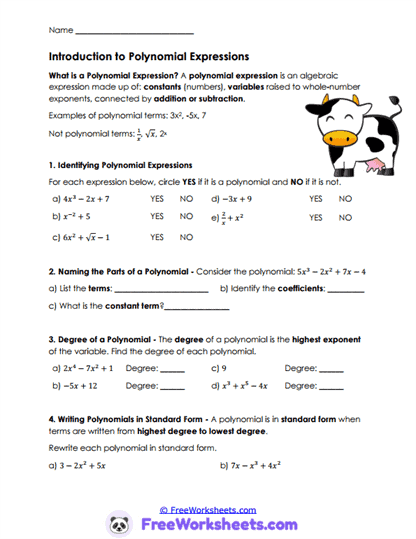
This collection of polynomial expressions and equations worksheets gives students meaningful practice simplifying expressions, solving equations, analyzing roots, interpreting graphs, and modeling real-world situations using algebraic relationships. Students work with factoring, polynomial roots, graph behavior, algebraic simplification, the Remainder Theorem, polynomial modeling, and equation-solving applications while building both conceptual understanding and procedural fluency. The activities help learners connect algebraic structure to graphical behavior, practical modeling, and mathematical reasoning.
The worksheets include graph-matching activities, polynomial modeling problems, simplification exercises, equation-solving tasks, root analysis, factor reasoning, and real-world applications involving geometry, production, motion, seating arrangements, and sales. Students practice interpreting roots and multiplicities, connecting factors to graph behavior, simplifying expressions carefully, evaluating polynomial structure, and deciding whether solutions make sense within context. The progression of activities supports both foundational algebra fluency and deeper polynomial analysis.
Teachers can use these printable PDF worksheets for guided instruction, independent practice, homework, review lessons, intervention, enrichment, or assessment preparation. The layouts provide organized workspaces for calculations, graph analysis, written explanations, and algebraic modeling. The mix of conceptual reasoning and real-world application also helps students strengthen confidence connecting symbolic algebra to meaningful problem-solving situations.
Paul’s Teacher Tip
Students are usually more successful with polynomial work when they slow down and focus on structure before solving. Encourage learners to identify degree, factors, roots, and expression patterns before jumping into calculations. Many mistakes happen because students skip simplification steps, forget to distribute correctly, or stop factoring too early. Graphing quick sketches can also help students connect roots, multiplicities, and end behavior to what the algebra is describing. Real-world modeling problems become easier when students clearly define variables before building equations. Asking students to explain what each term or factor represents in words often improves both reasoning and accuracy.
Worksheet Collection Skill Spotlights
Algebra Paths
- What Kids Do:
Students solve multi-step algebra problems involving simplification, factoring, equation solving, and reasoning while organizing detailed algebraic work carefully. - Target Skill:
Students strengthen procedural fluency and algebra reasoning by combining multiple algebraic techniques within structured multi-step problems.
Equation Roots
- What Kids Do:
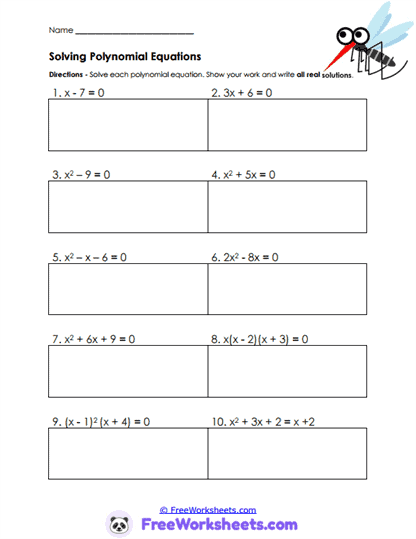
Students solve polynomial equations using factoring, zero-product reasoning, and simplification while identifying all real roots and repeated solutions. - Target Skill:
Students improve equation-solving fluency by connecting factoring techniques to polynomial roots and algebraic solution strategies.
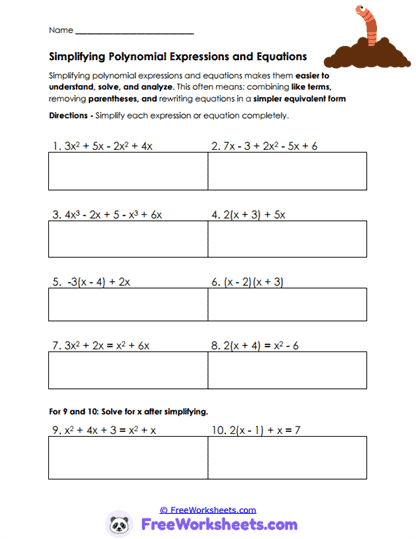
Expression Builder
- What Kids Do:
Students simplify expressions by combining like terms, distributing factors, and rewriting equations into cleaner equivalent forms. - Target Skill:
Students strengthen algebraic structure and simplification skills by organizing terms carefully and applying distribution accurately.
Function Forms
- What Kids Do:
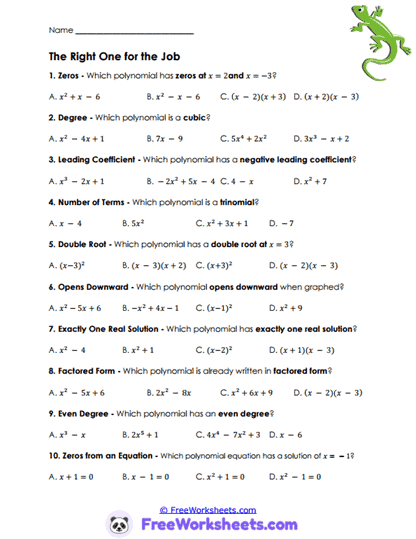
Students analyze equations and expressions to identify roots, degree, intercepts, and graph behavior while comparing algebraic structures. - Target Skill:
Students deepen understanding of polynomial structure by connecting algebraic forms to graph features and solution behavior.
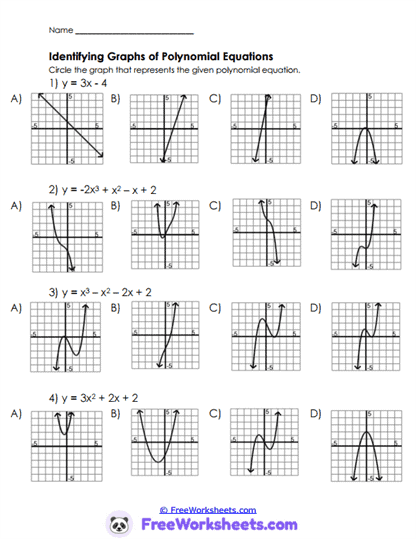
Graph Match
- What Kids Do:
Students compare polynomial equations and graphs by analyzing intercepts, degree, turning points, and end behavior to identify matching representations. - Target Skill:
Students strengthen graph interpretation skills by connecting polynomial equations to visual graph behavior and structural characteristics.
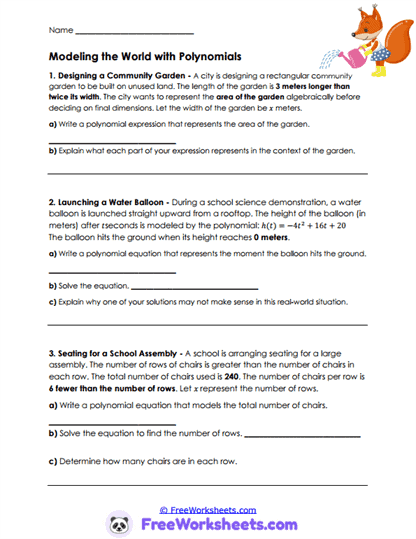
Modeling the World with Polynomials
- What Kids Do:
Students create polynomial equations from practical scenarios involving geometry, motion, and arrangements while solving and interpreting results. - Target Skill:
Students improve algebraic modeling and contextual reasoning by translating real-world situations into polynomial equations accurately.
Polynomial Stories
- What Kids Do:
Students build polynomial expressions and equations from verbal descriptions involving sales, production, area, and fundraising situations. - Target Skill:
Students strengthen algebraic modeling skills by translating written descriptions into structured polynomial expressions and equations.
Remainder Logic
- What Kids Do:
Students apply the Remainder Theorem to evaluate functions, identify factors, and determine divisibility using substitution reasoning. - Target Skill:
Students improve polynomial reasoning by connecting remainders, factors, zeros, and function evaluation relationships.
Root Patterns
- What Kids Do:
Students analyze polynomial roots, multiplicities, and graph behavior while connecting factors to zeros and end behavior patterns. - Target Skill:
Students strengthen conceptual understanding of polynomial structure by interpreting roots, repeated factors, and graph characteristics.
Story Models
- What Kids Do:
Students translate real-world situations involving geometry, production, and costs into polynomial expressions and simplified algebraic models. - Target Skill:
Students improve algebraic modeling fluency by building equations and expressions that represent practical relationships accurately.
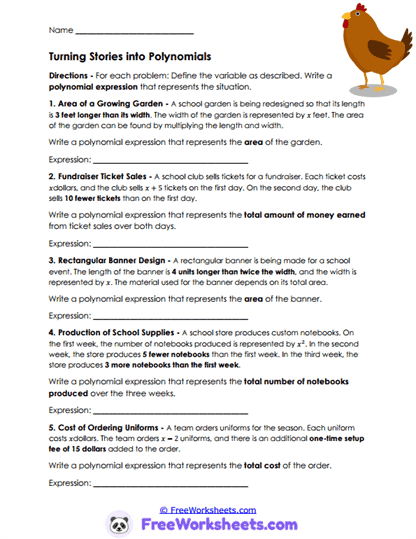
Turning Stories into Polynomials
- What Kids Do:
Students define variables and write polynomial expressions representing ticket sales, area models, and production changes over time. - Target Skill:
Students strengthen expression-building and modeling skills by connecting variables and operations to contextual relationships.
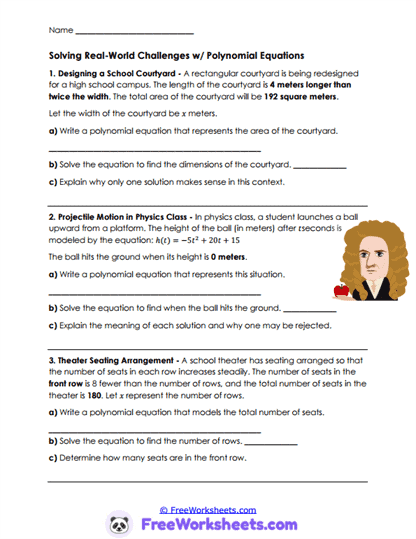
World Models
- What Kids Do:
Students solve real-world polynomial equation problems involving motion, seating arrangements, and geometry while interpreting meaningful solutions. - Target Skill:
Students strengthen application and interpretation skills by solving contextual polynomial equations and evaluating realistic solutions carefully.