
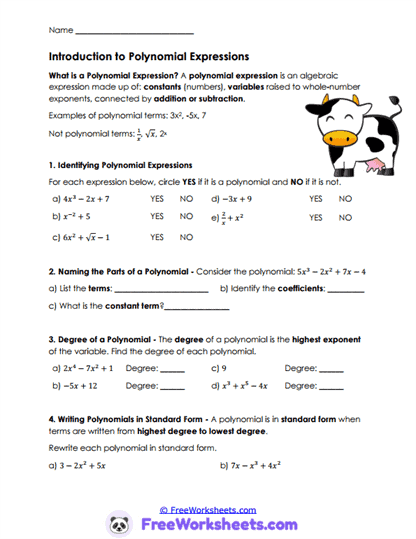
About This Worksheet
Polynomial expressions can model real-world situations involving area, sales, production, and cost. This worksheet helps students translate written scenarios into algebraic polynomial expressions. Students define variables carefully and represent totals using addition and multiplication of terms. For example, students model ticket sales, garden area, and production increases over time. The activity strengthens connections between algebraic expressions and real-life situations.
Curriculum and Grade Alignment
This worksheet supports Algebra 2 standards involving polynomial modeling and algebraic representation. The main learning goal is to write polynomial expressions from verbal descriptions and contextual information. Students should already understand variables, multiplication, and combining terms before beginning. The next learning step is solving polynomial equations and interpreting results in context. This aligns with high school algebra modeling standards.
Student Tasks
On this worksheet, students will define variables and write polynomial expressions from real-world situations. They will model area, sales revenue, production totals, and ordering costs. Students practice identifying relationships between quantities before building algebraic expressions. Several problems require translating multi-step descriptions into simplified polynomial form.
Common Challenges and Misconceptions
Some students may confuse whether values should be added or multiplied. Others may forget to distribute expressions correctly when modeling dimensions or totals. A common mistake is failing to define the variable before writing the expression. Teachers can help by encouraging students to label quantities clearly before building equations.
Implementation Guidance
This worksheet works well during an introductory unit on polynomial modeling. Teachers can model one real-world example step by step before assigning independent work. Parents helping at home can ask students to explain what each variable represents before simplifying expressions. Verbal explanation often improves understanding and accuracy.
Details and Features
The worksheet includes polynomial modeling problems involving geometry, fundraising, production, and cost situations. Students practice building expressions from written descriptions using multiple algebraic operations. The printable format provides organized space for setup and simplification work. The contextual focus helps students connect algebra to everyday applications.