
Systems Of Equations & Inequalities Worksheets
These worksheets help students solve systems algebraically and graphically while interpreting constraints, intersections, and feasible regions. These free, ready-to-print worksheets come in PDF format for immediate classroom use, homework assignments, intervention support, or independent review. Students strengthen skills involving substitution, elimination, graphing, nonlinear systems, inequalities, optimization, and algebraic modeling through structured practice and applied reasoning activities.
About This Collection of Worksheets
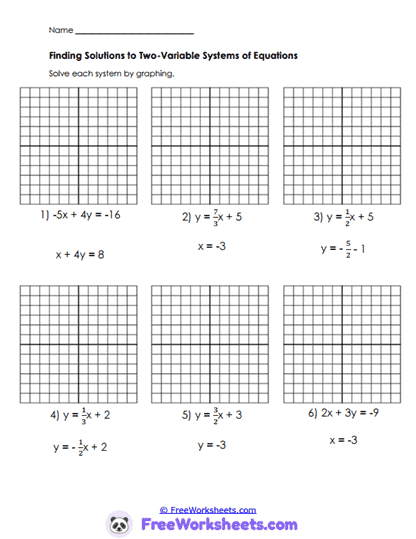
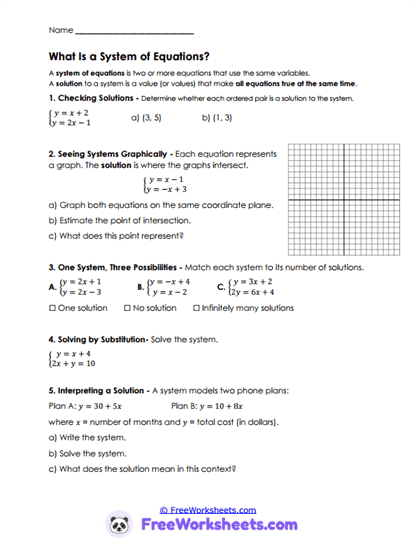
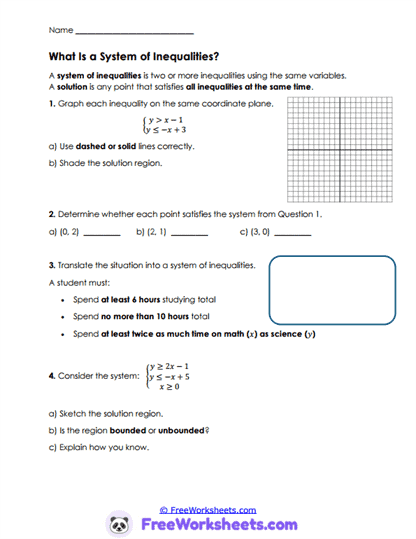
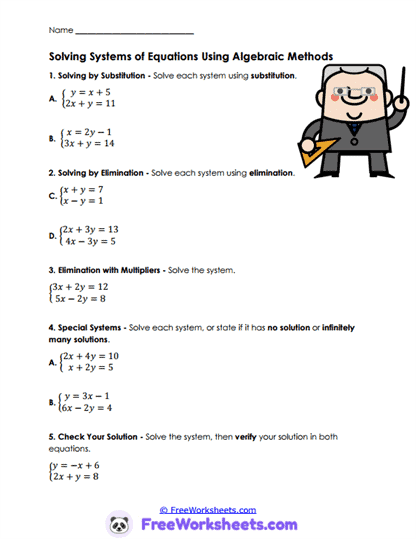
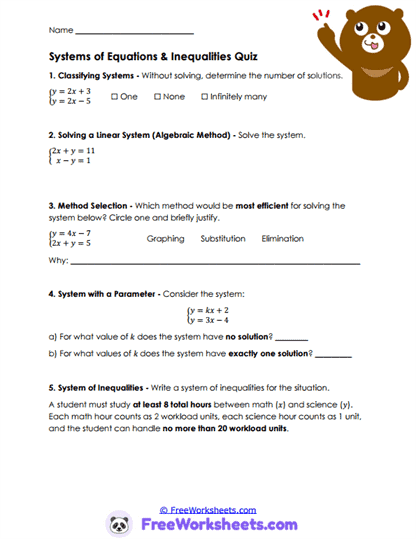
This collection of systems of equations and inequalities worksheets gives students meaningful practice solving, graphing, classifying, and modeling systems in both symbolic and visual ways. Students work with substitution, elimination, graphing, nonlinear systems, feasible regions, optimization problems, and parameter analysis while building conceptual understanding and procedural fluency. The activities help learners connect algebraic structure to graph behavior, real-world constraints, and mathematical decision-making.
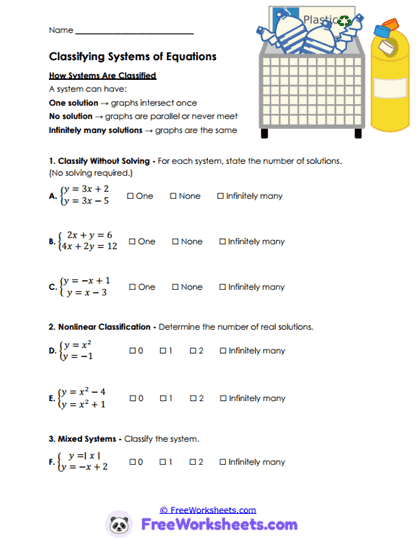
The worksheets include systems-solving practice, graphing activities, nonlinear equation analysis, inequality shading tasks, optimization problems, feasible-region interpretation, and real-world modeling situations involving scheduling, production limits, fundraising, and pricing plans. Students practice recognizing when systems have one solution, no solution, or infinitely many solutions while also learning how to choose efficient solving strategies based on equation structure. The progression of activities supports both foundational systems fluency and more advanced reasoning involving constraints and visual interpretation.
Teachers can use these printable PDF worksheets for guided instruction, independent practice, homework, intervention, review lessons, enrichment, or assessment preparation. The layouts provide organized workspaces for algebraic solving, graphing, written explanations, and strategy comparison. The mix of symbolic, graphical, and application-based activities also helps students connect systems concepts to practical problem solving and mathematical modeling situations.

Paul’s Teacher Tip
Students are usually more successful with systems when they pause to analyze the structure before solving. Encourage learners to look at the equations first and decide whether substitution, elimination, or graphing makes the most sense instead of automatically using the same method every time. Many mistakes happen because students rush into calculations without thinking about slopes, intercepts, or equation forms. Graphing systems of inequalities also becomes much easier when students test points before shading and use different colors for each boundary line. Real-world modeling problems improve when students define variables clearly before writing equations or inequalities. Asking students to explain what the solution means in context often strengthens both reasoning and accuracy.
Worksheet Collection Skill Spotlights
Constraint Stories
- What Kids Do:
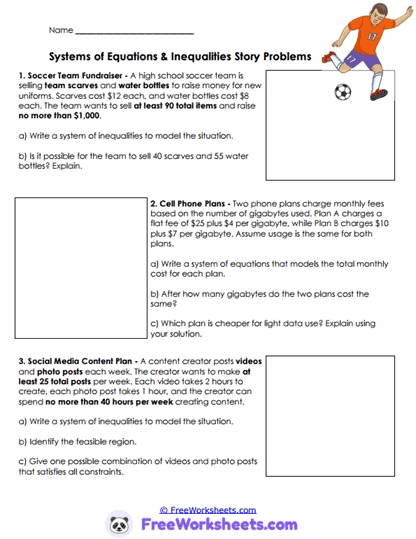
Students write systems of equations and inequalities from real-world situations involving fundraising, scheduling, phone plans, and budgeting. - Target Skill:
Students strengthen algebraic modeling and interpretation skills by translating practical situations into systems and analyzing feasible solutions.
Curve Crossings
- What Kids Do:
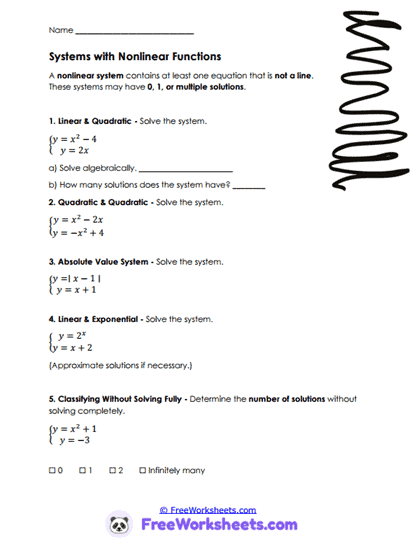
Students solve nonlinear systems involving quadratics, exponentials, and absolute value functions while analyzing graph intersections and solution counts. - Target Skill:
Students improve nonlinear system reasoning by connecting algebraic solutions to graphical intersection behavior and multiple solution possibilities.
Feasible Paths
- What Kids Do:
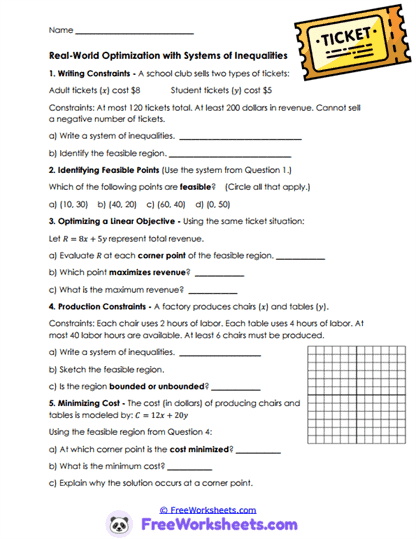
Students graph systems of inequalities, identify feasible regions, and solve optimization problems involving production limits and revenue constraints. - Target Skill:
Students strengthen optimization and graphical reasoning skills by analyzing feasible regions and evaluating objective functions systematically.
Graph Zones
- What Kids Do:
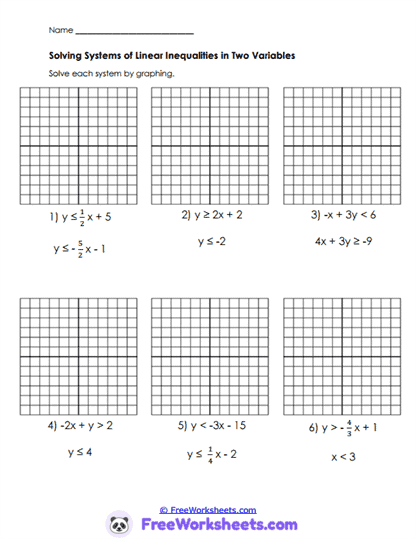
Students graph systems of inequalities, shade overlapping solution regions, and interpret feasible regions on coordinate planes. - Target Skill:
Students improve visual inequality reasoning by connecting boundary lines, shading directions, and overlapping regions to solution sets.
Method Match
- What Kids Do:
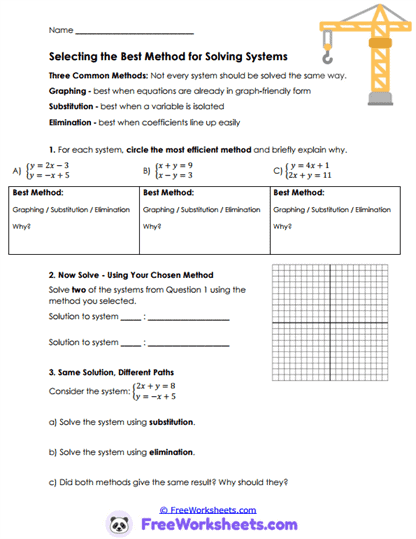
Students compare graphing, substitution, and elimination methods to determine which solving strategy is most efficient for each system. - Target Skill:
Students strengthen algebraic decision-making by selecting efficient solving methods based on equation structure and graph behavior.
Mixed Methods
- What Kids Do:
Students solve systems using substitution and elimination while classifying systems with one solution, no solution, or infinitely many solutions. - Target Skill:
Students reinforce systems-solving fluency by organizing algebraic work carefully and recognizing special system behavior.
Parameter Play
- What Kids Do:
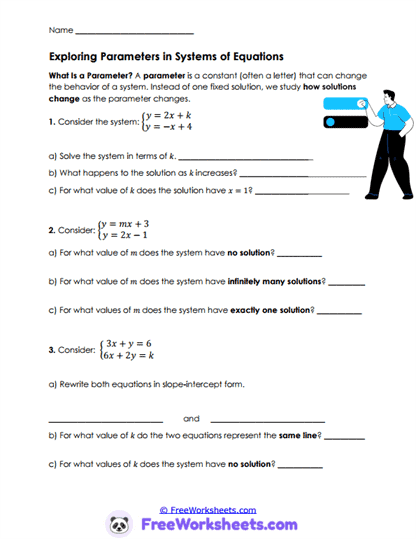
Students analyze systems containing parameters to determine when equations intersect once, never intersect, or overlap completely. - Target Skill:
Students deepen conceptual understanding of systems by connecting slope relationships and parameter changes to system behavior.
Region Rules
- What Kids Do:
Students graph systems of inequalities, test points, and identify bounded and unbounded feasible regions visually. - Target Skill:
Students strengthen coordinate-plane reasoning by analyzing overlapping constraints and interpreting feasible solution regions accurately.
Solution Check
- What Kids Do:
Students classify systems as having one solution, no solution, or infinitely many solutions without fully solving every equation. - Target Skill:
Students improve conceptual reasoning by analyzing graph behavior, slopes, and equation structure efficiently.
Solution Zones
- What Kids Do:
Students analyze intersections, overlapping regions, and feasible solution sets using both equations and inequalities on graphs. - Target Skill:
Students strengthen graphical interpretation skills by comparing exact intersections to broader inequality solution regions.
System Check
- What Kids Do:
Students complete mixed systems practice involving equations, inequalities, graph interpretation, method selection, and parameter analysis. - Target Skill:
Students reinforce overall systems fluency by combining algebraic solving, graph reasoning, and strategic problem-solving skills.
System Strategy
- What Kids Do:
Students compare solving strategies, classify systems, and justify why substitution, elimination, or graphing works best in different situations. - Target Skill:
Students strengthen flexible algebra reasoning by recognizing equation structure and choosing efficient problem-solving methods.