
About This Worksheet
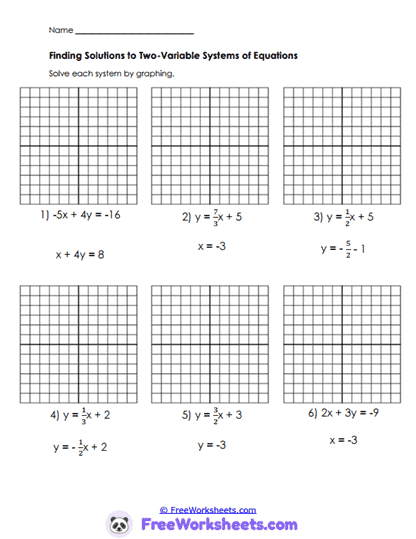
Not every system is made of straight lines, and this worksheet introduces students to systems involving curves, quadratics, absolute value graphs, and exponentials. Students explore how nonlinear systems can have multiple intersection points or sometimes none at all. The problems feel more visual and investigative while still using algebraic solving skills.
Curriculum and Grade Alignment
This worksheet supports Grade 12 algebra standards involving nonlinear systems of equations and graphical interpretation of intersections. Students solve systems containing quadratic, absolute value, and exponential relationships. Before beginning, students should already know how to solve linear systems and graph common nonlinear functions. This lesson strengthens understanding of how different function types interact.
Student Tasks
Students solve systems involving linear and quadratic equations, quadratic pairs, absolute value equations, and exponential relationships. They determine the number of real solutions and interpret intersections graphically. Some problems require exact algebraic solutions while others involve approximation and estimation. Students also classify systems by the number of intersection points.
Common Challenges and Misconceptions
Students often expect every system to have only one solution because of their experience with linear systems. Others forget that nonlinear graphs can intersect more than once. Exponential systems can also feel strange because the growth changes so quickly. Encouraging students to sketch rough graph shapes before solving usually improves understanding dramatically.
Implementation Guidance
This worksheet works really well alongside graphing calculators or graphing software so students can visualize the intersections. Teachers can compare linear systems to nonlinear systems to highlight how the behavior changes. Parents helping at home can ask students how many times the graphs appear to cross before solving algebraically. That prediction step helps build stronger intuition.
Details and Features
The worksheet includes quadratic systems, absolute value systems, exponential systems, graph interpretation, and solution classification. Students practice solving nonlinear relationships while strengthening visual reasoning skills. The printable format leaves room for sketches, algebraic work, and written conclusions. The conversational style keeps advanced concepts approachable.