
About This Worksheet
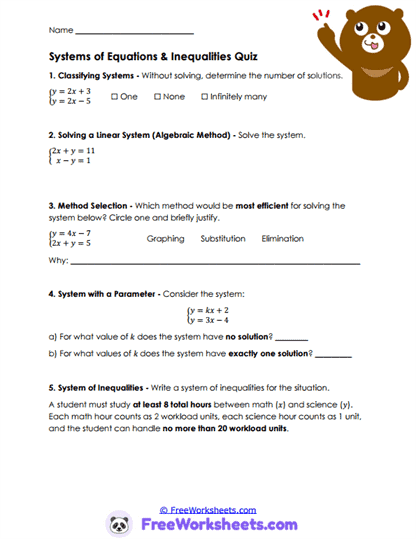
This worksheet is all about understanding how inequality systems create regions instead of single answers. Students work with overlapping constraints, boundary lines, and feasible zones while thinking visually about what solutions actually satisfy every condition. The problems gradually build from simple graphing into more layered reasoning tasks.
Curriculum and Grade Alignment
This worksheet supports advanced algebra standards involving systems of linear inequalities, feasible regions, and graphical interpretation. Students practice graphing inequalities, identifying overlapping solution regions, and testing points for validity. Before starting, students should already understand slope-intercept form and basic inequality graphing rules. This lesson builds confidence with visual reasoning and coordinate-plane analysis.
Student Tasks
Students graph systems of inequalities, shade feasible regions, and determine whether specific points satisfy all constraints. They identify bounded and unbounded regions and explain what the overlapping shaded area represents. Some problems include real-world restrictions while others focus purely on graph interpretation. Students also justify why certain points work or fail.
Common Challenges and Misconceptions
Students often forget that the solution must satisfy every inequality at once, not just one of them. Others accidentally shade the wrong side of a boundary line or confuse dashed and solid boundaries. Another common issue is assuming any point inside the graph works without checking all conditions carefully. Testing sample points usually helps students catch mistakes quickly.
Implementation Guidance
This worksheet works especially well with colored pencils or markers so students can clearly separate multiple shaded regions. Teachers can model how to test points before students begin independent practice. Parents helping at home can encourage students to explain why a region is feasible instead of only pointing at the graph. Those explanations help strengthen understanding.
Details and Features
The worksheet includes graphing systems of inequalities, feasible regions, point testing, bounded regions, and graphical interpretation tasks. Students combine algebraic setup with visual analysis throughout the lesson. The printable design includes large graph grids for organized work. The conversational wording keeps the material approachable while still mathematically rigorous.