
About This Worksheet
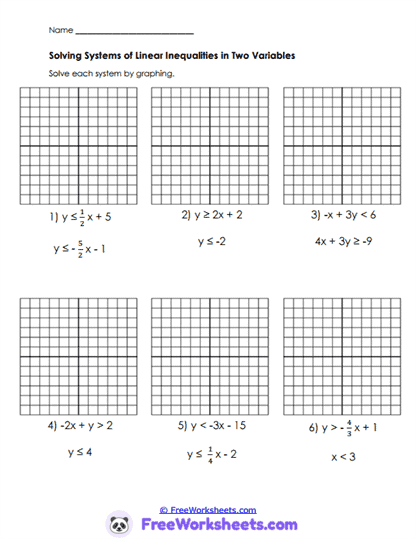
This worksheet focuses on figuring out what kind of system students are actually looking at before jumping into solving. Instead of calculating intersections immediately, students analyze slopes, equations, and graph behavior to determine whether systems have one solution, no solution, or infinitely many solutions. It’s quick-thinking practice that builds stronger algebra instincts.
Curriculum and Grade Alignment
This worksheet supports Grade 12 algebra standards involving classification of systems of equations and systems with nonlinear relationships. Students determine the number of solutions by analyzing equation structure and graph behavior. Before beginning, students should already understand slope-intercept form and how intersections represent solutions. This lesson strengthens conceptual reasoning and system interpretation skills.
Student Tasks
Students classify systems as having one solution, no solution, or infinitely many solutions without fully solving them. They analyze linear systems, nonlinear systems, and mixed systems involving different function types. Some questions involve comparing slopes and intercepts, while others involve thinking about graph intersections visually. Students also justify reasoning for their classifications.
Common Challenges and Misconceptions
Students sometimes assume that matching slopes automatically means infinitely many solutions, forgetting that intercepts matter too. Nonlinear systems can also confuse students because they may intersect multiple times. Another common issue is rushing to solve algebraically instead of analyzing structure first. Encouraging students to think graphically often clears up confusion quickly.
Implementation Guidance
This worksheet works well as warm-up practice or review before solving more advanced systems. Teachers can challenge students to explain their thinking without using heavy calculations. Parents helping at home can ask students whether the equations “look like the same graph” or “look parallel.” Those simple visual comparisons are often enough to guide the reasoning.
Details and Features
The worksheet includes linear systems, nonlinear systems, graph-based reasoning, and classification tasks involving solution behavior. Students practice recognizing system structure and interpreting intersections conceptually. The printable format provides room for notes and explanations. The conversational wording keeps the lesson feeling approachable instead of overly technical.