
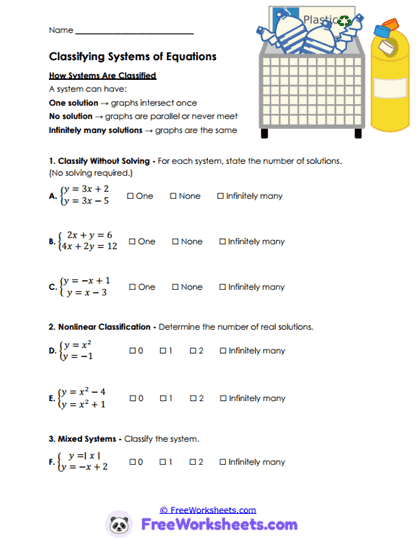
About This Worksheet
This worksheet turns systems of equations and inequalities into realistic situations students can actually picture. From fundraiser planning to phone plans and content creation schedules, students build equations and inequalities directly from word problems. The focus is on translating situations into math models and then interpreting what the solutions actually mean in context.
Curriculum and Grade Alignment
This worksheet supports advanced algebra standards involving systems modeling, systems of inequalities, and real-world interpretation of solutions. Students practice writing equations from contextual information and analyzing feasible regions. Before beginning, students should already understand solving systems algebraically and graphing inequality systems. This lesson strengthens mathematical modeling and interpretation skills.
Student Tasks
Students write systems of equations and inequalities from real-world scenarios involving fundraising, phone plans, and scheduling. They solve systems, analyze feasible regions, and determine whether proposed solutions satisfy all constraints. Some problems ask students to explain solutions in context instead of giving only numerical answers. Students also create possible combinations that satisfy restrictions.
Common Challenges and Misconceptions
Students often struggle deciding whether a situation should use equations or inequalities. Others forget to define variables clearly before building the system. Real-world contexts can also create confusion because students may ignore practical restrictions like nonnegative values. Encouraging students to underline key phrases like “at least” and “no more than” usually helps.
Implementation Guidance
This worksheet works really well for collaborative problem solving because students can discuss how to translate words into equations. Teachers can encourage students to explain what each equation or inequality represents before solving. Parents helping at home can ask students to describe the situation in plain language first. That step often makes the algebra easier to organize.
Details and Features
The worksheet includes systems modeling, inequalities, feasible regions, contextual interpretation, and multi-step real-world applications. Students solve applied algebra problems while strengthening reasoning and communication skills. The printable layout provides room for setup work, graphs, and written explanations. The conversational style helps the problems feel less intimidating and more relatable.