
About This Worksheet
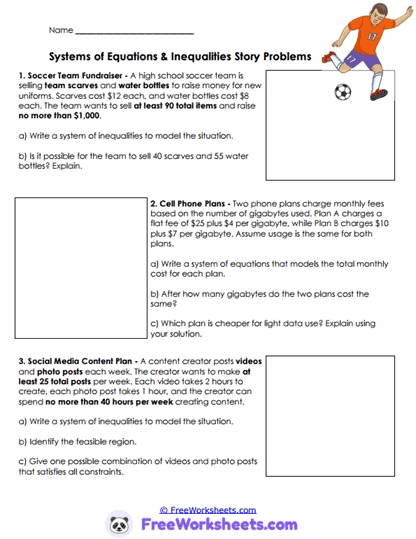
This worksheet combines systems of equations and inequalities into one big visual problem-solving experience. Students analyze where graphs intersect, where shaded regions overlap, and how restrictions affect possible solutions. Instead of focusing only on exact answers, the worksheet encourages students to think about entire sets of possibilities and how constraints shape them.
Curriculum and Grade Alignment
This worksheet supports advanced algebra standards involving systems of equations, systems of inequalities, feasible regions, and graphical modeling. Students interpret intersections, overlapping solution regions, and real-world constraints using algebra and graphs together. Before starting, students should already know graphing techniques for both equations and inequalities. This lesson strengthens visual reasoning and applied modeling skills.
Student Tasks
Students graph systems, identify intersections, shade feasible regions, and interpret solution sets in context. Some problems ask students to compare exact solutions with entire regions of solutions. Others involve determining whether proposed points satisfy all constraints. Students also explain how graphs represent real-world limitations and possibilities.
Common Challenges and Misconceptions
Students sometimes confuse the solution to a system of equations with the feasible region of a system of inequalities. Others may forget that inequality systems can contain infinitely many solutions. Graphing errors with shading and boundary lines can also lead to incorrect regions. Encouraging students to test points and double-check overlap areas usually improves accuracy.
Implementation Guidance
This worksheet works especially well for tying together multiple systems concepts into one review activity. Teachers can encourage students to discuss how equations and inequalities behave differently on graphs. Parents helping at home can ask students what the shaded region actually represents in words. Those conversations make the graphs more meaningful and easier to interpret.
Details and Features
The worksheet includes graphing systems, feasible regions, intersections, solution analysis, and contextual interpretation tasks. Students combine algebraic reasoning with visual graph analysis throughout the lesson. The printable design provides graph grids and organized workspace for explanations. The conversational tone keeps the content approachable while reinforcing advanced algebra skills.