
About This Worksheet
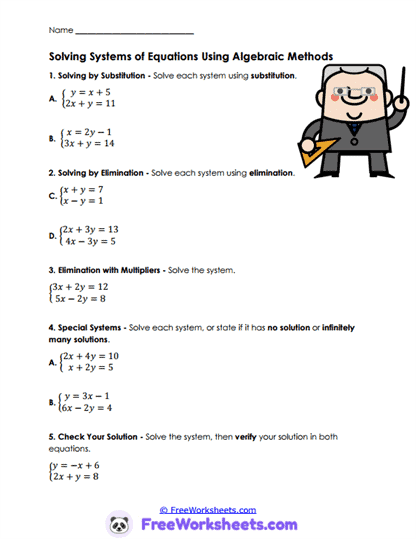
This worksheet shakes things up by adding parameters into systems of equations. Instead of solving one fixed system, students explore how changing a number changes the entire behavior of the system. Some values create one solution, some create no solution, and others make the equations identical. It turns solving systems into more of a puzzle and less of a routine procedure.
Curriculum and Grade Alignment
This worksheet supports Grade 12 algebra standards involving systems of equations with parameters and classification of solution behavior. Students analyze how changing constants affects intersections, slopes, and system outcomes. Before starting, students should already understand solving systems and recognizing parallel or identical lines. This lesson strengthens conceptual understanding of how systems behave dynamically.
Student Tasks
Students analyze systems containing variables like kkk and mmm and determine when the system has one solution, no solution, or infinitely many solutions. They rewrite equations in slope-intercept form and compare slopes and intercepts. Some problems involve finding specific parameter values that create special cases. Students also explain how system behavior changes as the parameter changes.
Common Challenges and Misconceptions
Students sometimes focus only on solving algebraically without thinking about the graph relationships underneath. Others mix up the conditions for parallel lines versus identical lines. Parameters can also feel confusing because the equations do not have fixed numbers immediately. Encouraging students to compare slopes first usually helps simplify the thinking process.
Implementation Guidance
This worksheet works well after students already understand normal system classification. Teachers can connect the algebra to graph movement visually by sketching how lines shift as parameters change. Parents helping at home can ask students what has to happen for two lines to “never meet” or “completely overlap.” Those conversations make the concepts much more intuitive.
Details and Features
The worksheet includes parameter systems, slope comparisons, classification tasks, graph interpretation, and special-case analysis. Students solve algebraically while also reasoning conceptually about line behavior. The printable format provides space for rewriting equations and explaining conclusions. The conversational tone helps students stay engaged with the more abstract ideas.