
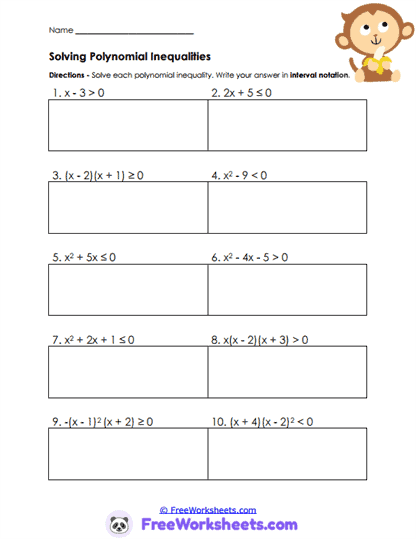
About This Worksheet
Polynomial equations can represent real-world situations involving area, motion, and organizational planning. This worksheet helps students model practical scenarios using polynomial expressions and equations. Students solve equations, explain variable meanings, and interpret solutions within context. For example, students analyze garden dimensions, balloon motion, and seating arrangements. The activity emphasizes both algebraic modeling and interpretation skills.
Curriculum and Grade Alignment
This worksheet supports Algebra 2 standards involving polynomial modeling, quadratic equations, and contextual interpretation. The main learning goal is to represent real-world situations using polynomial equations and solve them meaningfully. Students should already understand factoring, simplifying expressions, and solving quadratic equations before beginning. The next learning step is analyzing polynomial graphs and behavior. This aligns with high school algebra modeling standards.
Student Tasks
On this worksheet, students will create polynomial equations from verbal situations and solve for unknown quantities. They will explain what variables and solutions represent in context. Students also analyze why certain mathematical solutions may not fit real-world situations. Several problems involve geometry and motion applications.
Common Challenges and Misconceptions
Some students may struggle to translate verbal descriptions into algebraic expressions correctly. Others may accept unrealistic solutions without checking context. A common mistake is failing to connect coefficients and terms to the quantities described in the problem. Teachers can help by encouraging students to label all quantities before solving.
Implementation Guidance
This worksheet works well during a polynomial applications or modeling unit. Teachers can demonstrate how to organize information from a word problem before writing equations. Parents helping at home can ask students to explain what each equation represents before solving. Verbal reasoning often improves accuracy and confidence.
Details and Features
The worksheet includes modeling tasks involving area, projectile motion, and seating arrangements. Students practice writing equations, solving them, and interpreting solutions in practical settings. The printable format provides organized spaces for algebraic work and written explanations. The application-based structure strengthens real-world problem-solving skills.