
About This Worksheet
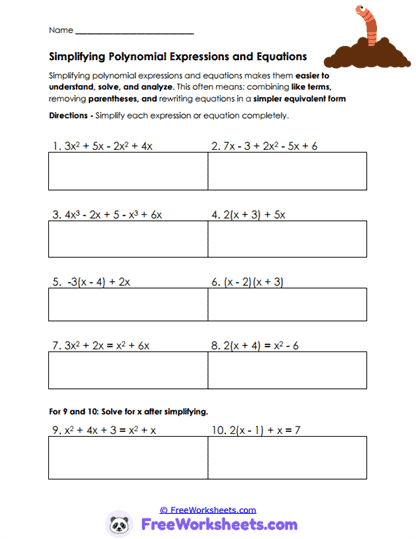
Algebraic expressions become easier to solve and analyze when they are simplified correctly. This worksheet helps students combine like terms, distribute expressions, and simplify equations involving variables and powers. Students practice rewriting expressions into cleaner equivalent forms before solving equations. The activity builds fluency with algebraic structure and simplification techniques.
Curriculum and Grade Alignment
This worksheet supports Algebra 2 standards involving simplifying algebraic and polynomial expressions. The main learning goal is to combine like terms, distribute factors, and solve simplified equations accurately. Students should already understand variables, exponents, and basic algebraic operations before beginning. The next learning step is solving more advanced equations and modeling problems. This aligns with high school algebra simplification standards.
Student Tasks
On this worksheet, students will simplify expressions by combining like terms and applying distribution. They will rewrite equations into equivalent forms before solving for variables. Students also practice identifying when expressions are fully simplified. Several problems involve multi-step algebraic reasoning.
Common Challenges and Misconceptions
Some students may combine unlike terms incorrectly or forget to distribute negative signs. Others may confuse exponents when simplifying variable expressions. A common mistake is solving equations before simplifying both sides completely. Teachers can help by encouraging students to organize terms carefully by degree.
Implementation Guidance
This worksheet works well during review or reinforcement lessons on algebraic simplification. Teachers can model one multi-step example before assigning independent work. Parents helping at home can ask students to explain why certain terms combine while others do not. Verbal reasoning improves algebraic precision.
Details and Features
The worksheet includes expression simplification, distribution, and equation-solving practice. Students work through increasingly complex algebraic structures while reinforcing organization skills. The printable format provides structured space for showing algebraic steps. The progression supports both fluency and conceptual understanding.