
About This Worksheet
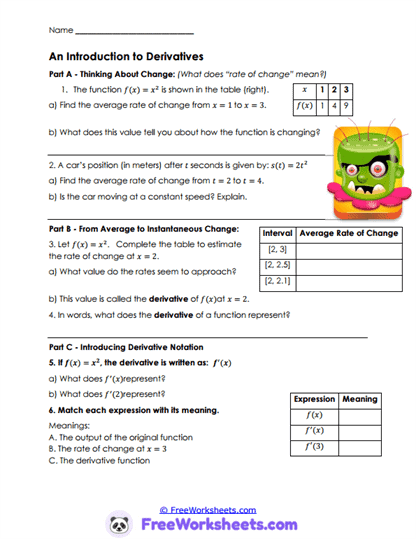
Derivatives help students describe how quickly something changes. This worksheet introduces derivatives by connecting them to average rate of change and instantaneous rate of change. Students explore function values in tables and compare how rates of change behave as points get closer together. For example, students estimate how quickly a car’s position changes at a specific moment in time. The activity helps students build an early understanding of derivatives as rates of change.
Curriculum and Grade Alignment
This worksheet supports introductory calculus standards involving derivatives and rates of change. The main learning goal is to understand a derivative as an instantaneous rate of change. Students should already understand functions, tables, and average rate of change before beginning. The next learning step is learning derivative notation and differentiation rules. This aligns with AP Calculus and introductory calculus standards involving conceptual understanding of derivatives.
Student Tasks
On this worksheet, students will calculate average rates of change from tables and functions. They will estimate instantaneous rates of change by shrinking intervals around a point. Students also interpret derivative notation and explain what derivatives represent in words. Several problems ask learners to compare average change to instantaneous change.
Common Challenges and Misconceptions
Some students may think average rate of change and instantaneous rate of change are exactly the same. Others may struggle to understand why intervals need to become smaller. A common mistake is treating the derivative as a single number without connecting it to changing behavior. Teachers can help by emphasizing that derivatives describe how functions change at one exact moment.
Implementation Guidance
This worksheet works well as a first introduction to derivatives before students begin formal differentiation rules. Teachers can model shrinking intervals visually on a graph before assigning independent practice. Parents helping at home can ask students what “rate of change” means in everyday situations like speed or growth. Those real-life examples often make the derivative concept easier to understand.
Details and Features
The worksheet includes tables, function evaluations, average rate of change practice, and introductory derivative notation. Students estimate derivatives and interpret what they represent in context. The printable layout provides organized spaces for calculations and written explanations. The gradual progression from average change to instantaneous change supports conceptual understanding.