
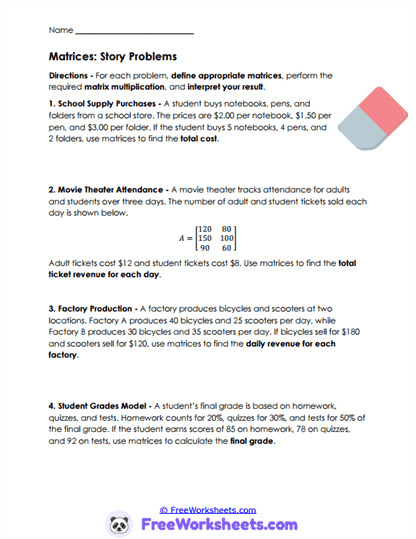
About This Worksheet
Organized arrays of numbers help students display information clearly and perform calculations efficiently. This worksheet introduces students to rows, columns, dimensions, and entries inside numerical arrays. Students practice identifying dimensions, reading values, and writing information in array form. For example, students organize store sales information into rows and columns. The activity helps students build foundational understanding of how arrays organize data.
Curriculum and Grade Alignment
This worksheet supports introductory algebra standards involving arrays, dimensions, and organized numerical notation. The main learning goal is to identify and interpret rows, columns, and entries accurately. Students should already understand basic arithmetic and ordered organization before beginning. The next learning step is performing operations with arrays and using them in applications. This aligns with introductory linear algebra standards involving notation and structure.
Student Tasks
On this worksheet, students will identify rows, columns, and dimensions in organized arrays. They will read and interpret specific entries using row-column notation. Students also organize real-world information into numerical arrays. Several problems ask learners to compare arrays and determine whether they are equal.
Common Challenges and Misconceptions
Some students may confuse rows with columns while identifying dimensions. Others may read entries from the wrong position in the array. A common mistake is believing two arrays are equal even when entries are arranged differently. Teachers can help by emphasizing careful row-column reading habits.
Implementation Guidance
This worksheet works well as an introductory lesson before students begin array operations. Teachers can demonstrate how rows move horizontally and columns move vertically before assigning practice. Parents helping at home can encourage students to point to rows and columns physically while reading entries. Visual tracking often improves accuracy.
Details and Features
The worksheet includes dimension identification, entry reading, equality comparisons, and real-world organization tasks. Students strengthen understanding of numerical structure and notation. The printable format provides organized diagrams and spaces for explanations. The gradual progression supports strong foundational understanding.